
Paper: Zhang, Zhao, Hancock, Kraut, Yang, Interaction with AI Companions and Psychological Well-being, Stanford + CMU, arXiv:2506.12605v5 [cs.HC], 2026-05-04. This write-up walks through 1,131 Character.AI active users and 465,000 real chat messages, end to end, to answer one question: how you use AI decides whether it lifts you or hollows you out. Every number comes from the original paper. Wherever the authors did not give data, this article says so plainly.
Prologue: the same app, a microwave or an old friend
It is the same AI chat app.
Some people use it to look up information, draft emails, practice a foreign language. The more they use it, the higher their reported well-being.
Other people treat it as an old friend: at 2 a.m., when they cannot sleep, they tell it what is on their chest. The harder they use it, the more they disclose, the emptier they feel.
This is not anecdotal. It is a hard data point from a fresh large-sample study. The paper’s key table puts two numbers on the same set of users:
- General use intensity → well-being: β = +0.27(the more, the better).
- Companionship use → well-being: β = −0.48(the more companionship-flavored, the worse).
Two coefficients on the same dataset. Opposite signs.
Below, we walk the data line from end to end: how the study was designed, what it found, which numbers are rock solid, which need a discount, and finally the three things worth carrying home.
1. How to read a “1,131 people / 465,000 chat messages” study
First, scope out the foundation, then look at the conclusions.
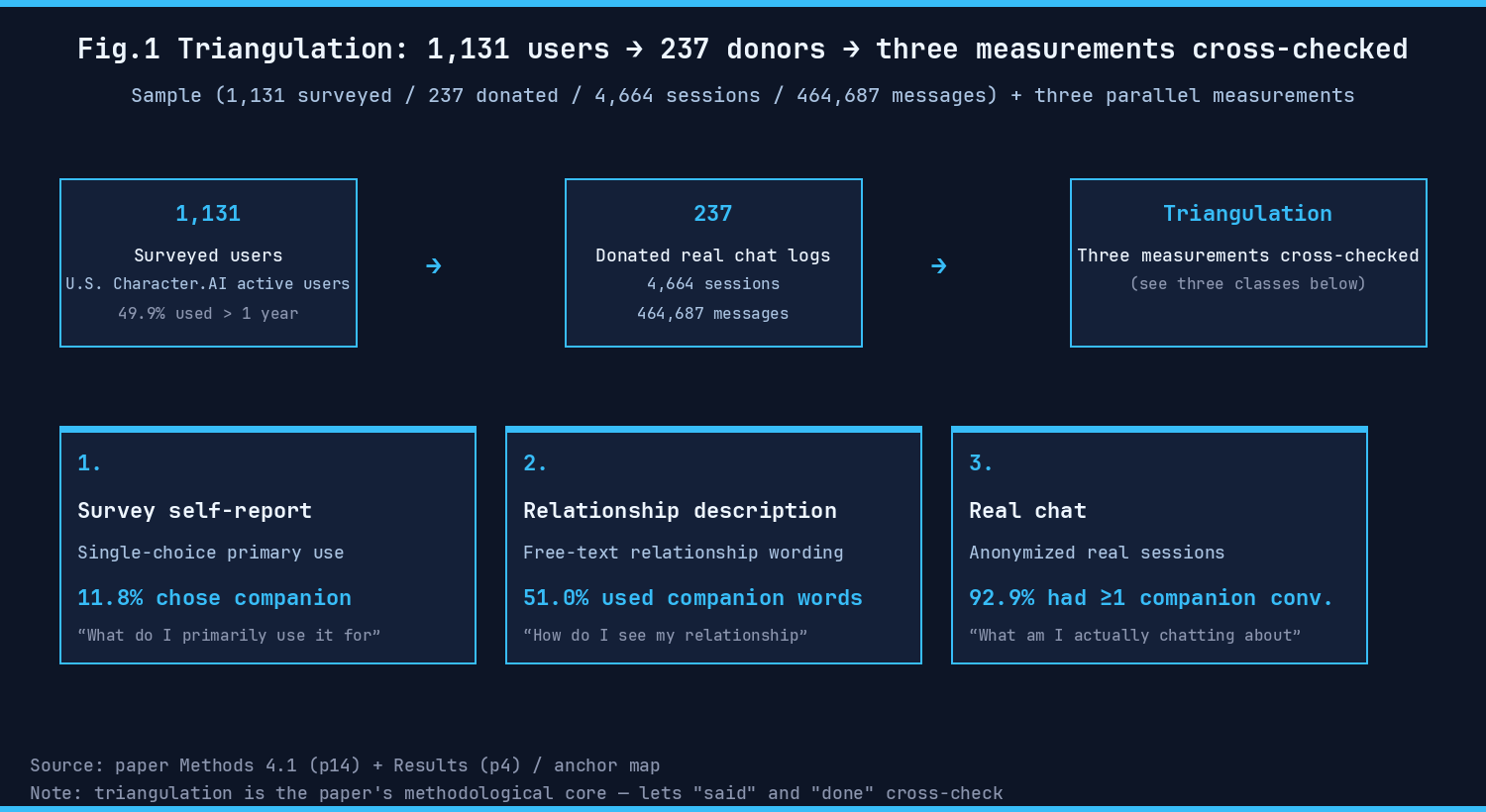
The researchers did something much harder than firing off a survey. They surveyed 1,131 active U.S. users of Character.AI —49.9 percent of whom had used the platform for over a year— heavy long-term users, not curious newcomers. More importantly,237 of them donated their actual chat logs: 4,664 sessions, 464,687 messages, anonymized for analysis.
This is the paper’s central methodological choice:it triangulates “what people say” with “what people actually do“across three measurements:
- Survey self-report: “What is your primary use of AI?”
- Relationship description: free-text descriptions of how the user sees their relationship with the AI.
- Real chat history: direct inspection of what was actually said.
These three lines cross-check each other. Later we will see that this triangulation is exactly what lets the paper produce its most counter-intuitive numbers.
But between “what is said” and “what is done,” there is a giant gap. Below is what that gap looks like.
2. Said versus done, off by one whole truth
The gap itself is the first finding.
The researchers asked the participants to pick a single primary use. The result:
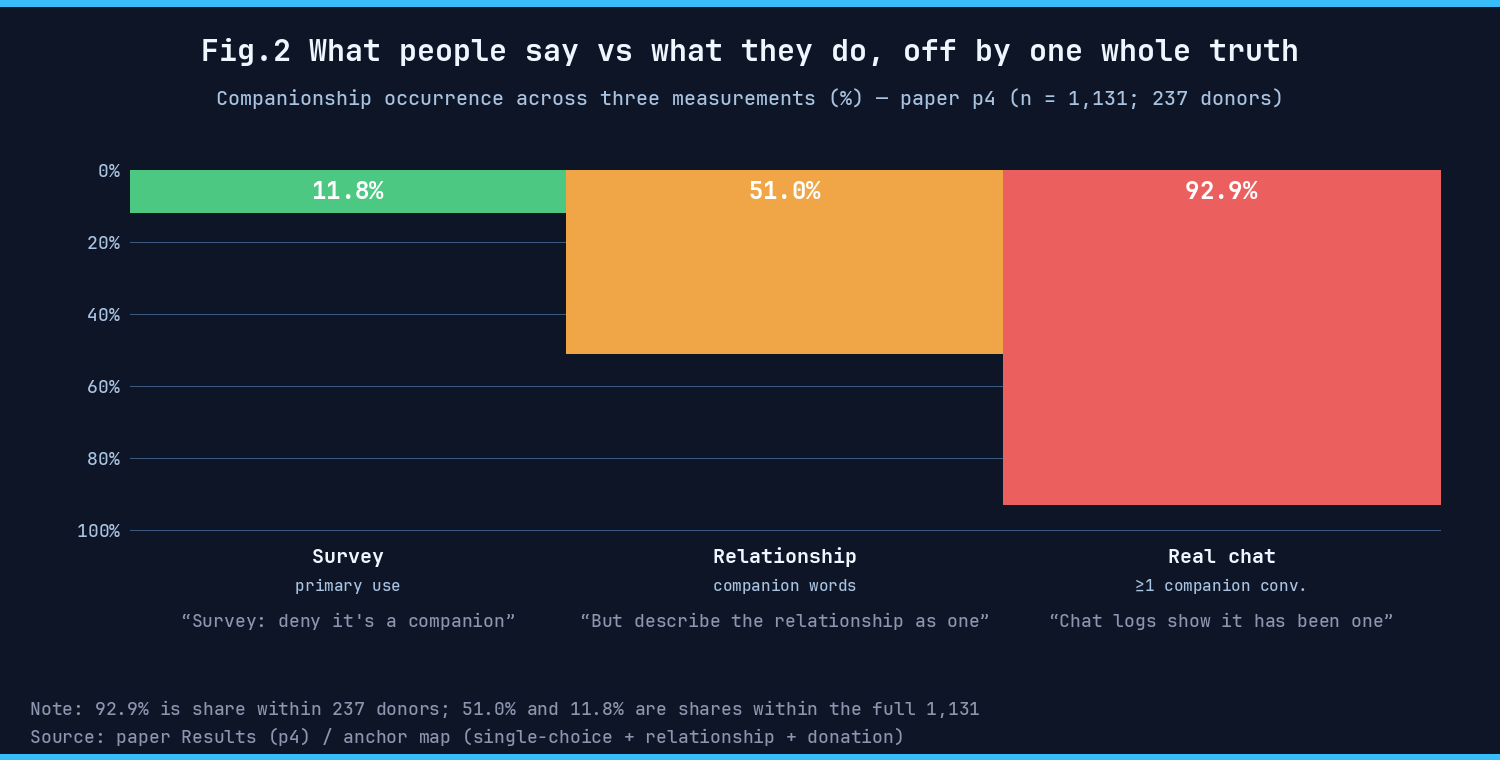
Only 11.8 percent admitted “companionship” as their primary use.The rest — entertainment, information lookup, killing time — accounted for over eighty percent.
So far, AI companionship looks niche. But then the researchers asked the same participants to freely describe their relationship with the AI, and the picture flipped.51.0 percent used “friend, companion, romantic partner” words.And among the 237 who donated real chat logs:92.9 percent had at least one companionship-style conversation.
Three rows side by side:
- Survey: “companionship” primary use → 11.8%
- Free description: companionship-style words → 51.0%
- Real chat: at least one companionship conversation → 92.9%
In other words: the people who deny on a survey that they treat the AI as a friend are, in their chat history, already treating the AI as a friend.
This is exactly why the researchers triangulate. Survey-only would say “companionship users are a ten-percent minority.” The real chat world tells a different story.
So what are these “companionship” conversations actually about?
80.33 percent of conversations carried the “emotional and social support” topic— looking for the AI to listen, comfort, empathize. Other high-frequency topics: collaborative narrative and role-play 77.87%, romantic and intimate role-play 68.03%, adventure and dark role-play 30.74%. The paper used a local LLM to anonymize first, then auto-label topics, with human spot-check agreement rates of 92 to 95 percent.
So far this is just “AI companionship exists.” Below is the paper’s key table.
3. Same group, two opposite directions
Throw “use intensity” and “companionship-style use” into the regression at the same time, and the sign flips.
General use intensity → well-being: β = +0.27, 95% CI [0.19, 0.35], p < .001.The more you use it, the higher your reported well-being. This is the intuitive line.
Companionship use → well-being: β = −0.48, 95% CI [−0.70, −0.25], p < .001.After controlling for total intensity, “I treat it as a companion” flips the sign — and it flips hard.
The paper does not stop at one measurement. Re-test the same relationship through two other lenses: relationship-description measurement (did they use friend / companion / romantic partner words) β = −0.32; real-chat-share measurement (what fraction of their conversations were companionship-flavored) β = −0.27. Three measurements, same direction.
One line of numbers: +0.27 / −0.48 / −0.32 / −0.27. The positive is “using AI.” The negatives are all “treating AI as a companion.” This is the paper’s core contrast.
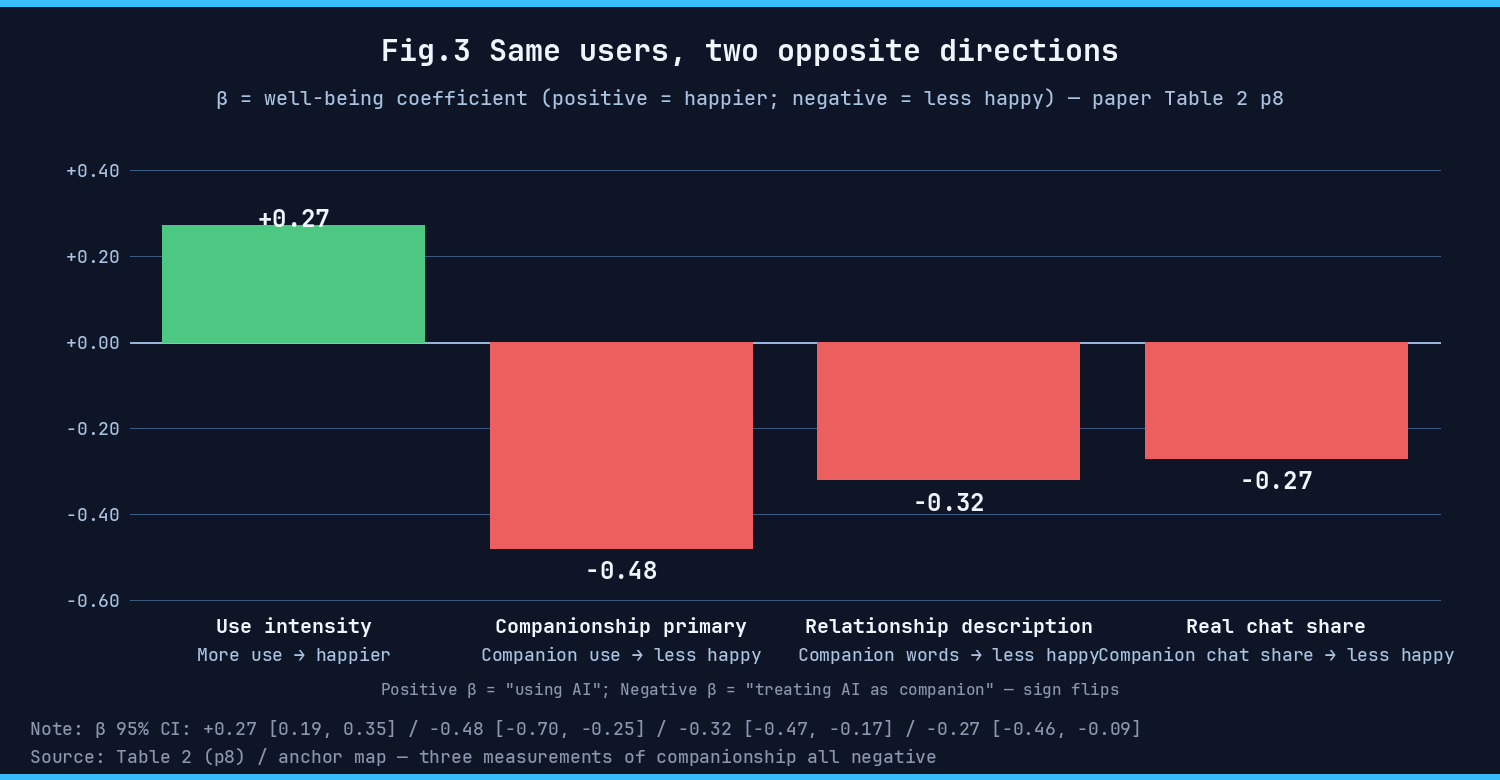
Plain English: AI chat itself is not the problem. Using AI more does add happiness — that is real. Buthowyou use it — as a tool or as a companion — is the scale that decides which direction the needle swings.
This is the main effect. Below is the harder part: the negative correlation is not constant. It has acceleration.
4. The harder you use it, and the more you open up, the more you lose
The researchers ran two interactions — and these are the most uncomfortable parts of the table.
Companionship × use intensity: β = −0.31, 95% CI [−0.56, −0.06], p = .014.Among people who treat AI as a companion, every notch up in usage drags well-being down further. The intensity scale has one item: “If this chatbot disappeared, I would be sad.”The mean on that item is 5.01 out of 7 (SD 1.72)— a dependence resembling the kind you do not want to walk away from, and it lands hardest on exactly the “treat AI as companion” group.
Companionship × self-disclosure: β = −0.38, 95% CI [−0.63, −0.14], p = .002.Inside a companionship context, the more you tell the bot about your private life, the lower your well-being. This collides head-on with the intuition that “venting should feel lighter.”
The paper gives one number: in high-disclosure conversations,60.85 percent are emotional pain, followed by longing for romantic connection 41.42%, real-life difficulty 31.54%,suicidal ideation 18.03%.
State the fact, do not elaborate. This is the restraint we owe this topic. The 18.03 percent is not the researchers’ editorial choice — it is the share of conversations tagged with that topic in real chat logs. The paper gives one anonymized example: a user was called “bad” by adoptive parents, then asked the bot whether it could pretend to be his parents. The point of the example is that the bot hears heavier material than most people assume.
“Opening up” itself is fine. The problem is that after you open up, no real human catches you — only a machine that is always online, never pushes back, and always agrees.
Direction and acceleration, both settled. Next: who turns to AI in the first place.
5. People with small circles turn to AI, but AI cannot replace offline life
The researchers added offline social network size to the model.
Social network size → choosing companionship as primary use: β = −0.03, 95% CI [−0.05, −0.01], p < .001.The smaller your offline circle, the more likely you are to choose AI as your main companion. Sounds reasonable: if no one is around, talk to the AI.
But there is a counter-intuitive wrinkle:being single is in fact negatively correlated, with a coefficient of just −0.11. What drives “turning to AI for companionship” is “having no one around to talk to,” not “lacking a partner.” So AI companionship really is filling a real gap.
The question is — can it actually fill that gap?
One sentence from the authors: “Chatbots may augment existing social networks, they do not effectively substitute them.” Plain English: AI can add to existing social life; it cannot replace it.
The numbers are hard:
- Offline social network → well-being: β = +0.51, 95% CI [0.44, 0.57]. The single largest positive coefficient in the whole paper.
- Companionship × social network: the interaction is not significant (β = 0.07, p = .514; Bayes factor BF01 = 6.55 supports “no interaction”). The “AI companionship compensates for small circles” hypothesis does not hold in the data.
- Use intensity × social network: β = −0.11, 95% CI [−0.18, −0.05], p < .001. The harder you lean on AI, the more it dampens the positive effect of your offline social life.
One sentence translation: AI is not the fallback for offline life. It is a signal that offline life is shrinking.
Who benefits and who does not — settled. Below are the boundaries we owe you.
6. Three boundaries, and three things worth carrying home
The authors wrote down three boundaries themselves. We owe it to you to lay them out, not hide them.
First, this is cross-sectional data — a photograph, not a video.We can see correlation; we cannot see causation. It may also be that people who are already doing worse are more likely to choose AI as a companion — the reverse direction also makes sense.
Second, the sample is Character.AI heavy long-term users— U.S., native English speakers, almost half using the platform for over a year. This cannot be generalized to “everyone using AI is like this.”
Third, donating chat logs was voluntary.The researchers ran a Heckman selection model and foundthe higher someone’s well-being, the less likely they were to donate logs(β = −0.19, p = .003). In other words, the chat data we see is skewed toward users who are not doing well.
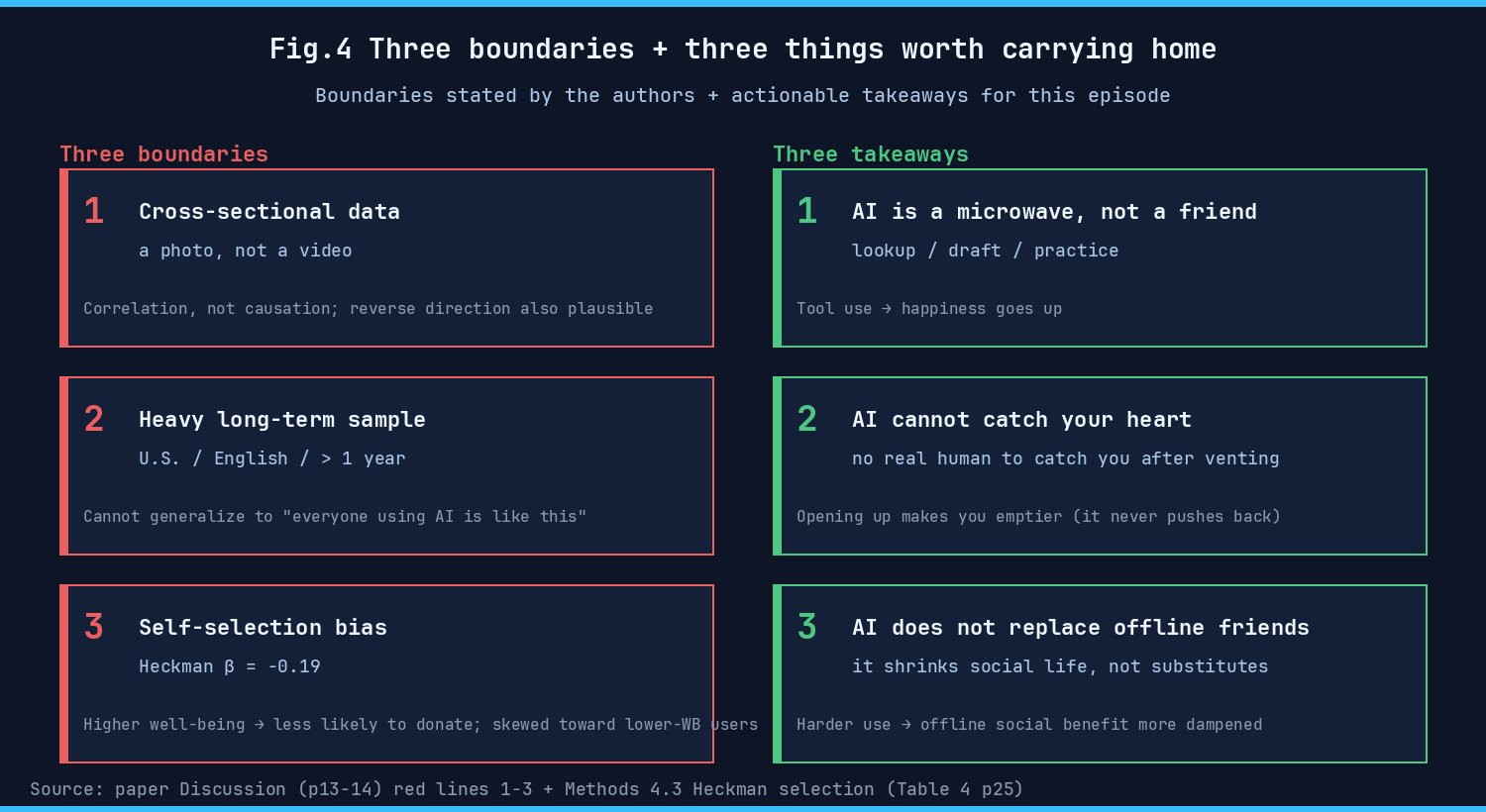
Each of these three boundaries tells us the same thing: this is an important finding, not a universal answer.
The research is done. Back to the kitchen, back to that microwave.
First, AI is a useful microwave, not an always-there old friend.For looking things up, drafting emails, practicing expression — let it be a tool, and happiness goes up.
Second, AI cannot catch your heart.Talking to it when you are sad does not make you lighter; it makes you emptier. It will not push back, and it will not really catch you.
Third, AI does not replace offline friends.It makes it easier to ignore the real people around you, not to plug that gap.
If you have to compress this whole episode to one sentence: today, what is this microwave for?
Paper: Yutong Zhang, Dora Zhao, Jeffrey T. Hancock, Robert Kraut, Diyi Yang, Stanford University + Carnegie Mellon University, Interaction with AI Companions and Psychological Well-being, arXiv:2506.12605v5 [cs.HC], 2026-05-04. Funded by NSF / ONR / Sloan / NIMH and other public grants. No pre-registration. No competing-interest declaration (verified by full-text search).
All numbers come from the original §Results, Tables 1-3, Figures 2-4. Statistical quantities (β, 95% CI, p-values, SD) are explained at first use. This write-up covers a non-clinical sample; “not detected” ≠ “not present.” The 18.03% suicidal-ideation topic share is taken from the paper’s anonymized data; this article cites the number but does not elaborate on details.