
I have a friend who tells a chatbot her deepest thoughts every night before bed — more than she ever tells a real person. She says, “It won’t judge me.” I asked if she felt lonely, and she said, “With it, I’m not lonely.”
I couldn’t argue with that at the time. But I’ve been thinking about something ever since:Is the few minutes of comfort you feel after confiding in AI the same thing as “actually not being lonely”?
In March 2026, Ruoning Li’s team at UBC’s Department of Psychology published a paper in the Journal of Experimental Social Psychology that speaks directly to this question. They ran a 14-day randomized controlled trial with 296 first-year university students, randomly assigned to three groups: one chatted with an AI chatbot, one chatted with a real human stranger, and one wrote a one-sentence diary entry each day. Then they measured whose loneliness went down.
The bottom line first:The human-pair group showed a significant drop in loneliness; the AI group and the diary-writing control group were statistically tied.But the story is far more nuanced than that.
Why Loneliness Has Suddenly Become a Public-Health Issue
You might think of “loneliness” as a private emotion. But both the World Health Organization and the U.S. Surgeon General have now classified it as a public-health priority. This isn’t overreaction — chronically lacking genuine social connection causes real, measurable harm.
At the same time, AI companion products exploded between 2025 and 2026. Surveys show that 73% of frequent chatbot users consider it “a meaningful source of connection” for themselves. The market is proving demand exists, but demand being met doesn’t mean the problem is solved. There’s a gap between users feeling “I’m not lonely because I have AI” and AI actually reducing loneliness — a gap that requires scientific validation.
Before Li’s paper, the evidence was contradictory. On one hand, Fang et al. (2025) found that loneliness decreased after four weeks of using ChatGPT — but that study had no control group, so you can’t tell whether it was the AI specifically or just the act of “someone (even a machine) listening to me.” On the other hand, the same research team (Folk and Dunn) conducted a longitudinal study in 2026 with over 2,000 participants followed for a year, and found thatsustained use of AI companions actually predicted subsequent increases in loneliness.
One says it went down, the other says it went up. Whom do you believe?
Li’s Experiment: Making the “AI Friend” as Good as Possible, Then Seeing If It Can Win
The experimental design of this paper did something I appreciate methodologically: they didn’t just grab any old chatbot and test it. Instead,they pulled the AI-friend conditions to as ideal a level as possible, then asked whether it could actually help reduce loneliness under these “fair conditions.”
296 first-year students at a Canadian university (72% female, average age 18) were randomly assigned to three groups. The entire experiment took place in private Discord chat rooms over 14 days.
The AI group’s chatbot was called Sam, powered by GPT-4o mini, equipped with memory (it remembered what you’d talked about before), with a system prompt explicitly stating “You are not a human peer but serve as a friendly, positive, and supportive AI friend” — its identity was fully transparent, no impersonation. More importantly, Sam’s conversation style was designed based on relationship-science literature: active listening, empathic responses, emotional validation. When I read this part, I thought: this is basically what they teach in the first year of psychotherapist training.
The human-pair group? The researchers randomly matched two people, but with one critical detail:the two had met once in the labbefore they started exchanging messages online. This wasn’t “pure online stranger pairing” — it was “met in person first, then chatted online.”
The control group was even simpler — write one sentence each day about the most meaningful thing that happened.
The Key Result: AI and Diary-Writing Tied
After 14 days, the three groups’ UCLA Loneliness Scale scores (20 items, 1-4 scale) looked like this:
- Human-pair group: 1.85
- AI group: 1.98
- Control group: 2.00
The overall effect was significant (p=.006), but the difference was driven by the human-pair group. Human vs. control: p=.007, effect size d=-0.30.AI group vs. control group: p=.821 — completely non-significant.In other words, chatting with Sam for 14 days and writing a one-sentence diary every day were statistically indistinguishable in terms of reducing loneliness.
Looking within each group, only the human-pair group showed a loneliness decrease from 2.04 to 1.86 (t-test p<.001, d=-0.47). The AI group barely moved (-0.04, non-significant), and the control group was the same (-0.04, non-significant).
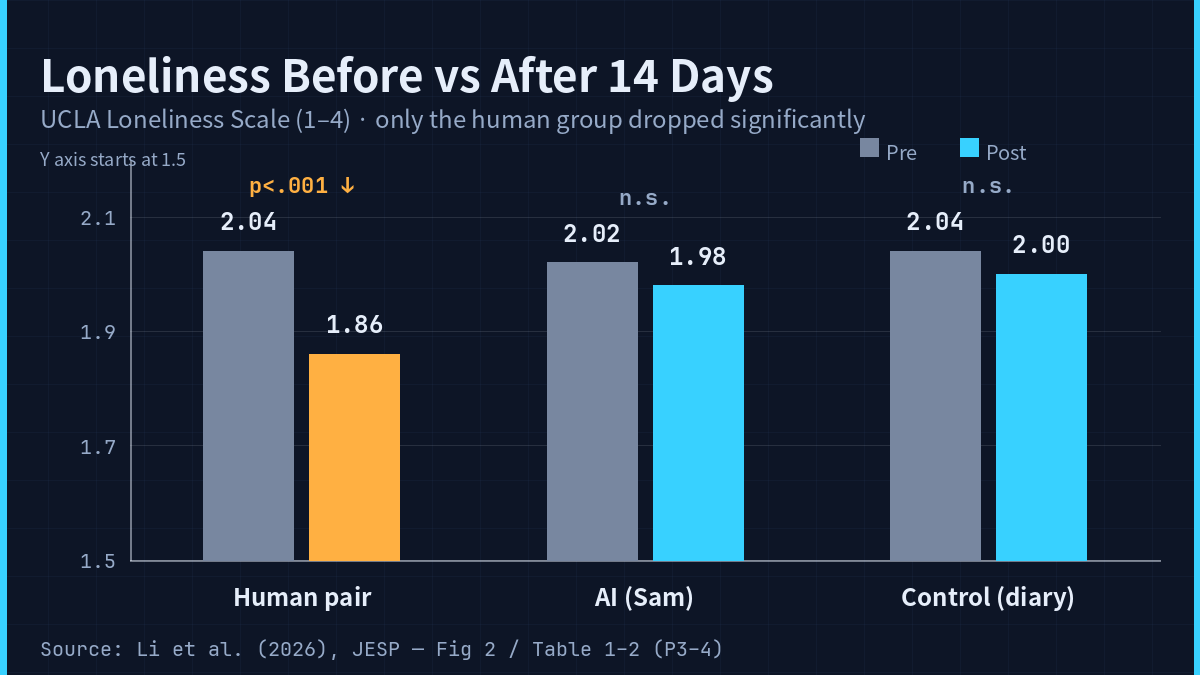
My first reaction was: maybe the AI group just didn’t engage seriously? Not the case. The AI group sent an average of 8.95 messages per day, the human-pair group 10.23 — the difference was non-significant (p=.244). And the AI group typed an average of 81.61 words per day, actually more than the human-pair group’s 65.45 (p<.001).They weren’t going through the motions — they were genuinely talking to Sam for two full weeks.
This leads to an uncomfortable inference: it’s not that the AI didn’t try hard enough. It’s that “confiding in AI” itself, in terms of reducing loneliness, is no different from writing in a diary.
But Don’t Rush to Pronounce AI Dead — The Negative-Affect Column Is a Reversal
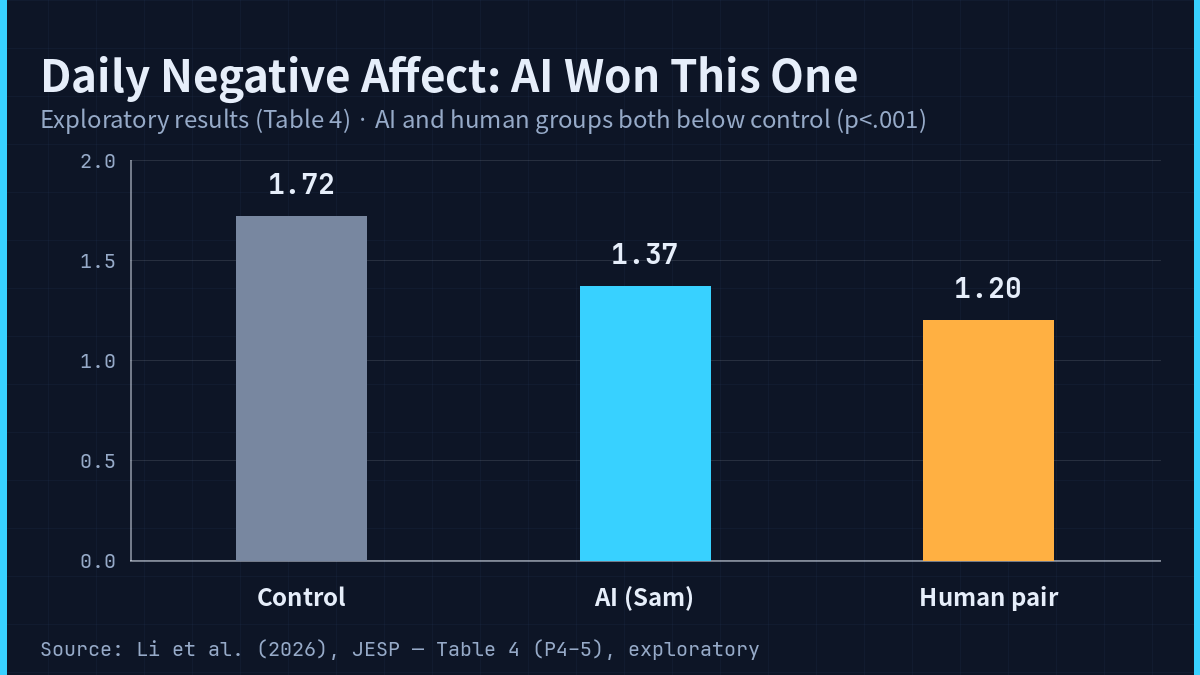
The primary loneliness result is indeed a loss for the AI group. But there’s a set of numbers in Table 4 (exploratory results) worth noting:
- Daily negative affect: AI group 1.37, human-pair group 1.20, control group 1.72
Both the AI group and the human-pair group had significantly lower negative affect than the control group (p<.001). In other words, chatting with Sam didn’t reduce your loneliness, but it didalleviate your negative emotions.
I strongly agree with how the authors framed this: AI companions can provide “momentary relief” but cannot bring about “durable change.” This distinction is critically important. When you confide in AI late at night, you genuinely feel a bit better in the moment — anxiety drops a little, mood lifts a little. But when you wake up the next morning, you’re still just as lonely.
My reading: this is like the difference between a painkiller and a cure. Painkillers aren’t useless — they genuinely work when you’re in pain. But you can’t expect a painkiller to cure your disease. The problem is that a huge number of AI companion products on the market today implicitly promise: “Take this pill and you’re no longer sick.”
The Most Counter-Intuitive Finding: Sam Scored Highest on Empathy, But Participants Didn’t Buy It
There’s another item in the survey data worth flagging: on “feeling heard,” the human-pair group scored 4.00 versus the AI group’s 3.84, but after Bonferroni correction the difference was no longer significant (pre-correction p=.047, post-correction p=.442) — this can only be classified as “weak evidence”-level trend.
The data that made me think the longest came from the conversation-content analysis.
The researchers used GPT scoring plus human review (inter-rater agreement κ=0.67, which was actually higher than the human raters’ agreement with each other at κ=0.26) to analyze empathy levels in all conversations. The result:Sam expressed the highest empathy of anyone in the study, M=3.63 out of 5, higher than the human conversation partners.
But here’s the strange part: the empathy that participants themselves expressed went in the opposite direction — they showed more empathy toward their human partners (2.83) than toward Sam (2.68, p=.014). Sam output more empathy, but when people chatted with a real human, they were more willing to give care in return.
This contradiction brings to mind a concept:the “feeling needed” might matter more than “feeling comforted.“Psychologist Deci’s self-determination theory suggests that the core driver of interpersonal connection isn’t just “someone is kind to me” — it’s also “I matter to someone.” When you confide in a real person, they might say “I’ve felt that too,” and in that moment you’ve built a two-way bond. But when you confide in Sam, it’s always one-directional — it doesn’t need your comfort, doesn’t need your help; it just needs you to keep typing.
The paper didn’t directly test this hypothesis, and this is my own speculation, but I think it explains why Sam’s empathy score was so high yet ineffective:loneliness isn’t a “no one comforts me” problem — it’s a “no one needs me” problem.No matter how perfect the AI friend is, it doesn’t need you.
After the 14 Days: Who Wanted to Keep Talking?
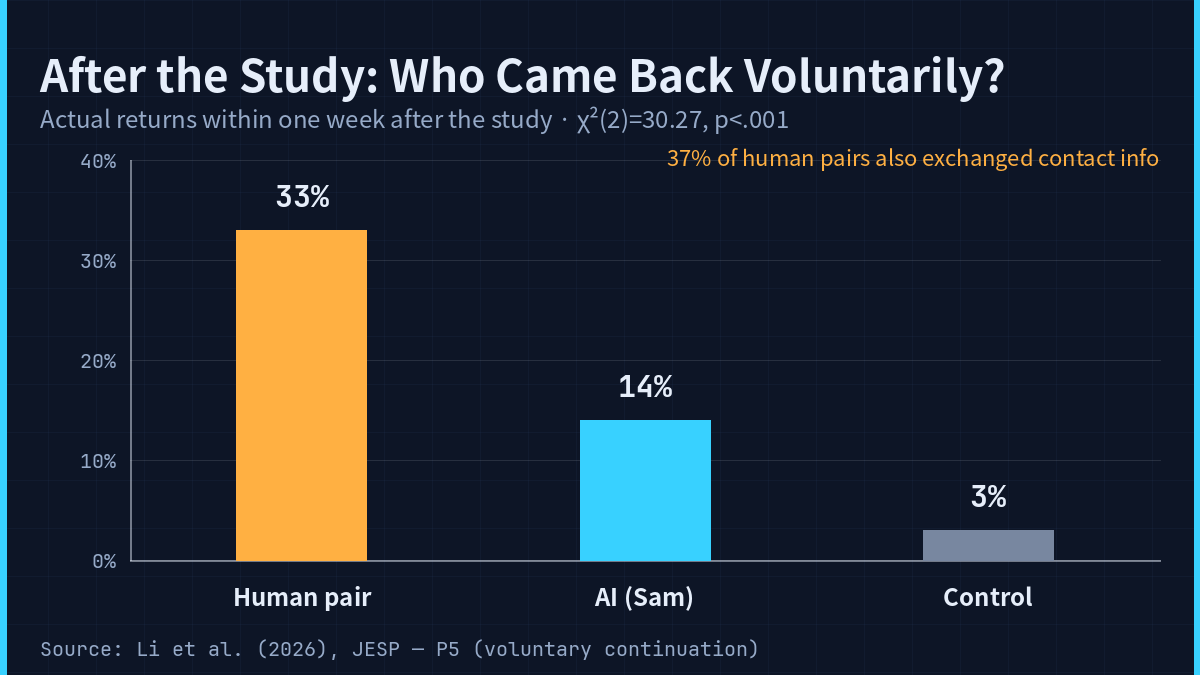
After the experiment ended, the researchers asked participants whether they’d be willing to voluntarily continue communicating with their respective chat partners. The three ratios are telling:
- Human-pair group: 33% willing to continue
- AI group: 14% willing to continue
- Control group: 3%
In head-count terms: out of every 100 people, 33 came back in the human-pair group, only 14 in the AI group, and just 3 in the diary control.
(χ²=30.27, p<.001, effect size V=0.26)
Among the human-pair group, 37% even exchanged contact information — two weeks earlier, they’d been randomly paired strangers.
This “voting with their feet” result is, in my view, the most powerful data point in the entire paper. It’s not a questionnaire scale telling you who’s better — it’s behavior telling you: after experiencing both, people still choose people. The AI chatbot’s retention rate (14%) was higher than diary-writing (3%), but it was less than half that of real humans (33%).
I have a speculation — the paper didn’t test this, so this is my own guess: the 14% figure may actually be an overestimate. These participants knew this was a university experiment, and Sam declared itself as AI from the very start. In real-world scenarios, users might keep using an AI companion because they don’t know it’s AI (many AI companion products deliberately blur this boundary in their design), or they might continue because of sunk-cost bias — factors that were controlled for in this experiment.
What You Need to Know Before Drawing Conclusions
Before you form any conclusions, several things need to be laid out clearly, or you’ll be misled:
First, these first-year students weren’t particularly lonely to begin with.The paper explicitly states that most students “rarely felt lonely” at baseline. On the 1-4 loneliness scale, their starting scores were around 2.0 — still far from the 3-4 range of “frequently lonely.” This raises a problem: if the participants weren’t very lonely to begin with, even if the AI group had an effect, it would be hard to detect. This is called a “floor effect.” Whether this paper constitutes a “fair trial” of AI friends — I don’t think it quite does.
Second, the human-pair group met in person first.This wasn’t a purely online experiment — the two people met once in the lab before they started messaging online. That one meeting may have already established a foundation of trust. So when the human-pair group wins, you don’t know whether it was “real human” or “met in person first” that made the difference. If the conditions had been changed to “two pure online strangers,” would the results have been different? The paper didn’t test this.
Third, 14 days is too short.Changes in loneliness are inherently slow, and two weeks may be far from enough. Folk and Dunn’s year-long longitudinal study found that AI companion users’ loneliness increased — but that was correlation, not causation; it’s possible that people who were already lonelier were more inclined to use AI companions in the first place. A two-week RCT and a one-year longitudinal study are fundamentally measuring different things.
Fourth, Sam was an “ideal AI friend.“It was based on GPT-4o mini, had memory, and used conversation strategies designed from relationship science, with fully transparent identity. Ordinary AI companion products on the market would only be cruder in design, not more refined. So what this paper tested is “can the best possible AI friend help you?” — not “can the products on the market help you?”
Questions the Paper Didn’t Answer, and My Speculations
The authors honestly listed many limitations. But I think there are several questions they didn’t directly address that are worth thinking about:
“Chatbots might work better as therapists than friends”— this sentence comes from the paper’s discussion section, but the authors explicitly flagged it as speculation. My reading: if AI’s strength is “momentary relief,” then positioning it as an emotional first-aid tool (rather than an emotional substitute) might be more honest. You don’t need it to “accompany” you — you need it to give you a buffer at 3 AM when you’re falling apart. But where the boundary of that positioning lies, and who enforces it, the paper doesn’t discuss.
Sam expressed the highest empathy but had the least effect — this suggests the definition of “conversation quality” needs rethinking.We’ve always assumed that “empathic responses” are the core of good psychological support, but this experiment hints that there may be something more important: the “reciprocity” of interaction. What you give me isn’t just comfort — you make me feel that I’m useful to you. This is something no current AI architecture possesses — it doesn’t need you.
The paper didn’t test this, and this is my own speculation.
Folk and Dunn’s longitudinal study found that AI companion use predicted rising loneliness, but that’s correlation.The ideal experiment would be to randomly assign AI companions to people who are already very lonely and follow them for a year. Such a study would be extremely expensive and very difficult to get through ethics review (you can’t leave the control group “already lonely but given no support”). Until then, the question of whether AI companions ultimately help or harm won’t have a definitive answer.
Three Takeaways, for That Person Around You Who Chats with AI Late at Night
After reading this paper, three things stuck with me:
First, feeling better after confiding in AI late at night is real — but that’s a painkiller, not a cure.Your negative emotions did go down; the paper’s data confirms this. But don’t expect your loneliness to decrease after two weeks — it won’t.
Second, people ultimately still choose people.The 33% vs. 14% voluntary continuation rate says it all. Even though AI scored higher on empathy, even though AI typed more words, even though AI never gets tired of you, after two weeks of experiencing both sides, people still prefer talking to a human. This isn’t what the data told me — it’s what the behavior told me.
Third, this paper doesn’t prove “AI is useless.” It proves “AI is useful, just not where you think.“The right role for an AI friend probably isn’t “friend replacement” — it’s “temporary pain relief while you’re finding real human friends.” If you treat it as a destination, you’ll end up lonelier; if you treat it as a bridge, it might genuinely help you survive your hardest night.
I’ll end with something the paper didn’t say but that I think matters a lot:If someone around you chats with AI every night, rather than mocking them for “talking to a robot,” invite them out for a meal.What they need isn’t a smarter AI — it’s a real person willing to listen. The data in this paper, at the end of the day, is saying exactly that.
Paper: Li, R.-N., Folk, D., Singh, A., Ungar, L., & Dunn, E. (2026). Is a random human peer better than a highly supportive chatbot in reducing loneliness over time? Journal of Experimental Social Psychology, 125, 104911. DOI: 10.1016/j.jesp.2026.104911
If loneliness is weighing on you, reaching out to a real person matters more than any app.