
A 2025 network analysis from an Oxford team, published in Depression and Anxiety. I picked it up for the old term “anhedonia,” but it ended up answering a phenomenon I’d never been able to explain in the people around me. This is a reading note, not professional advice. Original DOI: 10.1155/da/5674096.
1. The person I could never explain
Everyone knows someone like this: their head is full of unhappy things, playing on repeat. You tell them to “go do something fun.” They go. They come back empty. They’re not faking it — they genuinely feel nothing.
My old explanation for this was simple: too many unhappy things, crowding out the space for happy ones. So the fix was simple too — lighten up, find some fun, time heals.
But that explanation has a hole in it: it assumes the happiness machine works fine and just isn’t being fed. Watch long enough and something’s off — some people, faced with clearly good things (a promotion, a vacation, a party a friend put together), react with “nah.” The machine isn’t underfed. It doesn’t respond when fed.
So where exactly is the machine broken? This Oxford paper (Rajesh et al., with Eleanor Leigh and Omid V. Ebrahimi among the corresponding authors) gave me the cleanest cut I’ve read in years.
2. First, a word I’d been using wrong for years
The DSM-5 has a term: anhedonia. The definition is short — markedly diminished interest or pleasure in all, or almost all, activities.
I used to treat it as the clinical name for “unhappiness.” That’s wrong. Unhappiness means something is making you feel bad; anhedonia means nothing makes you feel good. One is a negative value, the other is zero. Opposite directions.
Don’t shrug off the distinction. Anhedonia is linked to worse social functioning and to more suicidal ideation (that’s from other people’s meta-analyses, not this paper’s data). “Nothing tastes good anymore” is not a personality quirk, not drama — it’s a symptom worth taking seriously.
Then I hit the paper’s first cut, and realized I wasn’t wrong enough — the word itself is blurry.
3. The first cut: maybe it’s not one broken machine, but two
The researchers split anhedonia in half:
- Anticipatory: no looking-forward to rewards. There’s a party tonight; you don’t feel any advance lift, don’t pick out clothes, don’t check who’s going.
- Consummatory: the reward is right in front of you and it still doesn’t land. The party happens, you’re there, and you just sit there, wooden.
One is “not yet,” the other is “it arrived and it didn’t help.”
They didn’t invent this cut — the anticipatory/consummatory distinction has been around for a while. But I stopped here and thought: if these two halves really are two separate machines, then the people around me probably don’t all have the same machine broken.
And if that’s true, the practical consequence is immediate: serving the same chicken soup — “cheer up, go get some air” — to someone with no anticipation and someone with no in-the-moment pleasure means at least half of it is being poured into the wrong machine.
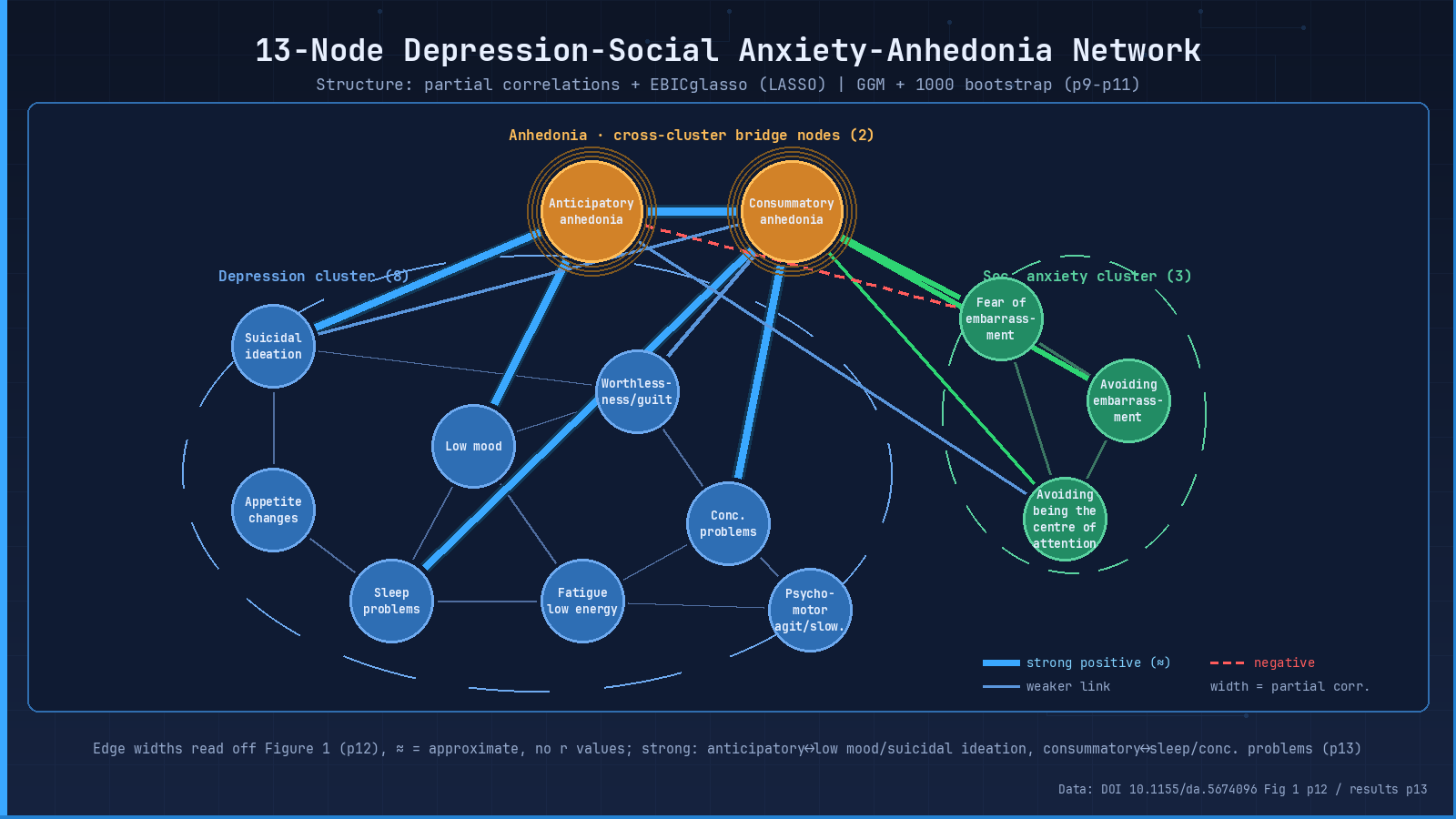
How do you test whether the two halves really differ? The most direct approach: lay out every relevant symptom of depression, social anxiety, and anhedonia, draw a network map, and see which symptoms each half sits closest to.
4. 672 people, 13 symptoms, one “who sits next to whom” map
The method, in one breath: data comes from wave three of CIPA Students, a nationally representative Norwegian student mental-health cohort — 672 university students, ages 19 to 24, about 70% women. Eight depression symptoms, three social anxiety symptoms, and two anhedonia dimensions become 13 nodes. The edges are partial correlations — the association left between two symptoms after controlling for everything else. Then 1,000 bootstraps to verify the map isn’t built from noise (the stability coefficients pass the usual bar; details in the paper).
Two background numbers worth remembering: 28.87% of this sample scored above the depression screening cutoff, 18.90% above the social anxiety cutoff. Screening thresholds, not clinical diagnoses — don’t read this as “a third of Norwegian students are depressed.”
Map built. What does each half connect to? This is where my note-taking genuinely started to wander — because the two answers are so different.
5. Anticipatory: it connects to the deepest wounds
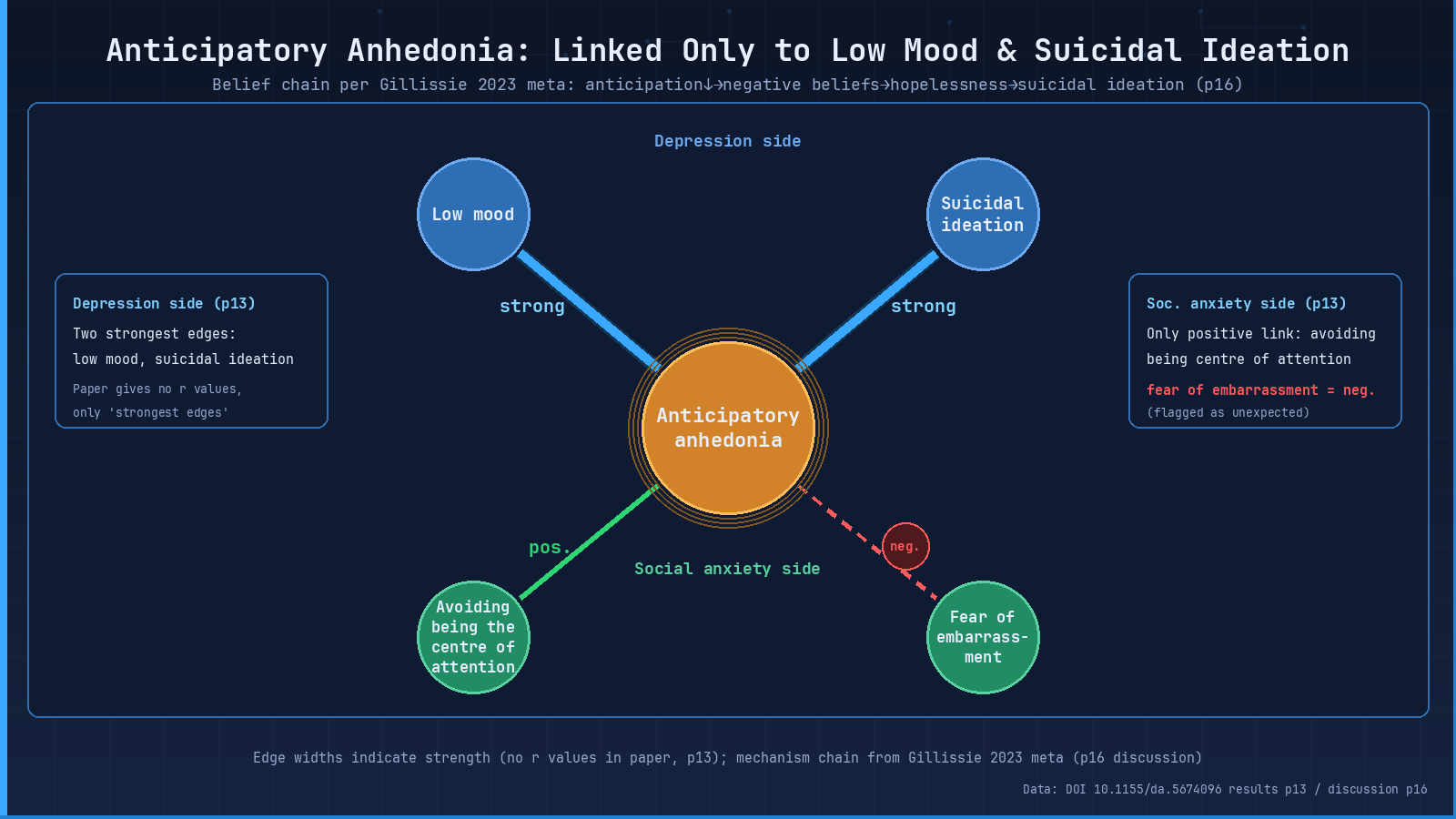
The anticipatory half connects almost exclusively to the depression side — and to the two heaviest items on it: “depressed mood” and “suicidal ideation.”
On the social anxiety side it holds just one edge (“avoiding being the center of attention”), plus one counterintuitive negative edge: the less people anticipate, the less they “fear embarrassment.”
My own reading first — this part is not in the paper: what is anticipation? It’s a projection of the future. To look forward to a weekend dinner, your head has to contain a weekend worth going to. When anticipation breaks, you haven’t lost one pleasant feeling — you’ve lost the sense of future. There’s nothing ahead. So its link to hopelessness and suicidal ideation reads naturally. The meta-analysis the paper cites (Gillissie 2023) describes the same chain: reduced anticipated pleasure → negative beliefs about the permanence of bad events → sadness, hopelessness → suicidal thoughts. A belief pathway, not a physiological one — and note this is a network-level partial correlation, not “anticipatory anhedonia causes suicidal ideation.”
That negative edge — “the less you anticipate, the less you fear embarrassment” — gets a tentative guess from the authors: “why bother.” But the same half also connects to avoiding attention, which looks self-contradictory, and the authors wisely don’t force an explanation. My reading: not-caring and avoiding might both be forms of withdrawal — one mental (don’t care), one behavioral (don’t go). Two moves, same direction: away from people. That interpretation is mine, not the paper’s. Flagged.
6. Consummatory: broader, messier — and I suspect it’s being mass-produced
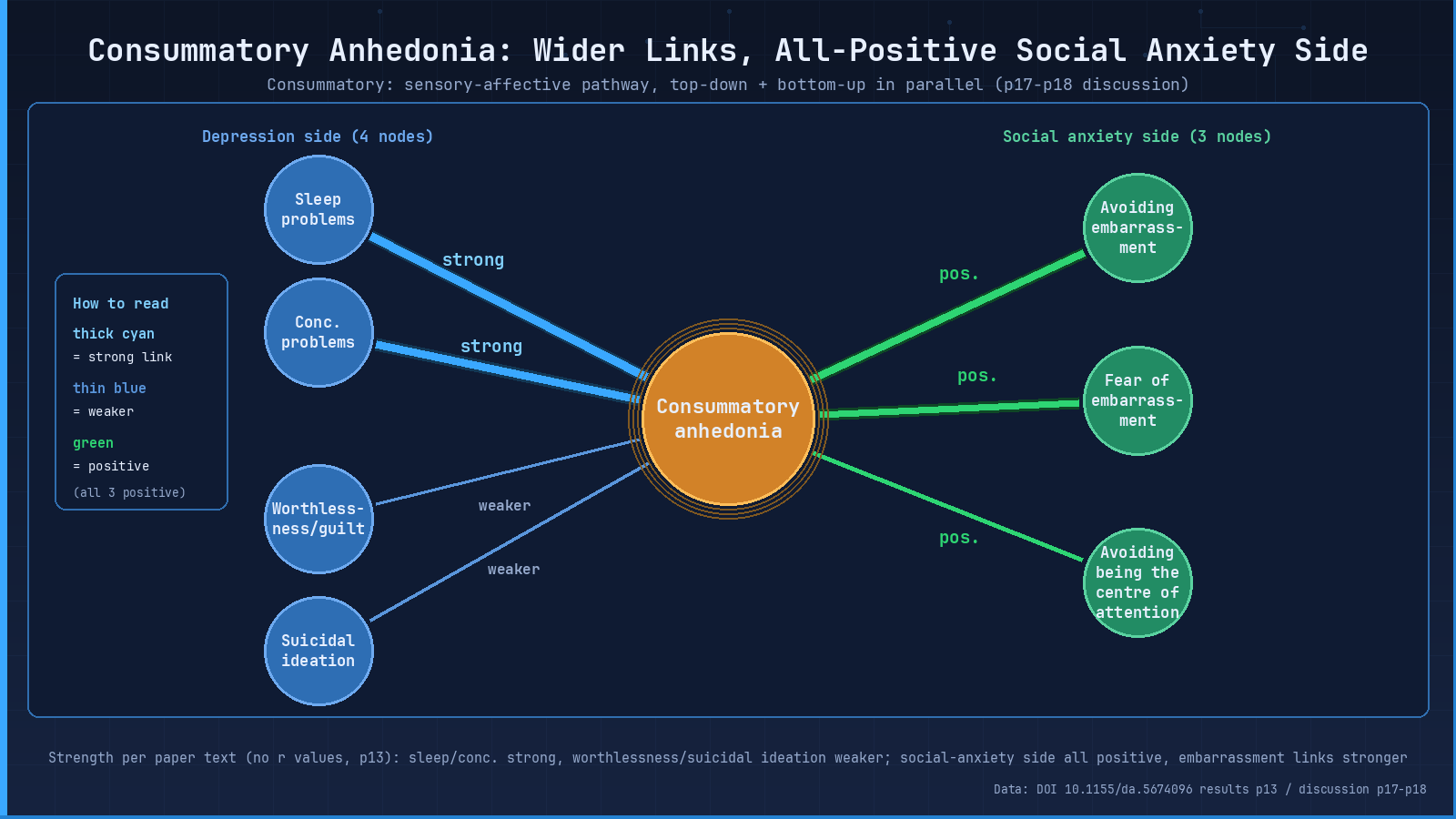
The consummatory half connects noticeably wider: strongest edges to “sleep problems” and “concentration problems” on the depression side, with “worthlessness/guilt” and “suicidal ideation” also linked; and on the social anxiety side, all three symptoms are connected — “fear of embarrassment” and “avoiding embarrassment” not weakly.
Why does failing to enjoy reach further? The authors’ explanation: reward consumption runs on two pathways at once — top-down cognitive appraisal and bottom-up sensory-affective processing. A junction that two pathways pass through naturally borders everything. Can’t unwind before sleep, can’t sink into activities (sleep, attention); no daily pleasure → negative beliefs about the self (worthlessness) — it all hangs together, and sleep problems further feed suicidal ideation (Patel 2024 and others).
Here’s an extra-curricular association of mine, for what it’s worth: the consummatory half is the “present-moment experience” link. And modern life excels at exactly one thing — shredding the present. Two hours of short videos, and the moment you put the phone down, it’s empty. Shows watched at 2x speed, meals eaten while answering messages. I don’t know whether any of this causally relates to consummatory anhedonia — the paper doesn’t test it. But if enjoying-the-present is a use-it-or-lose-it capacity, our era is running degradation training on it every single day. Of everything in this paper, this is the line I least want to verify on myself.
7. The ranking that surprised me most
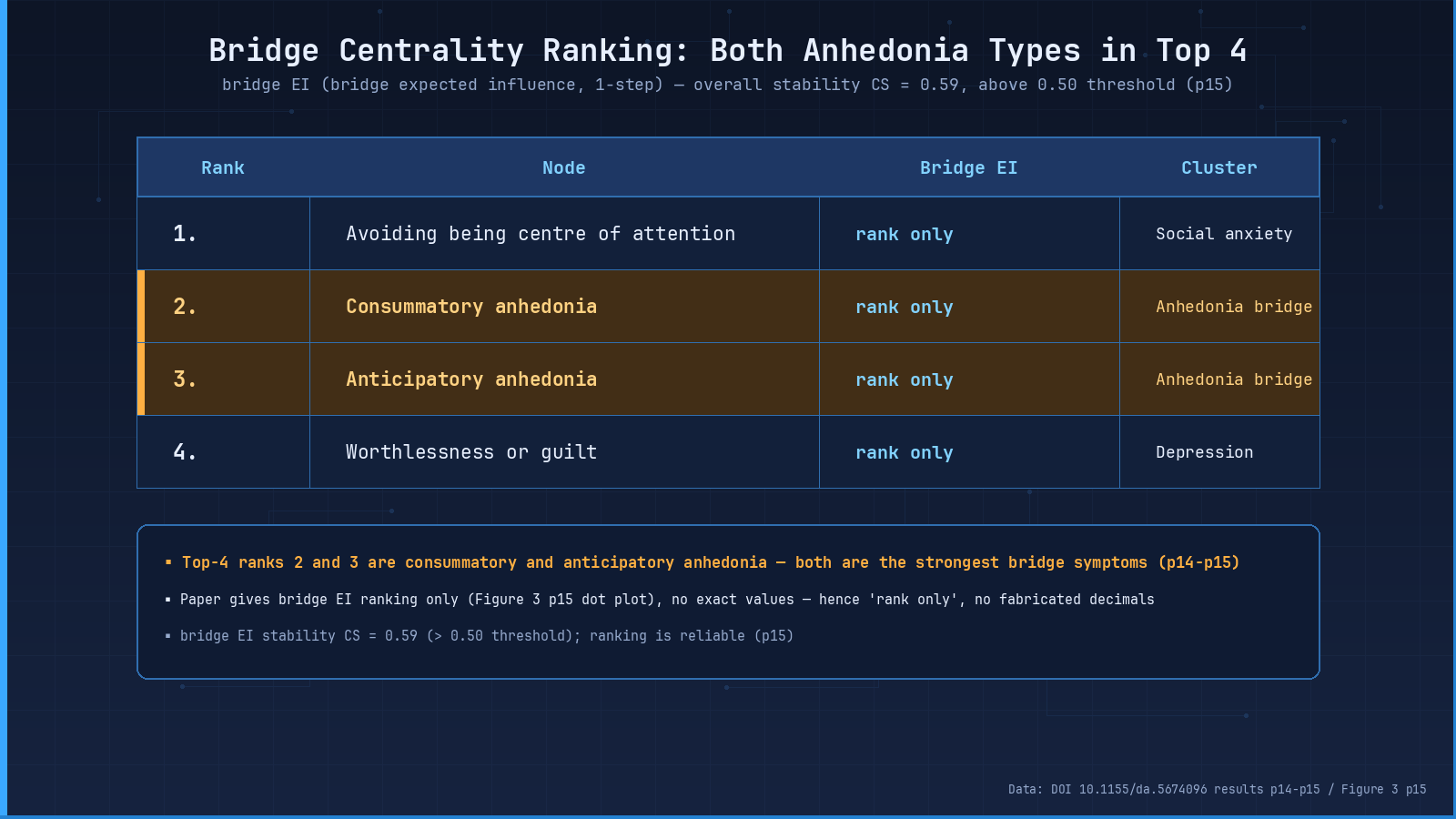
The authors also computed bridge centrality — which symptoms best serve as bridges between the depression and social anxiety clusters. Top four:
- Avoiding being the center of attention
- Consummatory anhedonia
- Anticipatory anhedonia
- Worthlessness or guilt
Both anhedonia halves in the top four — not surprising. What stopped me was number one: not “depressed mood,” not “sadness” — hiding. Avoiding attention.
It makes sense once you sit with it. Depression and social anxiety are two different conditions, but the core move they share may not be an emotion — it’s retreat. Dodge the gaze, dodge the occasion, dodge the anticipation, dodge the experience. The bridge is built out of hiding, not out of sadness. Early models treated anhedonia as depression-specific, but social anxiety patients show anhedonia levels comparable to depressed patients (Brown 1998, Kashdan 2007) — both conditions are being dragged by the same symptom.
The boundary has to be held: a “bridge symptom” is a hub in an association structure, not a proven transmission channel. This is cross-sectional — no causality, no direction anywhere. High bridge strength = topologically important, not “fix it and you prevent both conditions.”
8. An old consensus, pried open: the machine isn’t broken — the readout is?
This is the chewiest part of the paper, for my money.
The mainstream judgment from neuroimaging and behavioral studies over the past decade-plus: depression impairs only the anticipating link, not the enjoying link. The back half of the machine is fine.
This self-report study finds the consummatory half just as broadly impaired — and more widely connected. Subjective report, used as a crowbar on the imaging consensus.
Two measurement traditions disagree; which do you trust? My reading: brain scans measure the machine’s voltages; questionnaires measure the person’s experience. Those two things may not live on the same layer at all. Maybe the depressed person’s enjoyment hardware is intact, and what’s broken is the layer that reads voltage as pleasure — the monitor works, the graphics driver is corrupt. It’s only an analogy, but it explains how both measurement traditions can produce different answers and both be right.
So don’t trust just one gauge. Self-report and neuroimaging aren’t rivals; lay them side by side on the table.
9. The most useful part for ordinary readers: two failures, two fixes
The paper ends by citing intervention directions (from the Craske 2019 positive affect treatment RCT). I’ve translated them into a self-check list:
- If your problem leans toward “no anticipation” — the matching direction is pleasant event scheduling: deliberately put small look-forward-to things on the calendar. Sunday breakfast, a Wednesday run, Friday dinner with a friend. The point is having something waiting ahead.
- If your problem leans toward “can’t feel it” — the matching direction is present-moment imaginal recounting: afterward, deliberately replay the experience in your mind, reinforcing “that moment was actually good.” The point isn’t scheduling; it’s the experience itself.
Caveat first: these are directions suggested by prior research, not therapies this paper validated. Nothing here replaces professional judgment.
But my own takeaway is bigger than the list: next time I hear the universal advice “cheer up, go find some fun,” I’ll ask one question first — which machine are you talking about? The two halves break differently and fix differently. Mixing them up is tightening a lightbulb with a wrench.
10. Three buckets of cold water (how much can you trust this)
First, cross-sectional. Every edge is a same-moment partial correlation — no causality, no direction, and you can’t read “what causes what” off this map.
Second, the sample. 672 Norwegian university students, 19–24, 70% women, screening cutoffs rather than clinical diagnoses. The authors themselves note symptoms are continuous and associations might be stronger in clinical samples — but that’s speculation, not this paper’s data.
Third, a detail the authors disclose themselves: the under-24 age cut was decided after seeing the data; slicing the sample from 1,256 to 672 was not preregistered, and the algorithm was accordingly switched from the preregistered plan to EBICglasso. The authors didn’t hide the cut — credit where due — but readers should know.
Also, social anxiety was measured with only the three-item Mini-SPIN screener; the full picture (self-focused attention, negative mental imagery) isn’t covered. Read the social-anxiety-side conclusions conservatively.
11. Closing: I only understood the word after it was split in two
Back to the person from the opening.
I used to think they had too many unhappy things crammed in. After this paper, I lean toward a different framing: maybe it’s not too many negatives — it’s too many zeros. And “no anticipation for good things” (anticipatory) versus “no feeling from good things” (consummatory) are two different machines, wired to different symptom networks, asking for different repairs.
So next time you’re about to tell someone to “cheer up,” hold the chicken soup. Figure out first which kind of can’t-be-happy they are.
And one paragraph that has to be said.
If you or someone near you is going through persistent depression, social anxiety, or suicidal thoughts, please contact a professional doctor or a mental-health helpline. An international directory of helplines by country: findahelpline.com. (In mainland China: national psychological assistance hotline 400-161-9995; Beijing Suicide Research and Prevention Center 010-82951332; Shanghai 021-12320-5; students can reach their campus counseling center.) Having a professional think it through with you beats guessing alone in the dark.
Paper: Rajesh, S. et al. “Differential Associations of Anticipatory and Consummatory Anhedonia With Depression and Social Anxiety Symptoms: A Network Analysis of University Students.” Depression and Anxiety, 2025, Article ID 5674096. DOI: 10.1155/da/5674096.