A re-read of the LIGO/Virgo Collaboration’s 2016 PRL landmark paper (PRL 116, 061102; arXiv 1602.03837). I am not announcing anything new; I am re-reading the original ten-year-old paper that first let humanity hear a gravitational wave directly, and asking what it actually said, how it said it, and which numbers are nailed down.
1. A 0.2-Second Signal, and a Hundred-Year Wait
On the morning of September 14, 2015 (still nighttime in the United States), two instruments about three thousand kilometers apart twitched at almost the same instant. The shaking lasted less than a fifth of a second, brief enough to be mistaken for an illusion.
And yet humanity had waited a full century for that single twitch.
Einstein wrote down the linearized wave solution in 1916, and for an entire hundred years no one had ever actually touched one. Einstein himself was pessimistic: the ripple, he thought, was so faint it might never be measured. The decades that followed ran through Weber’s resonant-bar detectors, then the laser interferometer concept proposed in the early 1970s, then the initial LIGO running for over a decade setting only upper limits, until 2015, when Advanced LIGO finally pushed strain sensitivity to three to five times that of initial LIGO in the 100–300 Hz band. That is when the story truly begins.
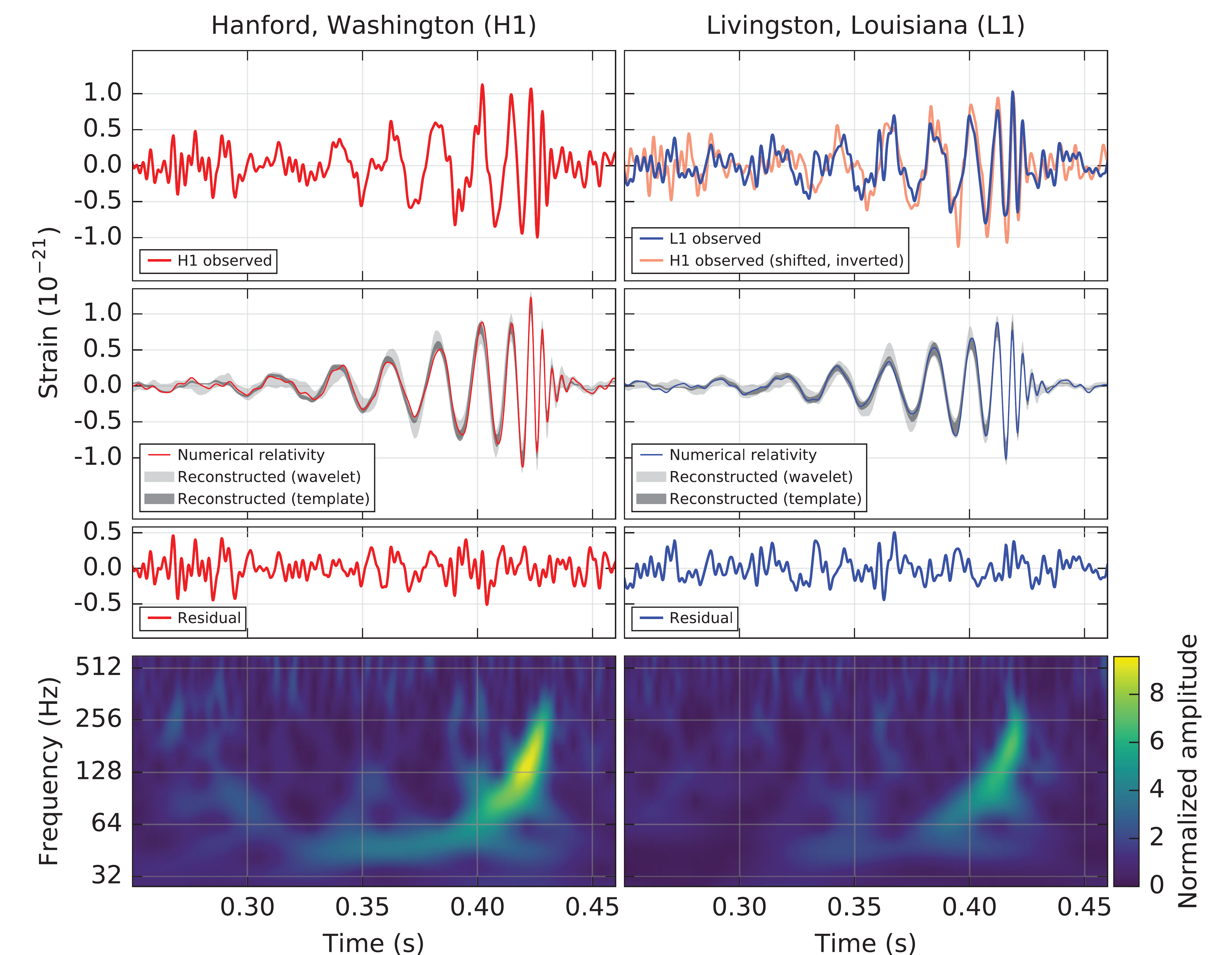
The figure above is the raw strain recorded that September morning: H1 (Hanford, Washington) and L1 (Livingston, Louisiana) saw waveforms of almost identical shape, separated by only a few milliseconds. The most important facts of the paper’s abstract are right there in that figure: the signal sweeps from 35 Hz up to 250 Hz, peaks at a strain of 1.0 × 10⁻²¹, with a matched-filter signal-to-noise ratio of 24, and a false-alarm rate below one event per 203,000 years.
But a figure is not enough on its own. What is this “waveform” actually? Is it the instrument trembling on its own, or did the universe really shake? To answer that, we have to anchor the magnitude first — how faint is this “heartbeat,” and what kind of instrument does it take to catch something that faint?
2. Why Nobody Caught It for a Hundred Years: A 4-Kilometer Ruler That Must Read a Thousandth of a Proton
To feel the difficulty, let us put the numbers on the table.
When a gravitational wave sweeps through the Earth, space itself gently stretches a little, then compresses a little. But the deformation is imperceptibly small: the paper does not state the absolute number directly, but back-calculating from the detector description in Section III (arm length L = 4 km, peak strain h ≈ 1.0 × 10⁻²¹, ΔL = h · L), LIGO’s 4-km arms were stretched by roughly 4 × 10⁻¹⁸ meters in that instant. A proton’s diameter is about 8 × 10⁻¹⁶ meters, so the arm-length change was less than a thousandth of a proton’s diameter.
Here is another way to feel it: it is like measuring the distance to the nearest star (a little over four light-years), with an allowed error no thicker than a human hair.
So the problem was never “does the signal exist” but “can humans build a ruler that magical.” That difficulty was underestimated for a hundred years.
How was that ruler actually built? How does it pull a thousandth-of-a-proton reading off a 4-km arm?
3. The Ruler Is a Michelson Interferometer — But Not the One from Your High-School Physics Book
The answer sits in Section III of the paper: a modified Michelson interferometer, the Advanced LIGO design.
The high-school version splits a beam in two, sends the halves down two perpendicular arms of equal length, and recombines them. Normally the two halves travel identical paths and cancel at the output, leaving total darkness; any change in one arm’s length leaks a tiny bit of light out. The principle fits on one page.
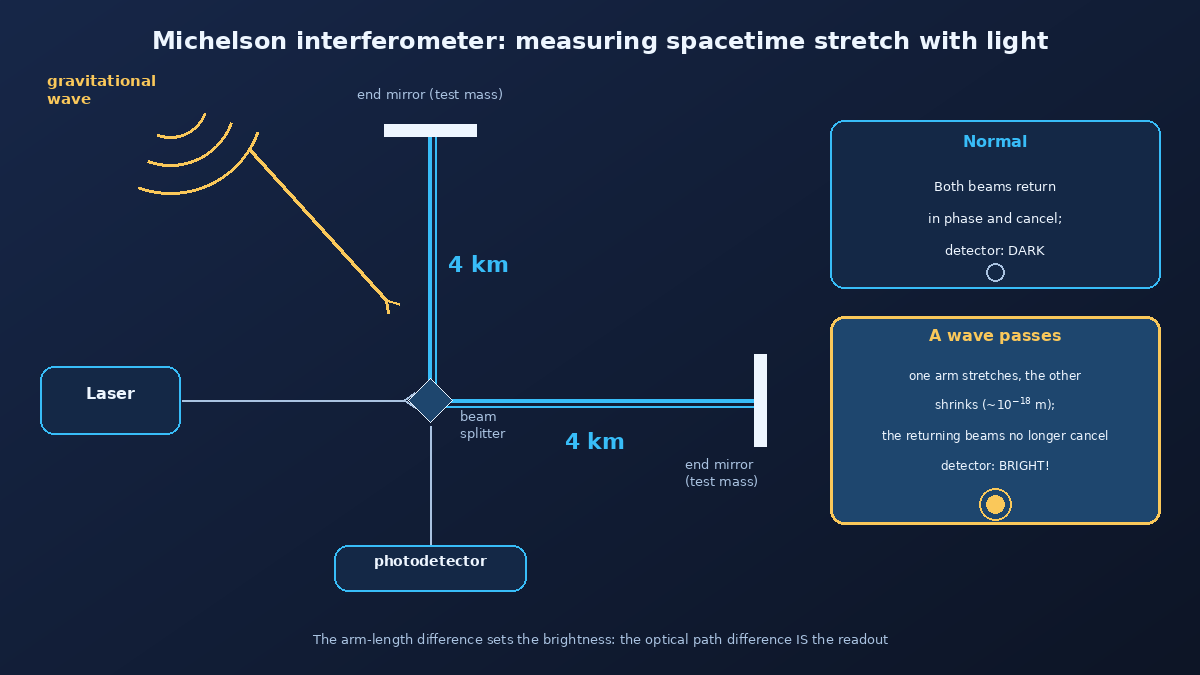
But LIGO is not the high-school version. The paper lists three decisive enhancements.
First, each arm contains a resonant optical cavity that bounces the light back and forth about 300 times before it exits — that stretches the effective optical path to roughly 1,200 km and multiplies the gravitational-wave effect on the light phase by a factor of 300.
Second, a partially transmissive power-recycling mirror at the input provides additional resonant buildup of the laser light: 20 W of laser input is amplified to 700 W incident on the beam splitter, and the circulating power in each arm cavity reaches 100 kW.
Third, a partially transmissive signal-recycling mirror at the output optimizes the gravitational-wave signal extraction by broadening the bandwidth of the arm cavities.
Add a 1064 nm Nd:YAG laser stabilized in amplitude, frequency, and beam geometry; 40-kg fused-silica test masses suspended as the final stage of a quadruple-pendulum system (collectively providing more than 10 orders of magnitude of isolation from ground motion above 10 Hz); and ultra-high vacuum tubes (pressure held below 1 μPa) to suppress Rayleigh-scattering phase noise. With all of that stacked together, the instrument reaches 3–5 times the strain sensitivity of initial LIGO in the 100–300 Hz band, and more than ten times better below 60 Hz.
This is an engineering miracle built from decades of condensed-matter physics, optics, vacuum technology, and control theory all stacked together — not the bright idea of any single genius.
But there is an even more pointed question waiting: how do you know the signal you saw was the universe’s and not your own machine shivering?
4. Why This Is Not an Illusion: Three Gates Plus One-in-203,000-Years
Sections IV “DETECTOR VALIDATION” and V “SEARCHES” of the paper spend almost the entire body answering that question. This is the most persuasive part of the paper, because it explains, in plain language, how fake signals were ruled out.
Gate one: the same waveform showed up at two detectors 3,000 km apart in sequence, with a time delay of 6.9 ms (+0.4 / −0.4 ms), which is exactly the time light needs to travel between the two sites at c. Local faults cannot fake this — two machines cannot independently, simultaneously, and coincidentally come down with the same time-correlated ailment.
Gate two: each site runs about 10⁵ monitoring channels — seismometers, accelerometers, microphones, magnetometers, radio receivers, weather sensors, AC power-line monitors, and a cosmic-ray detector — and all of them were quiet around the second that contained the signal. No environmental disturbance evolved in time and frequency like this signal, and all environmental fluctuations during that second were too small to account for more than 6% of its strain amplitude. The paper actually ran that number.
Gate three: simulated gravitational-wave waveforms were injected into the instrument with the calibration laser, validating that the entire detection chain responds correctly. This is essentially an end-to-end pressure test run before delivery.
Three gates passing at the same time is not yet enough — there is one final statistical sieve. The paper does not simply “see” the signal; it scores it independently with two completely separate search methods that did not communicate with each other.
The matched-filter search (assumes a waveform shape and applies the optimal filter): about 250,000 theoretical template waveforms cover the parameter space of binary component masses from 1 to 99 M⊙, total mass under 100 M⊙, and dimensionless spins up to 0.99. GW150914’s detection-statistic value ρ̂c = 23.6 is larger than any background event, so only an upper bound can be placed. Across the three search classes, the bound is one event per 203,000 years — “translated into human speech,” that is greater than 5.1σ, which in plain language means: the chance of noise alone faking a signal this strong is one in 203,000 years on average.
The generic transient search (assumes no waveform model, looks only at the time-frequency plane): it looks for coincident excess power in time-frequency representations of the detector strain, in both detectors. This looser search returned a significance of 4.6σ (false-alarm rate below one in 22,500 years).
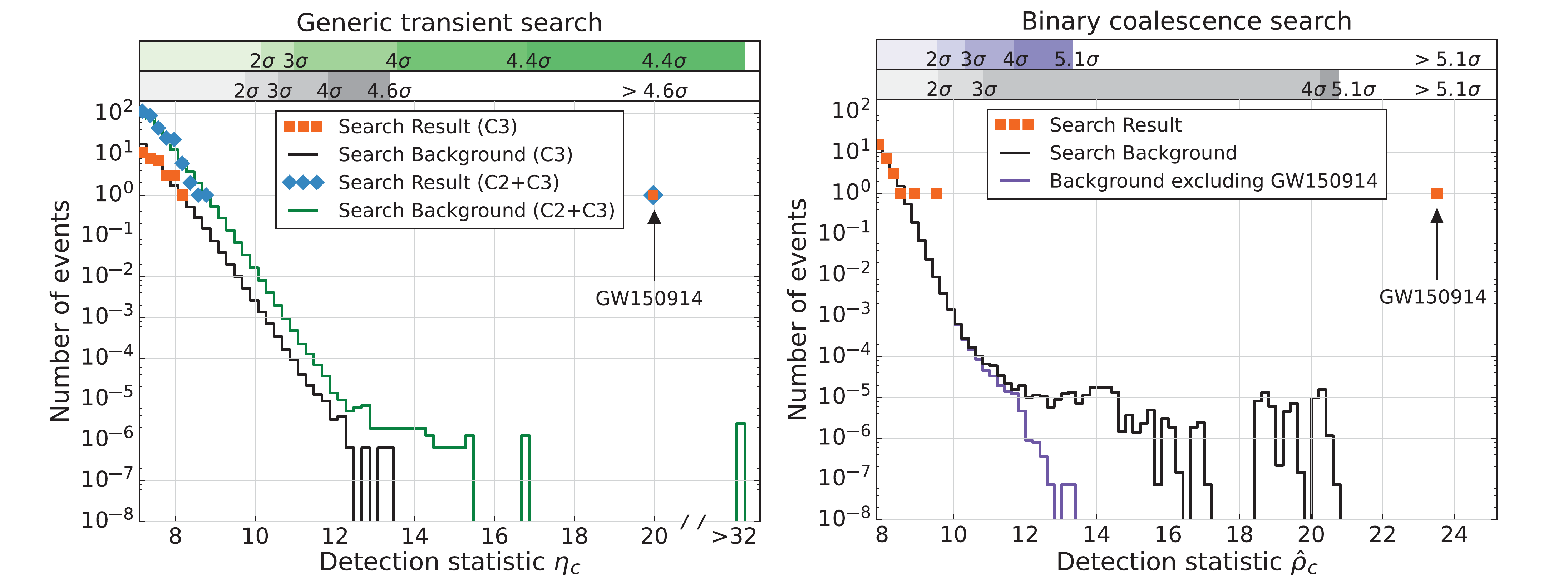
The figure above is the paper’s FIG. 4: background noise piles up on the left in both panels, while the September 14 signal sits alone on the far right, beyond anything the noise can reach. Two methods, two teams, no communication between them, both pointing at the same event, the same time, the same parameters. That is the hardest possible evidence that this was not an illusion.
With the numbers on the table, the story can move to the next question: now that the signal is real, what was it actually saying?
5. What It Said: 36 + 29 → 62, Three Suns of Mass Turned into Gravitational Waves
This is the “dossier” in Section VI “SOURCE DISCUSSION” and Table I.
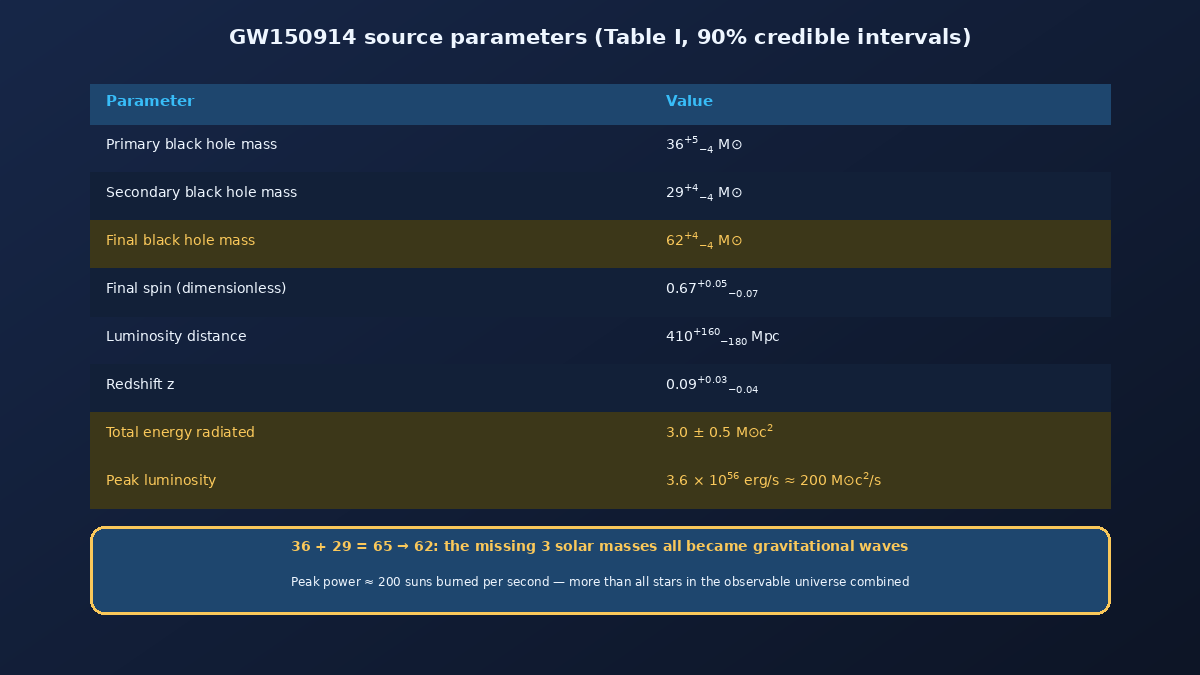
The numbers (median values with 90% credible intervals):
- Primary black hole mass: 36⁺⁵₋₄ M⊙
- Secondary black hole mass: 29⁺⁴₋₄ M⊙
- Final black hole mass: 62⁺⁴₋₄ M⊙
- Final black hole spin (dimensionless): 0.67⁺⁰·⁰⁵₋₀.₀₇
- Luminosity distance: 410⁺¹⁶⁰₋₁₈₀ Mpc, redshift z ≈ 0.09⁺⁰·⁰³₋₀.₀₄
- Total energy radiated in gravitational waves: 3.0 ± 0.5 M⊙ c²
- Peak gravitational-wave luminosity: 3.6 × 10⁵⁶ erg/s, equivalent to about 200 M⊙ c²/s
The most counter-intuitive number is that three solar masses. Add the two together — 65 — and only 62 remain after the merger. The missing three did not “vanish”; they were all radiated away as gravitational waves. At the peak, the system was pouring gravitational-wave energy into space at a rate equivalent to burning 200 suns per second. In that instant, the radiated power already exceeds the combined electromagnetic luminosity of all the stars in the observable universe (the stellar luminosity of the observable universe sits in the 10⁴⁵–10⁴⁶ erg/s range, so 3.6 × 10⁵⁶ is more than ten billion times larger).
Even more worth dwelling on is the “why it has to be black holes” reasoning in Section II. From the rate at which the frequency changes, one can extract a quantity called the chirp mass:
M = (m₁ m₂)³ᐟ⁵ / (m₁ + m₂)¹ᐟ⁵ ≈ 30 M⊙
That implies a total system mass of at least 70 M⊙ (in the detector frame). Any compact object’s Schwarzschild radius satisfies R_s = 2GM/c², so the two together must fit within at least 210 km. Use Newtonian mechanics for a back-of-the-envelope estimate: to reach an orbital frequency of 75 Hz (half the gravitational-wave frequency), two point masses orbiting at that frequency would be only about 350 km apart.
350 km is a counter-intuitively small number. The Sun itself would not fit inside it, and certainly two ordinary stars would have touched long before reaching that separation. Neutron stars, the dense ashes of dead stars, are small enough but not heavy enough — their combined mass would not reach 70 M⊙. A black-hole–neutron-star binary would be too massive in total and would merge at much lower frequency.
After sifting through every candidate, only one possibility remains: two black holes.
The paper also did one elegant thing alongside that: it cross-checked the late-stage ringdown of the waveform against the final black-hole mass and spin inferred from the early-stage inspiral. The two are consistent, and they match the Kerr black hole predicted by general relativity (described by just mass and spin). This is a textbook example of cross-validating the same data with different methods.
With the main story told, one tempting question remains: aside from “proving gravitational waves exist,” what else did this data hand us on the side?
6. The Bonus Haul: Strong-Field Tests of GR, an Upper Bound on the Graviton Mass, and Direct Evidence of a Binary Black-Hole Population
Section VI “SOURCE DISCUSSION” and the concluding section of the paper are essentially a “bonus list.”
Bonus one: tests of general relativity in the strong-field regime. For decades, every test of GR (Solar System, binary pulsars) sat in the weak-field, slow-motion regime. Gravitational waves push the test directly into a strong-field extreme — two black holes orbiting each other at half the speed of light and then colliding — a dynamical regime humanity had never reached before. The paper does three things:
- It uses fitting formulas calibrated to numerical-relativity simulations to verify that the final mass and spin inferred from the late inspiral are consistent with those inferred from the ringdown.
- It allows the post-Newtonian phase coefficients to deviate from the GR-predicted values and finds no significant deviation in the data.
- All three tests are summarized in one sentence: “all three tests are consistent with the predictions of general relativity in the strong-field regime of gravity.”
Bonus two: an upper bound on the graviton mass. If gravitational waves have mass (i.e., the graviton has a non-zero rest mass), different-frequency gravitational waves propagate at slightly different speeds in vacuum, and over 1.3 billion light-years of travel that leaves a measurable dispersion. The constraint the paper places is a Compton wavelength λ_g > 10¹³ km, corresponding to a graviton mass bound m_g < 1.2 × 10⁻²² eV/c². That bound beats Solar-System tests by factors of a few and beats the binary-pulsar indirect bound by a factor of a thousand, but it does not challenge the stronger, model-dependent bounds from galaxy-cluster dynamics and weak-lensing observations.
Bonus three: direct evidence for a binary black-hole population. Before GW150914, every confirmed black-hole candidate in astronomy had been found through electromagnetic observations (X-ray binaries). This paper is the first to directly see two stellar-mass black holes forming a binary and merging within a Hubble time. The merger-rate estimate the paper quotes is 2–400 Gpc⁻³ yr⁻¹ in the comoving frame, consistent with a broad range of theoretical predictions and ruling out only the most optimistic low-rate scenarios.
Of these three bonuses, the second is what I personally find most striking — because the graviton-mass bound is the cleanest single door to “physics beyond general relativity.” One number, unchallenged in any meaningful way for over a decade, is worth keeping in the back of your mind.
So what does this all mean for an ordinary reader who is not an astronomer?
7. What It Means for an Ordinary Reader: Gravitational-Wave Astronomy Has Opened, But Don’t Expect a Sky Full of Gravitational-Wave Telescopes Any Time Soon
Start with the most tangible point: gravitational waves give humanity a brand-new sense.
For thousands of years, every observation of the universe ran through the electromagnetic spectrum (visible light, radio, X-rays, …), and black-hole mergers happen to be “silent”: two black holes slamming into each other shine no light, no radio, no X-rays, so telescopes were doomed to see nothing. Gravitational waves let us directly “hear” black holes collide — the first time humanity has ever done so.
But do not get carried away. The paper gives some engineering realities:
- Between September 12 and October 20, 2015, the paper analyzes 16 days of coincident observation from the two detectors, and caught only this single high-confidence event; the full first observational period ran until January 12, 2016, and the paper explicitly leaves its complete results to future publications.
- The outlook section is restrained: Advanced LIGO is still being commissioned, and at design sensitivity a GW150914-like event will be detected with about three times the SNR; Advanced Virgo, KAGRA, and a possible third LIGO detector in India will extend the network and push source localization down from the current 600 deg² (90% credible region) to tens of square degrees, where the host galaxy can actually be pointed at.
- For the next three to five years, gravitational-wave events will still be “news-grade” events, not “daily occurrences.” Ordinary readers will keep hearing about a small number of individual gravitational-wave discoveries per year.
So what did I personally take away from this paper? Not the headline “gravitational waves were discovered,” but three things.
First, the matched-filter + dual-independent-search + quarter-million-template statistical recipe is the field’s paradigm for fighting “false positives.” Any research that claims a “new discovery” can be cross-examined by exactly this template: is what you saw just noise? How likely is it to be a coincidence? Have you cross-validated it with an independent method? GW150914 is the textbook of that cross-examination.
Second, the inference chain “from one figure to a 70-M⊙ object” is worth remembering for life. One strain time series, then chirp mass, then a Newtonian back-of-the-envelope, then a sieve of compact-object candidates, and out pops “must be black holes.” The whole chain runs without any prior assumption. That is the power of physical inference.
Third, this paper is a classic, not news. The 2017 Nobel Prize in Physics went to Weiss, Barish, and Thorne (history outside the paper; mentioned here only as background), and that settled the historical standing of GW150914. But for a reader today, what is worth reading is not the word “Nobel” but the way the numbers were nailed down — SNR 24, FAR < 1/203,000 years, 3.0 ± 0.5 M⊙ c², 62⁺⁴₋₄ M⊙ — each backed by years to decades of engineering, analysis teams of dozens, hundreds of thousands of templates, and hundreds of millions of Monte Carlo draws.
8. One-Sentence Takeaway
The biggest takeaway from this paper is that scientific discovery is not a flash of inspiration — it is compound interest on instrumentation, method, and patience. A hundred years ago Einstein wrote down the prediction; forty years ago Weber’s resonant bars came up empty; thirty years ago the laser interferometer was proposed; fifteen years ago initial LIGO finished its run with only upper limits to show. Only when Advanced LIGO pushed sensitivity to 3–5 times that of initial LIGO did GW150914 naturally land in both detectors simultaneously — that day was waited into being, not stumbled into.
The next time two black holes collide, LIGO / Virgo / KAGRA will be online. For the next paper in this series, we will pick something with a more restrained methodology — “how gravitational waves measure the Hubble constant” or “how gravitational waves test strong-field GR” — and break it down in more detail.
Original paper: PRL 116, 061102 (2016), arXiv:1602.03837, DOI: 10.1103/PhysRevLett.116.061102. The 2017 Nobel Prize in Physics was awarded to Weiss, Barish, and Thorne for their decisive contributions to LIGO and the observation of gravitational waves — that is history outside the paper, mentioned here only as background; all core numbers in this article follow the original paper. Every mass, distance, frequency, SNR, FAR, and year cited here has been cross-checked against paper-full.txt.