
Why a chimp’s joints shrug off a lifetime of abuse while ours wear out
The chimpanzees in zoos and sanctuaries never warm up, never brace their lower backs, never pick running shoes. They climb and leap through trees every day, their limbs load-bearing year-round, and their joints hold up for decades anyway. Humans sit at the opposite extreme: osteoarthritis is the most common bone disease in our species, with patients in the hundreds of millions. From middle age to retired athletes, everyone knows someone who has had a joint replaced. Same planet, same primate family, and joint durability differs by an order of magnitude. And no, this is not pampered domestication: wild apes are the same.
“Modern humans sit too much” doesn’t explain it away. By human standards, great apes are all heavy manual laborers. They don’t sit for a living, and their joints still don’t fail. The gap shows up across every kind of human society: manual workers, office workers, athletes. The degree varies; nobody is truly exempt. So the question naturally splits in two: what exactly did evolution change in us, and did those changes cheap out on our joints?
A Nature paper this year (Yan, Mishol et al., DOI 10.1038/s41586-026-11053-x) answers both. The method in one sentence: test every gene switch that differs between humans and apes, one by one; then read both species’ genomes inside shared cells so they compete on identical cellular ground; then dissect actual joint cartilage from both sides and assay the chemistry. This cold case has sat open in evolutionary medicine for a long time. Why do humans degenerate so easily? This is the first paper to put human and ape joint material on the same scale. What it found may change how you think about the question “is my bad back my own fault?”
The answer hides in a lump of shock jelly
Articular cartilage is a living tissue with no blood vessels and no nerves. It survives every impact on a water-swollen matrix. The workhorse of that matrix is a long sugar chain called glycosaminoglycan (GAG): it carries a heavy negative charge, pulls water in, and inflates itself until the whole cartilage is a waterlogged elastic pad. Think of it as a lump of built-in shock jelly in every joint. Every landing, every bend, it deforms and absorbs the hit.

The measurement is blunt: the ape species have roughly similar jelly levels, and humans overall have only about one third as much. Knee, hip, shoulder, elbow, wrist, fingers: check all eight joints one by one, and the direction is the same everywhere. And the way it’s missing is specific: not worn away, but turned down at the production end. The paper also knocks out the two easiest explanations along the way. Age and sex? Doesn’t line up. Use it more, wear it faster? Doesn’t line up either: high-load joints show the same drop as low-load joints.
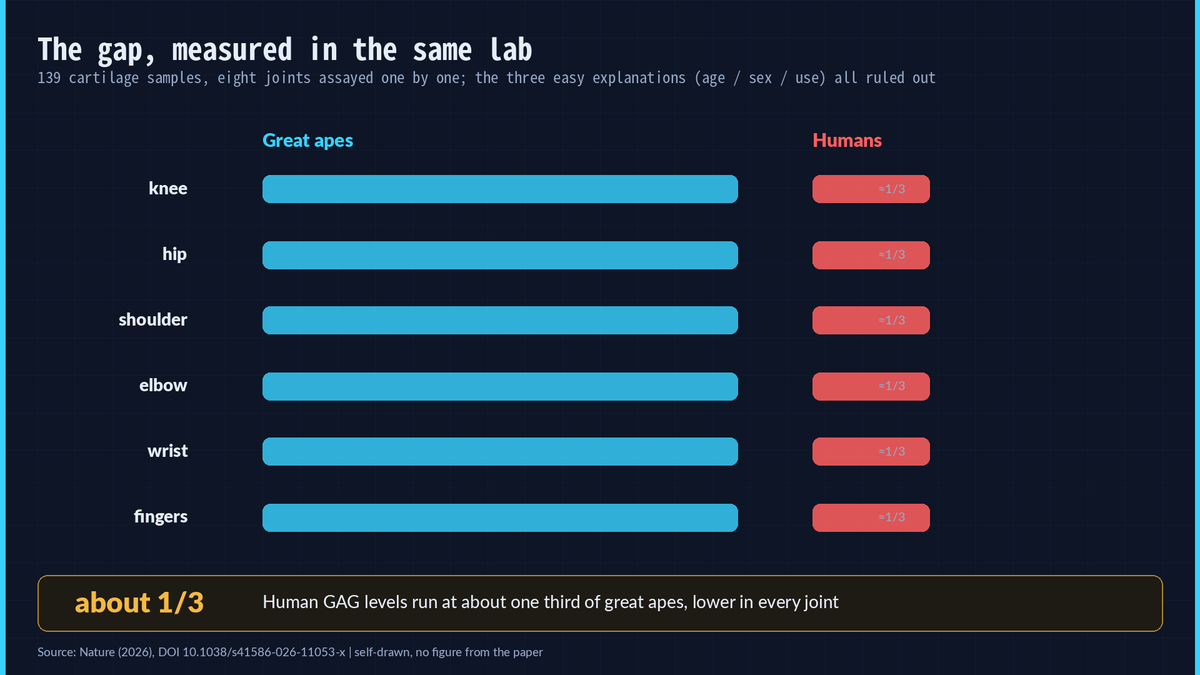
Do the arithmetic in human terms. The cartilage jelly of osteoarthritis patients is lower than that of healthy people, by a clear margin. But the human-ape gap that ordinary people are born with is even bigger than the patient-versus-healthy gap. From this, the authors infer that our species as a whole has been pushed to the edge of a vulnerability threshold: everyone is born with a baseline deficit, and joints are inherently more prone to degeneration.
Sit with the implication for a second. Your creaky knees, your bad back: you didn’t do anything wrong. It’s the factory setting of the species. It’s in the genes. People who have hurt for half their lives instinctively ask “was it my posture, was it the sitting?” and then dive into posture-correction courses, lumbar gadgets, and maintenance clickbait. This paper gives a more fundamental answer: on your spec sheet, the shock-jelly line item is discounted from birth. The problem is not your operation of the machine. This is not a license for laziness. It moves the fire from self-blame to strategy. If the config can’t be changed, only usage can be optimized, which is exactly what the next section is for.

Why would evolution turn the config down? The paper gives facts, not motives: these changes sit on the same genome as bipedal walking, lengthened limbs, and the explosion in brain size, and the signal from natural selection is mixed. No verdict. My reading is that evolution tunes global parameters and never optimizes a single item. The human skeleton was rebuilt wholesale over millions of years, and the joint subsystem got re-tweaked along with everything else. Some changes served the new body (walking upright freed the hands, and brain size ballooned); some were just collateral. And a deficit that only cashes out in middle age is almost invisible to selection. Evolution only watches performance up to reproductive age. A disease that strikes after forty? It simply doesn’t care. So don’t call it a defect. The accurate description: leftover old configuration from a body upgrade, like legacy settings that survive a major software version bump. Mostly harmless, until a specific environment starts pushing on it.
Two boundaries, so nobody reads this wrong. The ape side has seven individuals, so individual variation and species variation can’t be separated. And the causal link between “less jelly” and “more disease” currently rests on correlation plus supporting evidence; nobody has run the intervention experiment. None of this overturns the finding, but you should know it. The paper’s data and code are fully public, and anyone can re-run them. In the current climate, that alone earns an extra point. But don’t swing to the other extreme: factory settings do not mean guaranteed breakdown. The right way to read the threshold model is: everyone carries the deficit, and whether the disease shows up depends on what you stack on top of the baseline. Climb the same hill: one person is fine the next day, another has a swollen knee for a week. The difference stacks on these variables: body weight, muscle strength, old injuries, usage. And of the four variables, not one is genetic. That is the best news the threshold model gives ordinary readers: every variable can be intervened on. The worse your starting hand, the less you can afford sloppy play. Genes set your opening inventory, not your maintenance record. That is why the next section is the one that actually matters.
What desk workers can do for their joints (especially the lower back)
First, a boundary: this section is not from the paper. It is the common-sense layer of sports medicine, and the paper didn’t test a single exercise. But that is exactly how to use the previous section. Your safety margin is born thinner than a chimp’s, so every item below brings a bigger marginal return for you than it would for a chimp.
Why you must warm up and stretch before exercise. Cartilage has no blood vessels. Its nutrition depends entirely on a squeeze-and-rebound pump: the joint surface presses and releases, squeezing metabolic waste out and drawing nutrients in from the synovial fluid. On a cold start, that pump hasn’t spun up yet: tissue temperature is low, viscoelasticity is poor, and the same load is far more likely to cause micro-damage. A knee that hasn’t warmed up is asking cold jelly to take the impact directly. So warming up is not ceremony; it is lubricating the shock jelly. Five to ten minutes of dynamic movement gets the joint fluid pumping and body temperature up. Static stretching goes after exercise, not before, and don’t reverse the order: long static holds on cold tissue gain little range and can briefly blunt muscle output.
Why sitting all day hits the lower back first. Intervertebral discs and articular cartilage are the same family of material, and the core ingredient is that same jelly. Sitting loads the lumbar disc with clearly higher static pressure than standing, and slumping or leaning toward a screen pushes it higher still. Static pressure has almost no squeeze-and-rebound exchange, so the jelly stays evenly flattened for hours and gets no nutrition. On top of that, long hours of hip flexion tighten the front muscles and tilt the pelvis forward, which makes the mechanical environment of the lower back even worse. One fact to make it vivid: you are about a centimeter taller in the morning than at night, because the discs re-absorb water and rebound after a night of unloading. Flip that around, and every hour of daytime sitting is saving that shrinkage back up. Worse, the hardware has a nasty trait: cartilage has no nerves, so wear doesn’t send a repair ticket; it has no blood vessels, so it barely repairs itself. Joint degeneration is a silent process, and by the time it hurts, a good chunk of it has already happened. Prevention is worth more than treatment, and this is the root of it. For most office crowds, the lower back is the first domino to fall: it sits in the middle, carrying the upper body on top of it. That’s why this list calls out the lower back on its own.
The minimum list, for people who sit all day:
- Get up and walk for a bit every 30 to 45 minutes. Fetching a glass of water is enough. The point isn’t how far you walk; it’s breaking the constant static pressure. Stretch your hips while you’re up, and it’s even better.
- Train your legs and core two to three times a week. Muscle is an external cushion for your joints. It helps cartilage share the impact, which patches exactly the shortfall of the jelly. No fancy moves needed: planks and bird-dogs for the core, squats and lunges for the legs. Start with whichever you can already do.
- Add one to two low-impact cardio sessions a week. Swimming is the friendliest to the back: the water’s buoyancy unloads the pressure. Cycling comes next. Unsure about intensity? Pick the level where you still feel like training again the next day. If a joint feels swollen, you have gone over.
- A back can’t be protected by braces alone. Training core stability and hip mobility is the foundation of a healthy back. And get your screen and chair set up properly: don’t lean forward all day, don’t slump.
- Body weight is a multiplier. Going up or down stairs, your knees already carry several times your body weight, and squatting or kneeling is higher still. Taking the stairs less and losing weight are, for your knees, the same thing.

How to work the list. Don’t do everything at once; there is an order. If you sit a lot, do item 1 first: lowest cost, biggest payoff. Add the rest only after that one holds. Building muscle comes second, because it is the only one that thickens your external cushion. Cardio and chair setup are bonus points; get to them once the first two are stable. One sentence: stop the bleeding first, then add extras. And if you can’t do all five, that’s fine. Make the first one a habit, get up and move a few times a day, and you’re already ahead of most people who sit from morning to night.
Common misconceptions, worth clearing up along the way. First: “rest it when it hurts.” A few days off right after an injury is fine, but stay immobile for months and muscles atrophy, joint-fluid exchange gets worse, and the jelly pump nearly stops. For most chronic neck, shoulder, back, and leg problems, doctors actually advise regular movement. Second: “a knee or lumbar brace makes you safe.” A brace is borrowed support. Wear it long enough and the muscles get lazier; the stability you were supposed to train never gets trained, and taking the brace off becomes more dangerous than never wearing it. Third: worshiping ergonomics. No chair, however expensive, saves you from sitting still for three straight hours. However perfectly your gear is adjusted, it cannot replace that one minute of standing up.
For people who already have symptoms: this article’s job is to explain why you are prone. It is not a treatment guide. The bigger your congenital deficit, the higher the marginal return on levers like body weight, muscle strength, and load management. Leave the specific treatment to your doctor. And about those products on the market that claim to “replenish cartilage, replenish jelly”: the shortfall this paper shows is in production-side regulation, which sidesteps exactly these products’ target of topping up the stock. The clinical evidence for such products was never consistent to begin with. Buy them as a consumer decision, not an act of faith. None of the above is medical advice.
Back to the chimp from the opening. It never warms up, never wears a brace, because its jelly shipped at full spec. There is no deficit line on its config sheet, so it never needed to learn any of this. You are different. Every time you stand up and move, every proper warm-up, you are budgeting carefully against your discounted inventory. The factory config is out of your hands. The play is not. And about those bottles on the supplement shelf, remember the core finding of this article: your problem is not the inventory. It is the production line.