A relative’s kid — fourth grade, already at -3 diopters. His mother’s first instinct was “too much iPad.” Her second was to buy blue-blocking glasses. Both reactions felt obvious. But after reading a recent paper, I suspect both may be pointing in the wrong direction.
The paper was published in Cell Reports Medicine in September 2026, from a team at the University of Alabama at Birmingham and Cincinnati Children’s Hospital. Using a small mammal called the tree shrew, they found that a specific shade of indigo light completely prevented myopia from developing. That shade is almost entirely absent from the LED bulbs on your ceiling, and window glass filters out a chunk of it too.
The most immediate takeaway: the old advice to “take your kids outside” may work not just because of fresh air or exercise, but because sunlight carries a wavelength that indoor lighting has been missing for decades.
A Fact Unfolding Right Now: Not “Slowly Growing” but “Accelerating Out of Control”
Some numbers first.
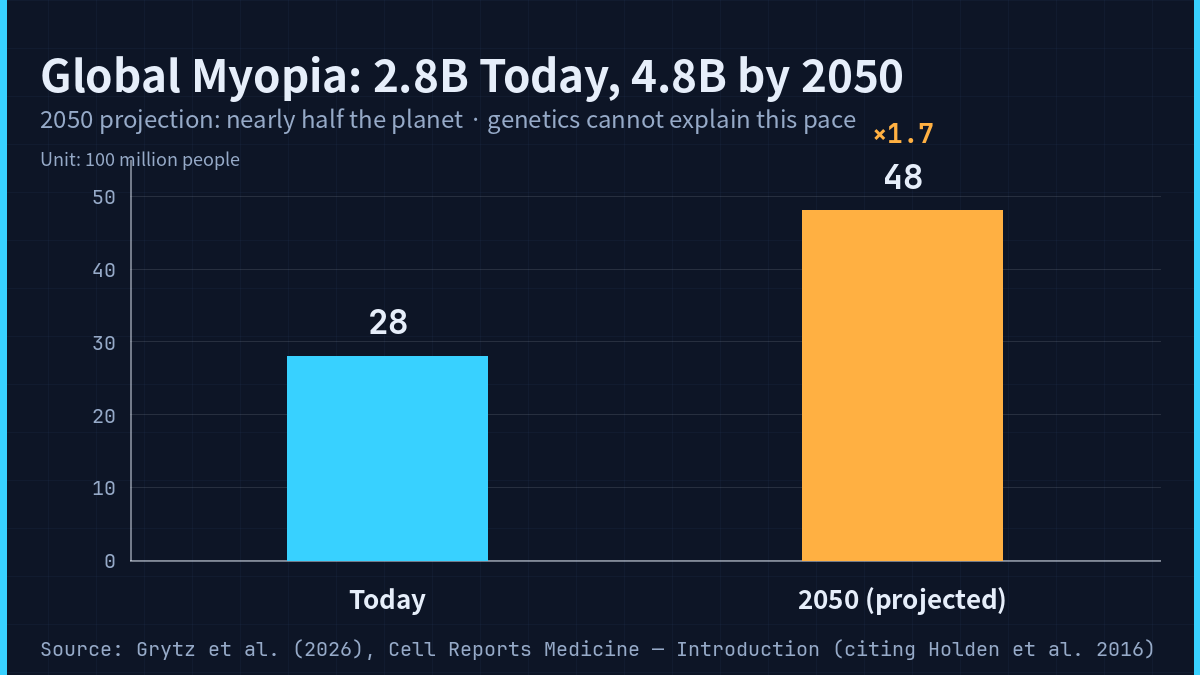
2.8 billion people are myopic today. By 2050 the projection is 4.8 billion — nearly half the planet.
Genetics alone cannot explain this pace. The human gene pool cannot have shifted that much in fifty years, yet myopia rates have multiplied. The paper points to an underappreciated factor: we spend 86 percent of our time indoors. Sunlight does not get in. Our eyes almost never see the full natural spectrum.
This suggests a counterintuitive possibility: maybe the problem is not just “screens for too long” but “indoor light itself is wrong.”
OPN5: A Sentinel in the Retina That Watches for Indigo
To follow the paper’s logic, you need to know about a protein called OPN5. Think of it as a sentinel stationed in the retina, tasked with detecting a very specific wavelength of light.
A decade of experiments in mice had already shown that ultraviolet light activates OPN5 and suppresses myopia. That was exciting — UV is everywhere, so prevention seemed straightforward.
But the team wanted to test this in an animal closer to humans. They chose tree shrews: small, day-active mammals closely related to primates, with eye development that mirrors ours. Tree shrews are a well-established model for myopia research.
The design was elegant. Fit young tree shrews with -10 diopter lenses to rapidly induce myopia. Then supplement their lighting with ultraviolet A and see if the sentinel responds.
It did not. UVA had zero effect. The myopia was completely unchanged.
My reading: This failure was more valuable than a success would have been. It forced the researchers to chase a specific question — where exactly did the light get stuck?
The Tree Shrew Lens: A Natural Filter That Blocks UV
The answer was in the lens.
In mice, the lens is transparent to ultraviolet light. UV passes through, reaches the retina, activates OPN5. But a tree shrew’s eyes open at around day 21, and by then its lens already works like a natural filter. It blocks ultraviolet light before it ever reaches the back of the eye.
This is essentially the same behavior as the human lens.
The team recalculated. Factoring in the lens’s filtering properties, the optimal wavelength to activate OPN5 shifted from 369 nanometers (UV range, optimal in mice) to 435 nanometers — deep in the indigo range.
In the paper’s words: “the optimal LED peak wavelength for retinal OPN5 stimulation in the mouse versus juvenile tree shrew are distinct (369 nm for mouse and 435 nm for juvenile tree shrew).”
My reading: UV failed precisely because it took the wrong path. The right path was a different color. The logic chain here is not “indigo is good” — it is “UV does not work → chase the reason → find the lens blocks it → calculate what wavelength gets through.” The most convincing discoveries in science are often the ones that failures force into the open.
Indigo Light at 419-446 nm Completely Prevented Myopia
The critical experiment arrived next.
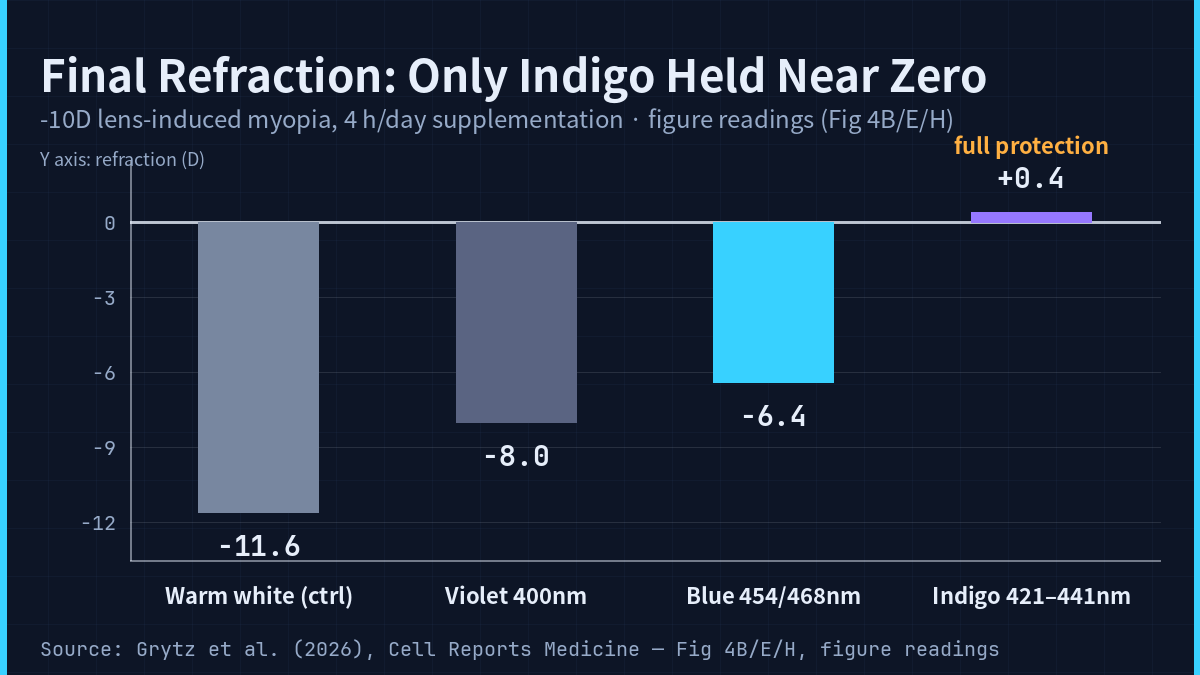
Each lens-wearing tree shrew received supplemental narrow-band light at different wavelengths — violet (400 nm), blue (454/468 nm), and indigo (421/432/441 nm) — four hours a day.
The results were unambiguous:
- Under warm white light alone, refraction plummeted to roughly -11.6 diopters — over a thousand degrees of correction
- With indigo supplementation (421/432/441 nm), refraction held at 0.4 diopters, nearly identical to healthy controls
- Violet (400 nm) gave only partial protection, shifting from -11.6D to about -8.0D
- Blue (454/468 nm) was similarly weak, settling around -6.4D
More importantly, indigo did not just stop the refractive shift — it completely suppressed the exaggerated eye elongation that drives myopia. The protection was structural, not cosmetic.
The effective window landed at 419-446 nanometers, the upper quartile of OPN5’s sensitivity curve. In the paper’s language: “short wavelengths in the indigo range of 419-446 nm are the most effective.”
My reading: Not all short-wavelength light works. Violet, blue, and indigo sit next to each other on the spectrum, but their effects differ by several fold. Indigo is special because its wavelength falls right at the peak of the sentinel’s sensitivity — a key fits a lock, and indigo is the right key.
One-Fifth the Dose, Full Protection
The team then ran a stress test. They cut the indigo intensity to one-fifth (from 250 to 50 μW/cm²/nm) and reduced exposure to just one hour per day.
Full protection still held.
Unlens control eyes under low-dose indigo showed almost no additional effect — meaning the dose window is wide. You do not need a lot. You just need enough.
My reading: This finding matters enormously for real-world feasibility. If the effective dose were so high that it required hours of exposure, there would be no practical application. But low doses work too, which means supplementing indigo in ordinary indoor lighting is, at least in principle, an engineering problem rather than a fantasy.
A Classroom Delivers 41 Times Too Little
Now shift from the lab to where your child spends most of the day — a classroom.
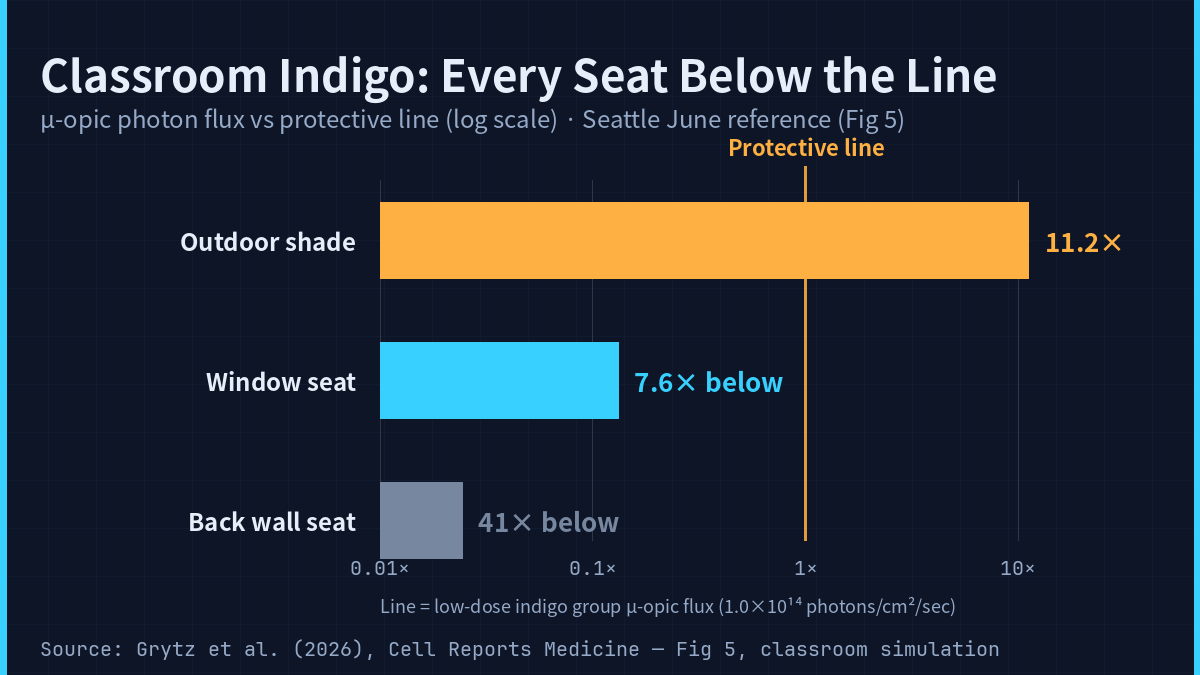
The team simulated classroom lighting and benchmarked it against real outdoor sunlight in Seattle. They drew a line at the minimum indigo level known to be protective: a μ-opic photon flux of 1.0 × 10¹⁴ photons·cm⁻²·sec⁻¹.
The results:
- Outdoor sunlight (Seattle, June, in shade): 11.2 times the protective line — more than enough
- Window seat indoors: 7.6 times below the protective line
- Back wall seat indoors: 41 times below the protective line
- Same classroom, window vs. back wall — a roughly five-fold gap in protection
The most painful data point: a warm white LED in the classroom delivers 326 photopic lux — perfectly adequate for reading. But its indigo content (1.28 × 10¹³) falls far short of what is needed. Only after adding supplemental indigo to that same LED does it meet both visual and protective requirements simultaneously — μ-opic rising from 1.28 × 10¹³ to 5.97 × 10¹³.
My reading: This is the number that shook me most. “Bright enough” and “spectrally adequate” are two completely different things. Our entire evaluation framework for indoor lighting — lux, color temperature, color rendering index — does not account for indigo content at all. Your living room LED might be 4000K, Ra 95, 500 lux, and look “perfect,” yet deliver essentially zero indigo light.
Blue-Blocking Glasses: You May Have Paid to Block the Light That Was Helping
This brings up a product you may have bought for your child.
Blue-blocking glasses filter short-wavelength light. That is the selling point.
But indigo light is short-wavelength light.
The authors explicitly hypothesize in the paper: “Because short-wavelength-attenuating (‘blue-blocking’) spectacles reduce indigo light transmission to the eyes, widespread daytime use in children could plausibly increase the risk of myopia.”
Note the language — this is a hypothesis, not a proven conclusion. The paper frames it as one of several “testable predictions with translational implications.” It needs human studies to confirm.
But the logic has a concrete anchor: blue-blocking glasses filter a wavelength range that covers the 419-446 nm indigo window. If indigo light is indeed protective, daytime blue-blocking is filtering out the good stuff.
My reading: Several parents I know bought blue-blocking glasses for their kids, reasoning it would “protect their eyesight.” If this hypothesis is eventually confirmed in humans, they will have spent money to protect nothing. I am not ready to draw that conclusion without human data. But it is worth reconsidering whether daytime blue-blocking — indoors or outdoors — makes sense for children.
Restate the Logic Chain, Then Challenge It
Let me pause here.
The paper tells this chain: sunlight contains indigo → indoor lights lack it → the OPN5 sentinel gets no signal → the eye elongates too much → myopia develops. In tree shrews, supplemental indigo light completely prevented myopia. The chain is internally consistent.
But you are probably already thinking of objections. So am I.
Tree shrews are not humans.The paper says so itself: “Though this is a valuable experimental model, it does not fully mimic the natural history of myopia development and progression in humans.” Indoor lifestyles involve screen time, genetics, and factors that a tree shrew experiment cannot address.
The study was not blinded.Investigators knew which group each animal belonged to. The paper states this frankly: “Investigators were not blinded to allocation of animals during experiments and outcome assessments including refractive and axial measurements.” Although refraction and axial length are objective instrument measurements, informed allocation can still introduce bias.
Conflicts of interest.Lead researchers R.G. and R.A.L. hold pending patents on related lighting technology. R.G. is also the founder and CSO of Electric Indigo, a UAB startup commercializing this research. These conflicts are not a scandal — the paper passed peer review at Cell Reports Medicine, and the authors disclosed everything voluntarily. But before you make any decisions, you need to know them.
Is the human lens really the same as the tree shrew lens?The paper cites multiple studies showing that the human lens also does not efficiently transmit wavelengths below 400 nm, with age-dependent changes that parallel the tree shrew’s developmental pattern. But “similar” is not “identical” — the precise filtering properties of the human eye still need direct measurement.
My reading: These limitations together mean the paper proposes a high-quality hypothesis, not a validated prevention strategy. But a high-quality hypothesis has value in itself — it offers myopia research a genuinely new angle, with every step supported by experimental data rather than speculation.
Three Things to Remember
Remember the question we started with? Is myopia really about screens?
This paper points in a new direction: maybe we should also look at our lights and ask what color is missing.
First, take your kids outside more. Sunlight is rich in indigo light, and it is free. This is the simplest protection available today, backed by multiple human epidemiological studies (He et al. 2022 school RCT, Xiong et al. 2017 meta-analysis, and others supporting outdoor time as protective against myopia).
Second, when choosing indoor lighting, spectrum matters more than brightness. A bright warm white LED looks fine, but its indigo content falls far short of protective levels. If you care about your children’s eyes, look for bulbs that include the indigo range. The paper’s “warm white LED + low-dose indigo” combination meets both visual and protective needs — that may be a glimpse of where lighting technology is headed.
Third, blue-blocking glasses are not necessarily harmless. They may filter out beneficial indigo light. Daytime use in children deserves a second look.
This is an animal study proposing a hypothesis, not a proven prevention strategy. But the direction — that indoor lighting has a spectral blind spot — is worth watching closely.
Paper DOI: 10.1016/j.xcrm.2026.102999, published in Cell Reports Medicine, September 2026.