
Short title (for platforms with tight limits): A Diploma Doesn’t Prove Ability — It Proves You Could Afford the Proof
Last year, a friend of mine failed the graduate school entrance exam for the second time and said something that stuck with me: “I feel like my bachelor’s degree is worthless.”
I couldn’t argue. Around me, plenty of people with decent degrees are working jobs completely unrelated to their major, earning no more than people without degrees. The weirder part: everyone keeps sprinting toward higher credentials — bachelor’s not enough, get a master’s; master’s not enough, get a PhD — while the job market’s credential bar rises in lockstep. Everyone spent two or three extra years in school, yet nobody ended up earning more.
What is going on?
I brought that question to a 1973 economics paper. The author, Michael Spence, was writing his doctoral thesis at Harvard at the time. He published it as “Job Market Signaling” in The Quarterly Journal of Economics (DOI: 10.2307/1882010). Thirty years later, the paper won him the 2001 Nobel Prize in Economics (shared with George Akerlof and Joseph Stiglitz).
My biggest takeaway was not “degrees are useless.” Quite the opposite — I finally understood why degrees keep losing value yet everyone is still forced to chase them.
The Employer’s Blind Spot: They Can’t See Your Ability
Before diving into Spence’s model, picture a scene.
You’re an HR manager with two resumes on your desk. Different universities, everything else roughly similar. You have to decide what salary to offer each candidate in the span of a short interview. The problem is that a person’s real productivity — how much value they create for the company each month — only becomes apparent after they start working. During those thirty minutes of conversation, you can’t see it.
Spence put it bluntly: “the employer is not sure of the productive capabilities of an individual at the time he hires him” (P4/QJE 356).
This is the same dilemma as buying a used car. The seller knows the mileage, the repair history, whether the engine has been overhauled. All you can see is whether the paint is shiny. Economists call this “information asymmetry” — one party knows far more than the other.
So here’s the question: if employers can’t see ability, how do they set your price?
Signals vs. Indices: Only What You Can Change Counts
Spence drew a crucial distinction.
He split observable human characteristics into two categories. The first he called “indices” — things you’re born with and can’t change, like race, sex, and age. Employers can see these, but you can’t invest in altering them. The second he called “signals” — characteristics you can choose to invest in. Education is the prime example.
The defining sentence: “I shall refer to observable, unalterable attributes as indices, reserving the term signals for those observable characteristics attached to the individual that are subject to manipulation by him.” (P5/QJE 358)
Why does this matter? Because signals have a special property: they can be purchased.
You can’t spend money to change your race or sex, but you can spend money and time to earn a degree. And what makes education work as a signal, Spence argued, is not what it teaches you — it’s that it costs you time and money.
This was counterintuitive enough. But then Spence did something even bolder — he linked education cost to ability.
The Core Assumption: Smarter People Find School Cheaper
Spence simplified the world into two groups.
Group I is average-ability workers. Each person generates 1 unit of value per month for the company (the voice script translates this into everyday terms as ten thousand yuan monthly). Getting a diploma costs them 1 unit — tuition, effort, the whole package.
Group II is high-ability workers. Each generates 2 units per month. But the same diploma costs them only half as much — 0.5 units — because they learn faster, pass exams on the first try, never need to repeat a course.
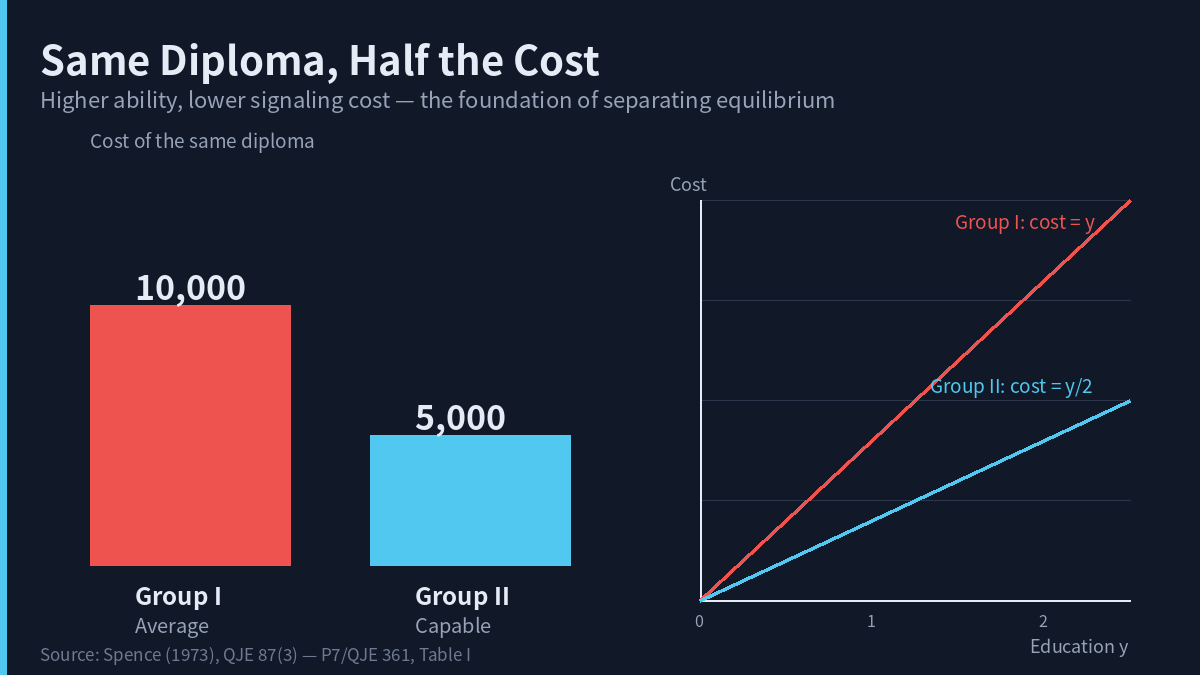
This cost difference appears in the paper’s Table I (P7/QJE 361): Group I cost = y, Group II cost = y/2.
I need to pause here because this is the foundation of the entire model, and the easiest part to misread.
This is not something Spence “discovered.” It’s an assumption he built into the model. He himself called it a “Critical Assumption” (P6/QJE 358). Whether education costs are actually higher for low-ability workers in the real world is a question the paper doesn’t answer — decades of follow-up empirical research have produced mixed results. But as a theoretical model, the assumption is clean enough to yield a striking conclusion.
What can that foundation support? Read on.
Separating Equilibrium: One Line Sorts People into Two Queues
Here’s where the model gets interesting.
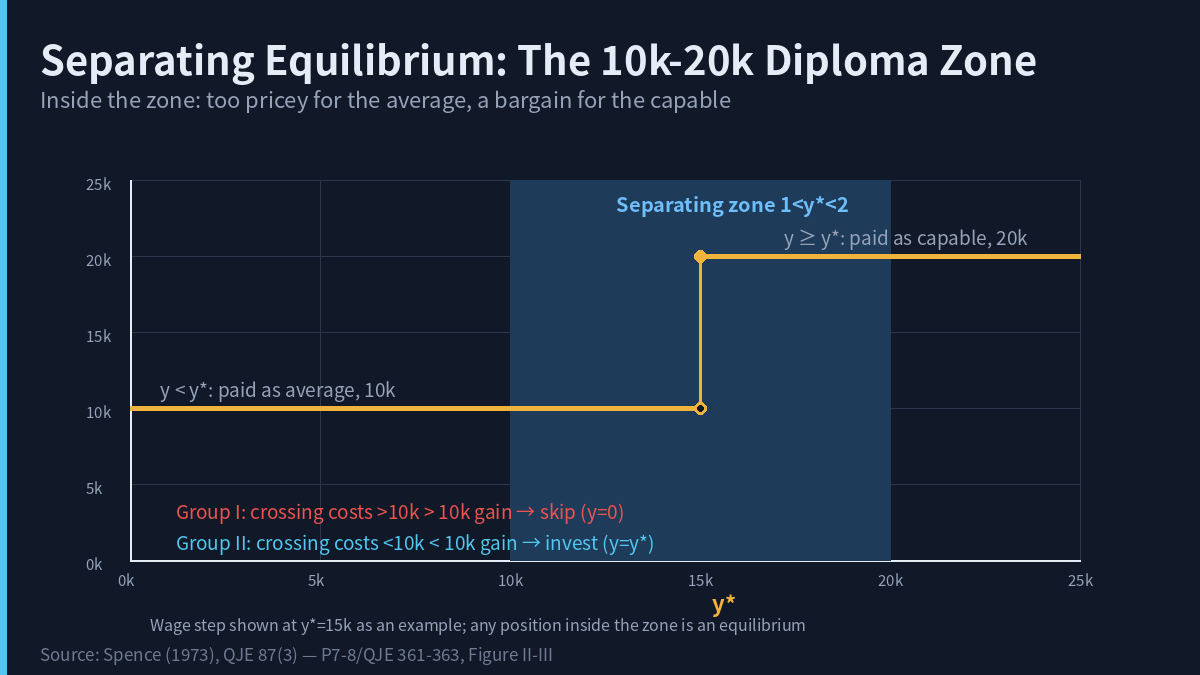
Spence imagined the employer drawing a threshold in their head, labeled y*. If your diploma falls below that line, you’re judged as average and paid 1 unit. If your diploma reaches or crosses the line, you’re judged as high-ability and paid 2 units.
Where should the line be drawn?
Everyone runs the same calculation. The average worker thinks: crossing the line raises my pay from 1 to 2 — a gain of 1 unit. But the diploma costs me more than 1 unit. Not worth it. So they skip it — set y = 0.
The capable worker does the same math: the diploma costs me only 0.5 units, well below the 1-unit pay bump. Worth it. So they invest.
Spence proved that as long as the diploma’s “price” sits between 1 and 2 (the everyday translation: between ten and twenty thousand yuan), the two groups automatically sort themselves into separate lines. The mathematical condition is 1 < y* < 2 (P8/QJE 363). The average worker finds it too expensive; the capable worker finds it a bargain.
He called this a “separating equilibrium.” And within that zone, the employer can set the line anywhere — at 1.2 or at 1.8 — and the sorting still works. The equilibrium is not unique; there’s an infinity of them (“there is an infinite number of equilibria,” P8/QJE 363).
My reading: this was the first time I understood why the “elite school effect” is so powerful. It’s not necessarily because elite schools teach better material. It’s because elite degrees are expensive (gaokao threshold + tuition + four years), and they naturally function as a filter. Employers don’t need to understand your actual ability — they just need to see whether you could “afford” the credential.
The paper adds a critical caveat: if both groups face identical education costs (say, both pay y), signaling breaks down entirely. High-ability and low-ability workers have the same incentive to invest, so employers can’t distinguish anyone by looking at their diploma (P6/QJE 358). This “costs must differ” condition later became known as the “single-crossing property” — the mathematical bedrock of signaling theory.
Everyone Can End Up Worse: The Pareto-Inferior Equilibrium
By this point you might think signaling makes the market more efficient — the capable get paid more, the average get paid less, and everyone lands where they should.
Spence showed the opposite.
Start with a baseline. If the diploma system didn’t exist at all, the employer couldn’t tell anyone apart and would pay everyone the population average. Suppose the two groups are split evenly (q1 = 0.5). The average comes out to 1.5 units per month for everyone.
With signaling, average workers are locked out of the 2-unit wage. They earn just 1 unit. Clearly worse off.
Capable workers see their gross wage rise to 2 units. But don’t forget — they paid for the diploma first. Spence calculated that when the two groups are evenly split, capable workers’ net income after the signaling cost falls below 1.5 units (P8/QJE 364).
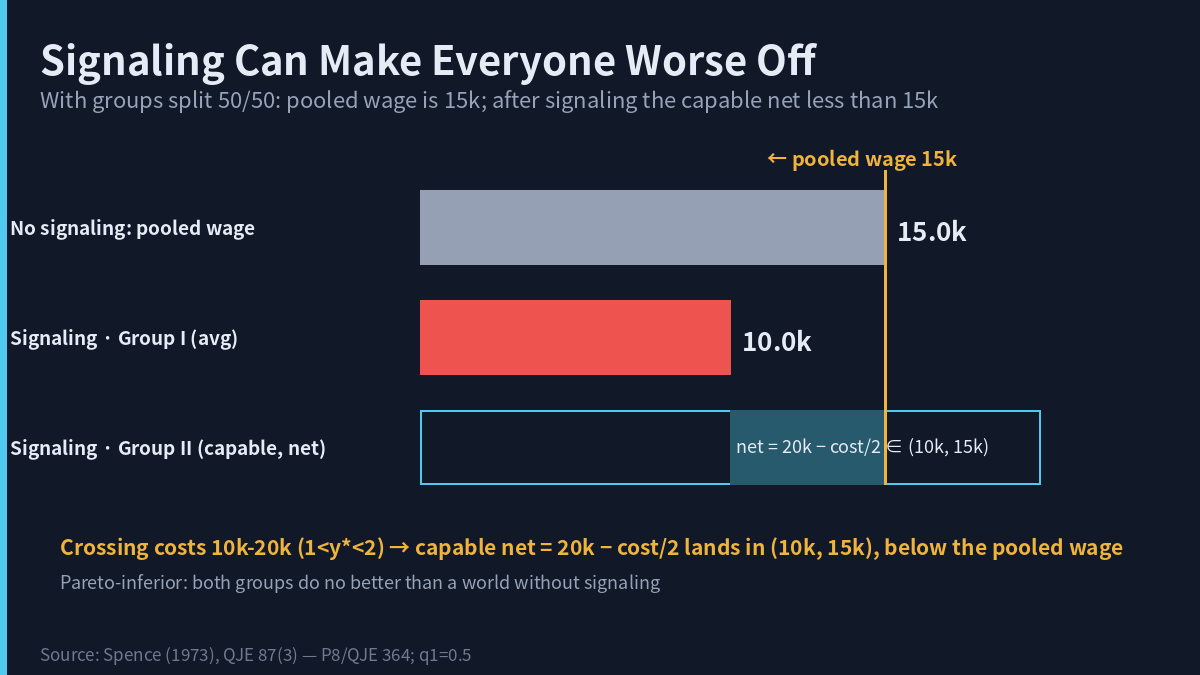
Lower than when everyone simply earned the average.
This is a Pareto-inferior equilibrium — signaling makes everyone (at least under these specific parameters) worse off.
The sting: Spence pointed out that raising the credential bar doesn’t improve sorting quality one bit — “Increases in y* improve the quality of the sorting not one bit. They simply use up real or psychic resources.” (P9/QJE 364-365). Everyone spends more time and money chasing higher degrees, but the market doesn’t sort anyone more accurately. It’s pure social waste.
My reading: This is where I thought of the graduate school arms race. In the signaling framework, this isn’t “wasteful competition” in the colloquial sense — it’s a self-sustaining equilibrium baked into the signaling mechanism itself. When every college graduate floods the market, the bachelor’s degree stops conveying information (signaling theory calls this a “pooling equilibrium”), and employers start looking at master’s degrees, school rankings, and internship experience. But Spence’s conclusion is that raising the bar doesn’t improve sorting. Everyone invests more; nobody gets sorted better.
One crucial caveat: “education doesn’t improve productivity” is a model assumption, not a finding. Spence’s exact words are “in this example, it does not increase his real marginal product at all” (P8/QJE 364) — under the extreme scenario where education is pure signal. In reality, education can do both: teach you real skills and signal your ability to employers. The signaling vs. human capital debate in economics is still open.
Gender Asymmetry: Same Diploma, Different Price
In Section 6, Spence did something remarkably forward-thinking. He put gender into the signaling model.
Assume men and women have identical productivity. But their signaling equilibria can differ.
He worked out a concrete example (P15/QJE 371-372): for equally capable people, if the threshold for men sits at yM = 1.1, the threshold for women reaches yw = 1.9. That means a high-ability woman must spend roughly seventy percent more on education to earn the same market recognition as a man.
This isn’t because employers are prejudiced — the model assumes they’re perfectly rational. The root cause is the market’s information structure itself: when group labels (gender) shape an employer’s conditional probability judgments, signaling costs automatically become asymmetric.
The paper states it plainly: “The source of the signaling and wage differentials is in the informational structure of the market itself.” (P17/QJE 372)
Spence called this a “lower level equilibrium trap” — once it forms, it persists without needing external bias to sustain it. His words: “once achieved, persists for reasons endogenous to the model” (P18/QJE 373-374).
My reading: This section gave me a new angle on discrimination. I used to think discrimination comes from prejudice — someone dislikes a group and pays them less. But Spence showed a subtler mechanism: even when nobody carries any prejudice, the market’s information structure alone (group labels affecting employer judgments) can generate asymmetric signaling costs across groups.
To be clear, this is a theoretical model demonstrating what informational structures can produce, not an empirical claim about real-world wage gaps. Section 6 discusses mechanisms that generate differences, not “the reason women earn less is signal discrimination.”
Pooling Equilibrium: When Diplomas Stop Talking
Separating equilibrium isn’t the only possibility. Spence also analyzed another outcome: the pooling equilibrium.
When does pooling happen?
First scenario: the diploma is so expensive that even capable workers find it not worth the cost. Nobody gets one. The diploma disappears from the market, and employers can only guess from population ratios. The pooling condition is y* > 2q1 (P10/QJE 366). Spence’s words: “Education conveys no information in this type of equilibrium.”
Second scenario runs in reverse: the diploma is so cheap that everyone grabs one — one per person. But then a diploma tells you nothing, because holders and non-holders look identical to the employer.
You might think this doesn’t apply to you. But think about today’s “credential inflation.”
When everyone has a college degree, the degree stops differentiating anyone. Employers start looking at graduate degrees, school rankings, internship experience, certification counts. That’s signal escalation, driven by pooling dynamics.
This is the underlying logic behind the graduate school race and the certification craze. It’s not because graduate students necessarily learn more useful material than undergraduates — it’s because the undergraduate degree has ceased to be an effective signal. The market forces everyone to seek more expensive, scarcer credentials.
Five Things You Should Watch Out For
First, “education doesn’t improve productivity” is a model assumption, not a conclusion. Spence himself said “in this example.” In reality, education does two things at once: teach you real skills and signal your ability. These two functions aren’t contradictory.
Second, the signaling vs. human capital debate is empirically unsettled. Decades of follow-up research (Lang & Kropp 1986, Tyler et al. 2000, Hungerford & Solon 1987, and others) have produced mixed results. Neither side has won decisively.
Third, the paper contains zero empirical data. It’s a 1973 pure theoretical model. All numerical examples are hypothetical. Spence admitted as much: “Obviously, an example does not prove generality.” (P4/QJE 361, footnote 2)
Fourth, the model has boundaries. Spence acknowledged it applies only to markets where “signalers appear with relative infrequency” (P19/QJE 374). Markets where consumers make frequent purchases (clothes, phones) don’t fit neatly.
Fifth, the paper ends with seven unanswered questions (P18-19/QJE 374), signaling that the framework was just the beginning. The existence of signaling equilibria, selection among multiple equilibria, interaction with discrimination policy — these remain active research areas today.
What This Paper Can Do For You
Back to the opening question: why do degrees keep losing value, yet everyone is still forced to chase them?
Spence’s signaling model offers a self-consistent explanation.
Degrees are losing value not because educational quality has declined (though it may have), but because too many people have them. When everyone holds a bachelor’s, the bachelor’s stops conveying information — it degrades from a “signal” into an “index” (something you can’t afford to lack, but that having it doesn’t help). Employers are forced to seek costlier signals (master’s, elite schools, internships), everyone is forced to invest more, but sorting quality doesn’t improve.
This cycle won’t stop on its own. Because each individual’s optimal strategy is still “invest more in signals” — if you don’t get the graduate degree and your competitor does, you get tagged as “low ability.” This is the self-sustaining nature of signaling equilibrium.
But this doesn’t mean education is worthless. Spence’s model demonstrates the extreme case of “pure signal.” Real-world education serves both human-capital accumulation and signal transmission simultaneously. The question isn’t “should you get educated” — it’s whether you’re investing in real skills or just buying a more expensive proof.
Next time you fill in your education on a resume, ask yourself: what exactly are you trying to prove?
References
Spence, M. (1973). Job Market Signaling. The Quarterly Journal of Economics, 87(3), 355-374. DOI: 10.2307/1882010