
The harder your boss measures you, the faster the unmeasured parts of your job die — and economists can prove it’s not a bug, it’s math.
I. The KPI Distortions Around Me
A friend works in operations at an internet company. Their team’s KPIs are just two metrics: daily active users (DAU) and time spent per user. So what happened? The ops team bombards users with push notifications, pop-ups, and hooks to drag them in. DAU goes up. Time spent goes up. But retention, satisfaction, and long-term value all tank. The boss sees the dashboard and smiles, while the product’s reputation craters.
Another friend is a high school teacher. The school only cares about college admission rates. So all effort pours into test prep. Math thinking classes, science experiments — all compressed. Students score high on exams, but freeze when they see novel problem types. They learned to solve test questions, but never learned to think.
You might call this management failure — bad KPI design. But in 1991, two economists wrote a paper showing it’s not failure; it’s mathematical inevitability. When you boost incentives on measurable tasks, unmeasured tasks shrink. Sometimes the optimal contract is a flat salary with zero incentive.
That paper is Bengt Holmström and Paul Milgrom’s “Multitask Principal-Agent Analyses: Incentive Contracts, Asset Ownership, and Job Design,” published in the Journal of Law, Economics, & Organization, Volume 7, Special Issue. On October 10, 2016, the Nobel Prize in Economics was announced — Holmström shared it with Oliver Hart. The citation: contributions to contract theory. This 1991 paper is one of the foundational texts of contract theory.
Today, I’ll unpack the core mechanism of this paper, show how it explains the KPI distortions we see around us, and explore what it means for managers, workers, and organizational design.
II. The Hidden Assumption in Standard Theory
Economics textbooks have said it for decades: stronger incentives mean harder work. Commission beats salary. Bonuses beat flat pay. Pay for performance, people perform.
But walk into any large firm. Executives get a fixed salary with a modest bonus. Engineers get monthly pay. Administrative staff get monthly pay. Compared to independent contractors, incentives inside firms are strikingly weak.
The paper opens with this puzzle: if strong incentives work, why do companies barely use them?
Standard theory’s explanation: workers are risk-averse. Strong incentives force workers to bear too much risk, so incentives must be weakened. But this explanation is incomplete — even when risk is irrelevant, firms still prefer weak incentives.
The answer hides in an assumption standard theory ignores: you only do one thing.
Standard theory assumes the agent (worker) performs a single task. The principal (boss) designs an incentive contract based on that task’s output. But in reality, you juggle many things at once.
Teachers teach reading skills and critical thinking. Engineers write code and maintain systems. Salespeople close deals and build relationships.
Your boss measures some of this — test scores, lines of code, revenue — but not the rest. Thinking quality, code maintainability, client trust — these are invisible to the incentive system.
This is the paper’s core setup: agents perform multiple tasks, principals observe only some dimensions. What happens when you tie incentives to only the measurable ones?
III. Your Energy Is a Fixed Pie: The Crowding-Out Mechanism
Key assumption: your energy is a fixed pie. Cut a bigger slice for one task, the others shrink.
The paper formalizes this as “substitutable effort.” Specifically, the agent chooses an effort vector t = (t₁, …, tₙ) with cost function C(t). When you increase t₁, the partial derivative C₁₂ > 0, meaning more effort on task 1 raises the marginal cost of task 2.
So when you raise incentives on the measurable task —
the agent shifts effort away from the unmeasured one.
Teachers drill test prep, stop leading discussions. Programmers pad line counts, skip documentation. Salespeople chase deals, abandon relationships.
The numbers go up. But teaching quality, code maintainability, client trust erode. And those invisible parts are often more valuable.
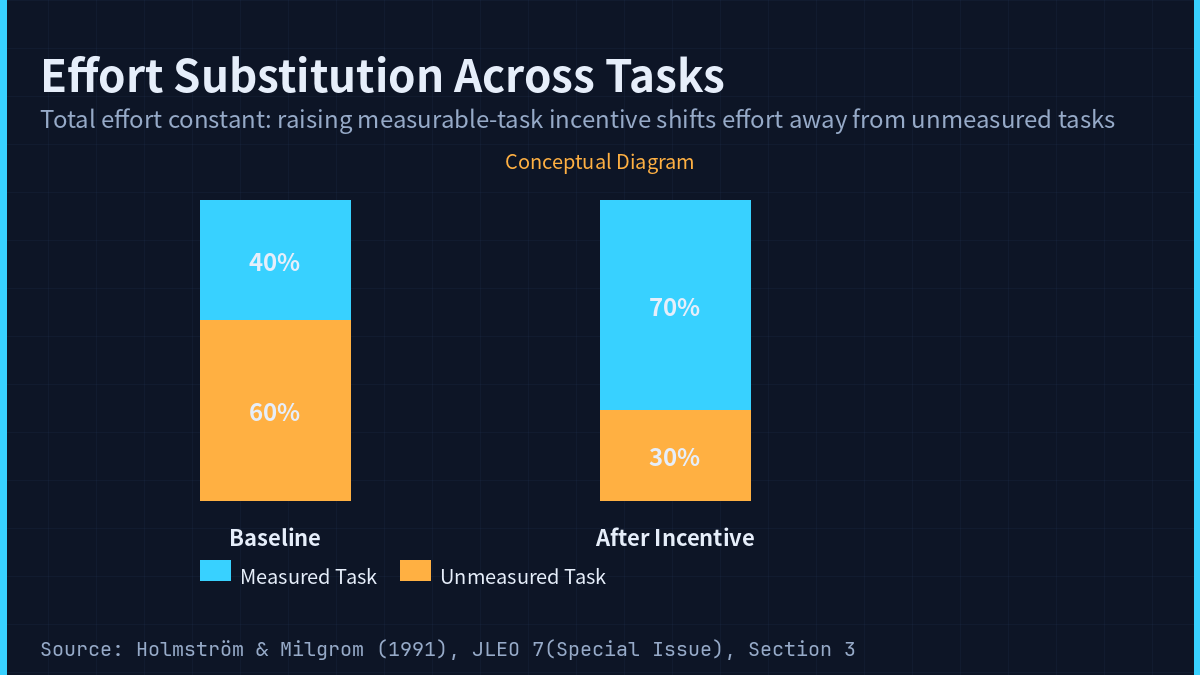
Figure fig01 illustrates this mechanism: total employee effort stays constant. When incentives on the measurable task increase, its share rises while the unmeasured task’s share falls. This is a conceptual diagram, but the paper’s mathematical model proves it rigorously.
IV. The Fixed-Wage Puzzle: Propositions 1 and 2
You might say: that’s just because workers fear risk. Risk-neutral workers should be fine with strong incentives.
Proposition 1 says no.
Even when the agent is risk-neutral, if the unmeasured task matters enough, a fixed wage with zero incentive is optimal.
Why? Because risk neutrality means no conflict between “incentive” and “risk-bearing.” The distortion comes entirely from effort substitution. Raise the measurable incentive, the unmeasured task still gets crowded out. So the optimal strategy: zero incentive, let the agent balance tasks freely.
Proposition 2 compares employment to independent contracting.
Employees do many unmeasurable things — maintaining assets, serving clients, team collaboration. Independent contractors own their assets. Asset appreciation belongs to them.
When unmeasurable contributions like asset maintenance are important enough — more valuable at the margin than the measurable task itself — the employment contract’s optimal incentive is necessarily zero: a flat wage. Strong incentives would pull employee effort away from those invisible contributions.
The independent contractor’s optimal incentive is high-powered — commissions. Because the assets are his. Ownership itself is the incentive. No additional performance pay needed.
That’s the answer. Not that managers don’t understand incentives — employees have too many unmeasurable dimensions.
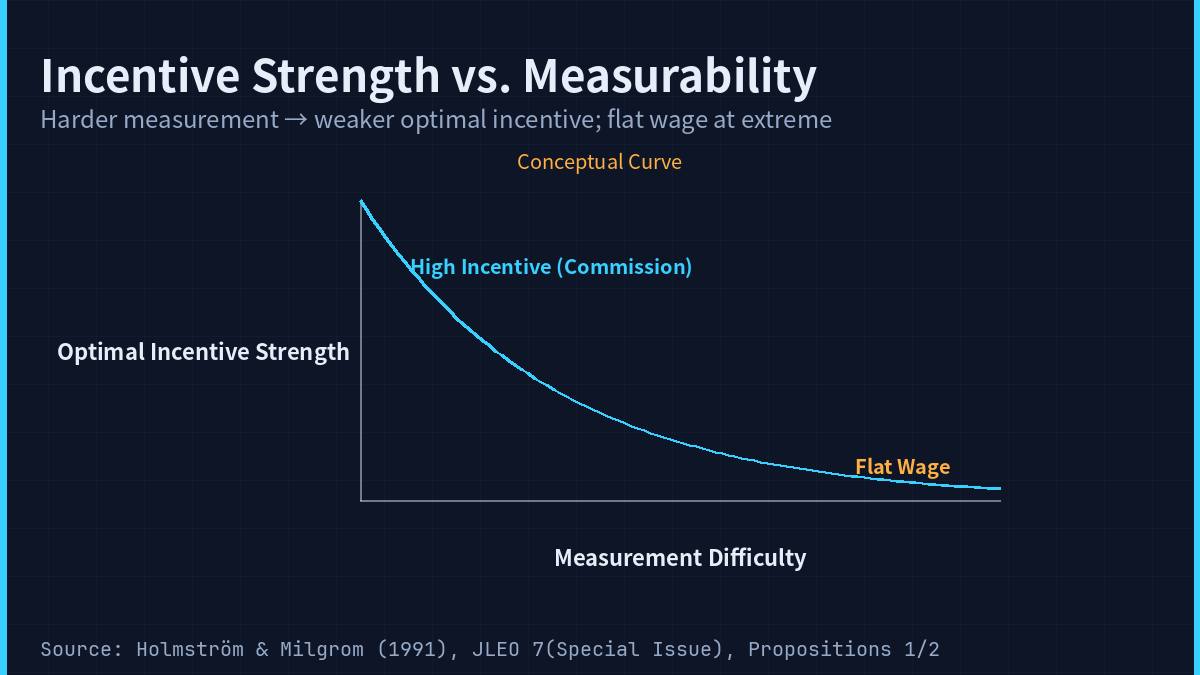
Figure fig02 shows the relationship between incentive strength and measurability: the harder to measure, the weaker the optimal incentive. At the extreme, it’s a flat salary. This is also a conceptual curve, but the paper’s mathematical derivation supports it.
V. Three Real-World Applications
The paper delivers the core mechanism. But its value goes further. Three extensions, each with real-world bite.
1. Asset Ownership: Why McDonald’s Owns Only 30% of Its Restaurants
McDonald’s owns about 30% of its restaurants. The rest are franchises. Franchisees pay at most 10% royalty — keeping at least 90% of revenue. Company store managers? Fixed salary, no explicit incentive.
Why? Because franchisees own their assets — the restaurant, equipment, staff. Their incentive comes from the asset itself. Company managers maintain someone else’s assets. Asset appreciation belongs to the company. Strong incentives would push them to chase short-term numbers and neglect maintenance.
The paper says this is the fundamental difference between employees and independent contractors: who owns the assets. The outsourcing logic lives here: how much unmeasurable contribution does this role have? If a lot, keep it in-house with a flat wage. If little, outsource with commissions.
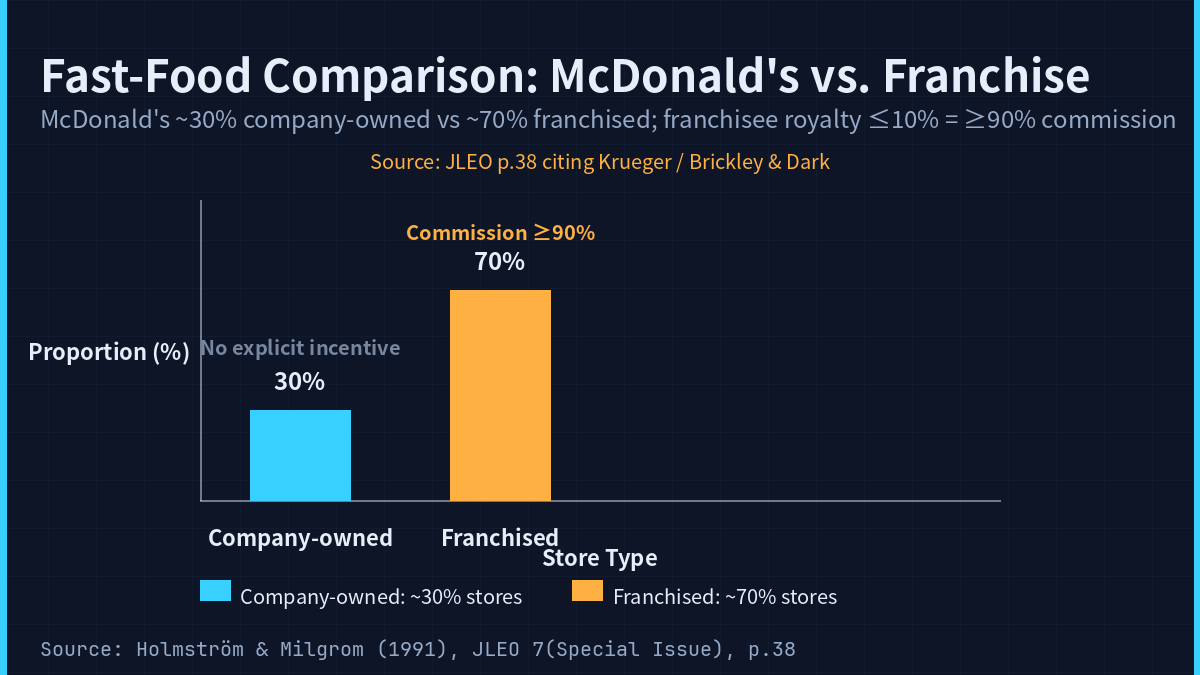
Figure fig03 contrasts incentive structures in fast food: McDonald’s owns ~30% of restaurants, franchisees pay ≤10% royalty (≥90% commission), company managers have no explicit incentives. Data from Krueger, Brickley and Dark studies cited in the paper.
2. Restrictions on Outside Activities: Stronger Incentives, More Freedom
Proposition 3 says incentive strength and freedom are complements. Salespeople on commission get more schedule freedom. Administrative staff on fixed salaries work nine-to-five under direct supervision.
Why? Because high incentives mean output is measurable — the worker’s own judgment disciplines them. Low incentives mean output is hard to measure — you need to watch them.
Think about remote work. Jobs that go remote have measurable output: coding, design, sales. The office jobs have hard-to-measure output — coordination, mentoring, culture-building. The only control is presence.
Proposition 4 adds a dynamic layer: as measurement technology improves, optimal incentives rise and restrictions relax. As measurement becomes harder, incentives weaken and supervision tightens.
3. Job Design: One Person, One Job
Proposition 5: two people should never jointly own the same task. Joint responsibility doubles fixed risk costs. The optimal scheme: each task belongs to one person. This is the cornerstone of hierarchy theory — the “unity of responsibility” principle.
Propositions 6 and 7 make subtler points. If you bundle all tasks into one role, the measurable crowd out the unmeasured. The solution: give easy-to-measure tasks to one person, hard-to-measure tasks to another.
Sales and customer service should be separate roles. Sales uses commissions — output is quantifiable. Customer service uses fixed salary — quality is hard to measure. Merge them, and the commission pulls all effort toward deal volume. Service collapses.
More counterintuitive: even if two workers start with identical skills, the optimal assignment is asymmetric. One gets the hard-to-monitor work at low incentive. The other gets the easy-to-monitor work at high incentive.
VI. The Model’s Boundaries: The Weakest Assumption
The model is elegant, but rests on four key assumptions. Linear contracts, normal noise, exponential utility — these three are for mathematical tractability. The weakest: perfect substitutability.
It means every minute on one task raises every other task’s cost by exactly one minute. Reality is messier. Teaching and research are partly substitutes, partly complements. Output and quality maintenance sometimes conflict, sometimes reinforce each other.
The paper’s Caveats section admits this: the model “excludes the possibility that some activities may be complementary.” This is a simplification, not truth.
Also note: this is purely theoretical. Zero empirical data in the paper. All evidence comes from other studies — Anderson and Schmittlein found that when sales performance is hard to measure, firms prefer in-house teams. Krueger and Brickley & Dark found fast-food franchising at 30% ownership, 70% franchise. These are consistent with the model, but they do not test it directly.
Goodhart’s Law — “when a measure becomes a target, it ceases to be a good measure” — captures the same logic. But that name came later. Goodhart 1975 was about monetary policy.
VII. My Reading: Seeing What KPIs Hide
Remember the broken KPIs from the beginning? Teachers, programmers, salespeople — tighter measurement, faster unmeasured work dies.
Now you know why. Incentive strength must match measurability. When unmeasured contributions matter, strong incentives backfire.
Three takeaways.
First, KPI distortion. Your employee didn’t get lazy. You pushed their effort elsewhere. When you reward measurable output, you silently punish unmeasured quality. The worker responds rationally to the incentive you set.
Second, job design and outsourcing logic. Sales and customer service are separate roles for a reason. When should a company use employees vs. contractors? The answer points to one question: how much unmeasurable contribution does this role have?
Third, why Holmström won the Nobel. His theory showed us the invisible world behind KPIs. Before this paper, economists thought incentive problems were about risk. After it, they knew it was about task structure.
Next time you see a performance metric, think about the work it doesn’t measure. Ask yourself: is this metric really worth all my effort?
References
- Holmström, B., & Milgrom, P. (1991). Multitask Principal-Agent Analyses: Incentive Contracts, Asset Ownership, and Job Design. Journal of Law, Economics, & Organization, 7(Special Issue), 24-52. DOI: 10.1093/jleo/7.special_issue.24
- Anderson, E., & Schmittlein, D. (1984). Integration of the Sales Force: An Empirical Examination. The RAND Journal of Economics, 15(3), 385-395.
- Krueger, A. B. (1991). Ownership, Agency, and Wages: An Examination of Franchising in the Fast Food Industry. The Quarterly Journal of Economics, 106(1), 75-101.
- Brickley, J. A., & Dark, F. H. (1987). The Choice of Organizational Form: The Case of Franchising. Journal of Financial Economics, 18(2), 401-420.