
One evening during autumn recruitment season, a link pops up in the graduation class group chat.
“Urgent hiring at a central SOE. No major requirements. Basically anyone who applies gets in.”
A roommate asks: real or fake?
No one answers. But someone forwards it to their parents.
Five minutes later, the family group chat explodes.
The kid’s question is whether it’s true. The parents’ question is whether it’s a chance.
Same link, two different heartbeats.
That’s the opening act of a business.
And at the other end of that act stands another set of numbers.
The education ministry says roughly 12.7 million students are expected to graduate next year.
Up another 480,000 from this year.
12.7 million people, one autumn, all flowing toward the same handful of gates.
A crowd like that is foot traffic.
And where there’s foot traffic, someone sets up a toll booth.
One: The Math of a Business
First, figure out who started this commotion.
On October 16, five government agencies spoke together.
The labor ministry, the cyberspace regulator, the education ministry, the police, and the state assets regulator.
One watches the job market, one the internet, one the students, one the cases, one the enterprises.
When five chairs line up like that, the other side is not a few scattered hustlers.
It’s an assembly line running across recruiting, platforms, campuses, and corporate reputations.
Get the weight of this document straight first. It’s a warning, not a battle report.
No arrest numbers, no case-closure statistics.
What it has is a playbook and a prevention checklist.
The only price range in it is the per-customer take.
Reading a warning as a victory report is the most common misreading in secondhand coverage.
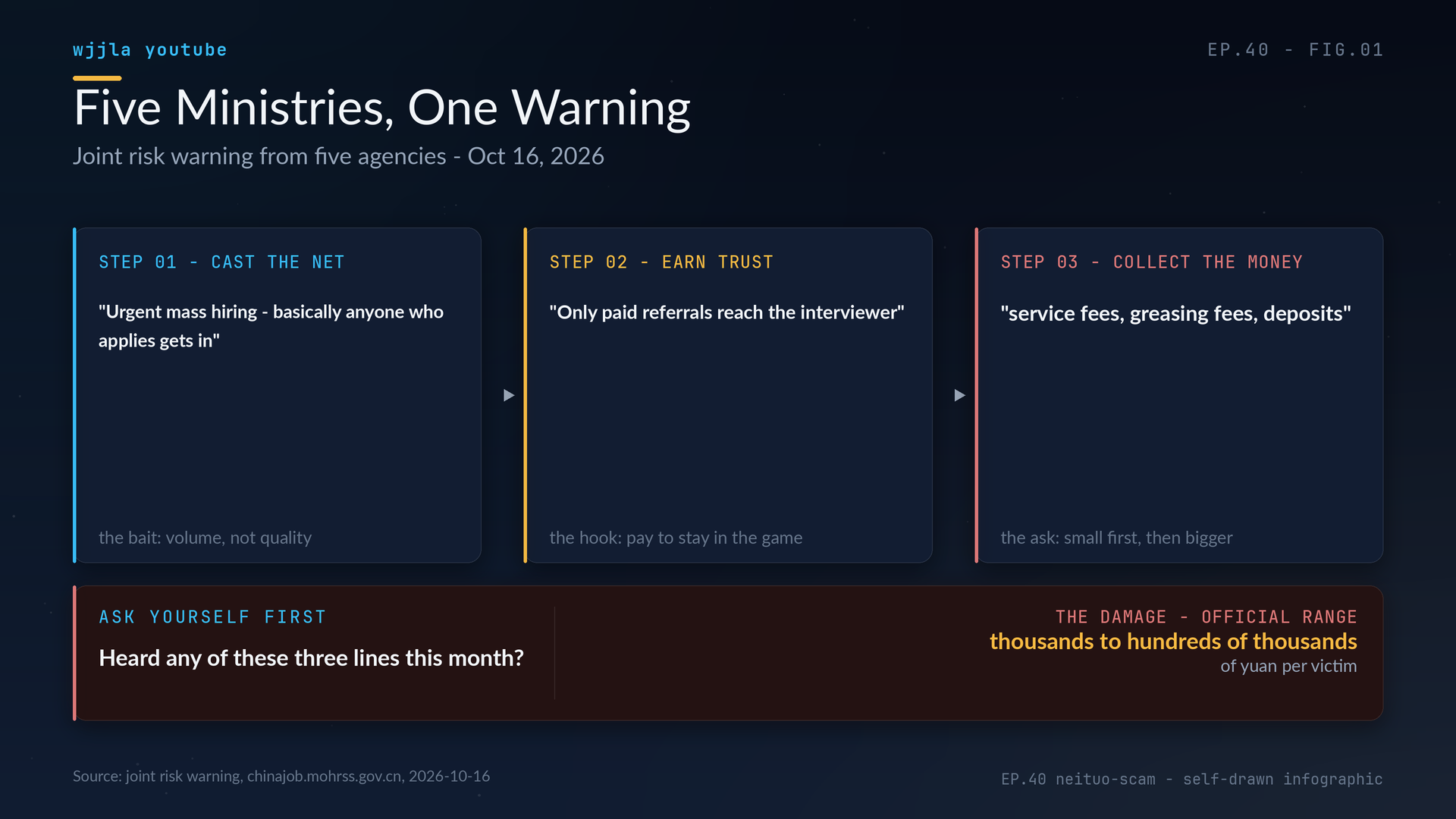
The official text breaks the playbook into three steps.
First, cast the net: fake experts broadcasting on social platforms.
“Urgent mass hiring. No major requirements. Basically apply and you’re in.”
Second, earn trust: claim to hold internal referral slots.
“Normal online applications never pass screening. Only paid referrals reach the interviewer.”
Third, collect the money: referral service fees, greasing fees, security deposits.
The names multiply. The stalling tactics stretch on.
Between the three steps runs a hidden channel.
The performance happens in public. The money changes hands in private.
Group chats. One-on-one messages. The small window of a livestream.
The deal happens behind the door. The regulators stand outside it.
A good show needs props.
Some scammers forge employment contracts. Forge job offer letters.
The Henan case defendant, Dai, even forged admission notices.
Tripartite agreements. Registration certificates. The full set.
The more convincing the props, the higher the ticket price.
All three steps come from the five agencies’ warning. I didn’t invent a word.
But the most weighty part of the warning isn’t the playbook. It’s the price.
Official wording: thousands to hundreds of thousands of yuan per victim.
Notice the floor of that range.
Five thousand per head, ten heads make fifty thousand.
A hundred heads?
You don’t need to invent a conversion rate. The court verdicts already did the math for you.
In Henan, one man scammed 59 graduates.
3.73 million yuan.
Average take: over sixty thousand per head.
Another case in Shanghai: five victims, 610,000 yuan total.
One of them, drip by drip, paid out 258,000 yuan.
First 30,000 or 60,000. Then “greasing the leaders” for more.
Then “a competitor bid higher” for more again.
Every additional payment tested how much oil was left.
Two more cases made the papers as well.
One posed as a head of HR, ran fake interviews, and took over a million.
One siphoned more than 4.7 million from over 150 trainees at a training company.
Four publicly reported verdicts. Combined “revenue” past ten million yuan.
And that’s only the part that got caught, convicted, and covered.
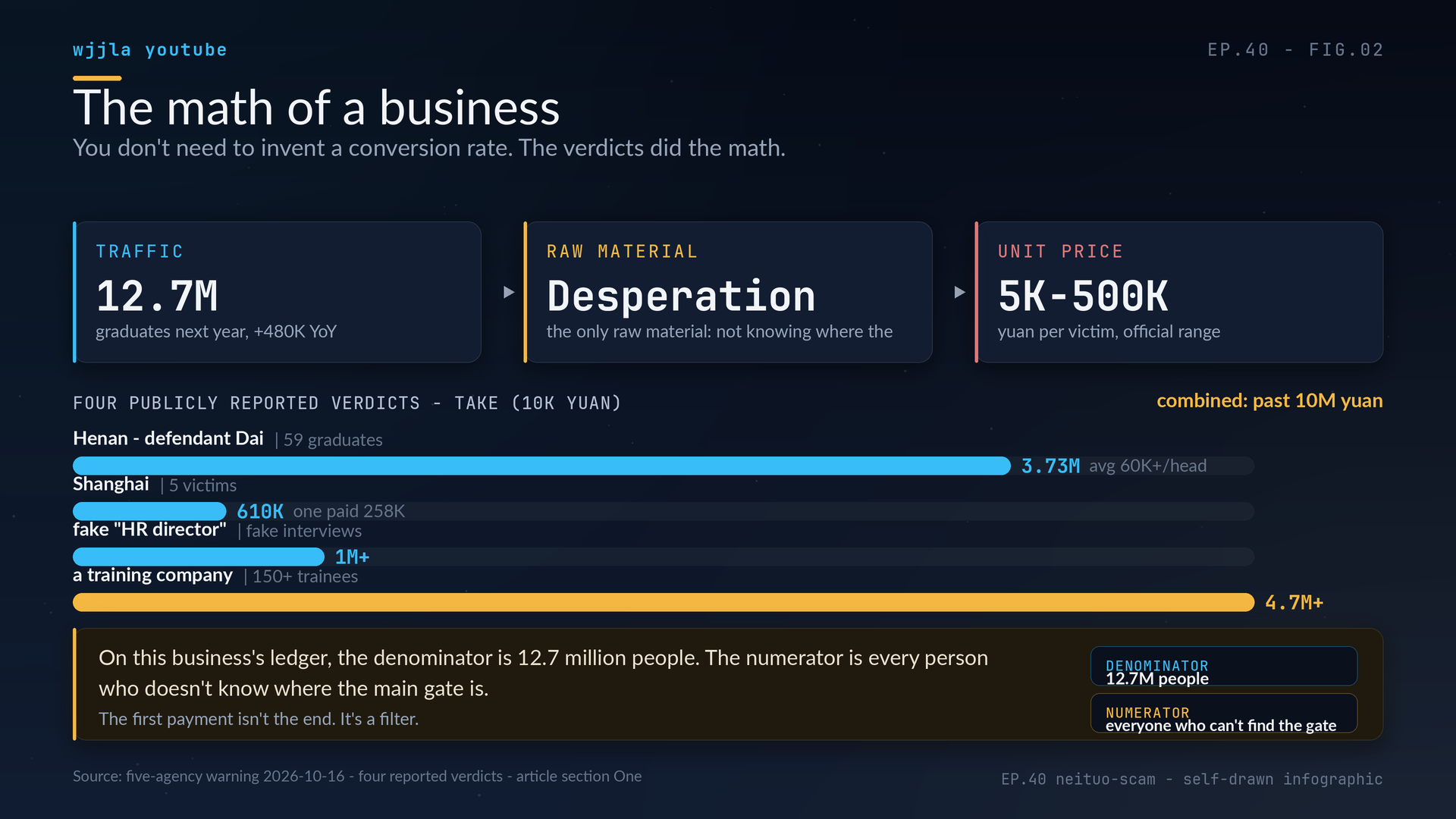
On this business’s ledger, the denominator is 12.7 million people.
The numerator is every person who doesn’t know where the main gate is.
The unit price runs from five thousand to hundreds of thousands, depending on how urgent the anxiety is.
So the question flips.
The scammers’ script is actually crude.
“Basically anyone gets in” — anyone who believes that is desperate.
Desperation is this business’s only raw material.
The coldest layer of the serial fraud, the officials spelled out.
The first payment isn’t the end. It’s a filter.
Anyone willing to pay once gets marked as someone who can be squeezed again.
So this business doesn’t select for gullibility. It selects for anxiety.
Where does the raw material come from?
It grows out of an outdated map.
Two: Two Generations of Maps
Start with the uncomfortable question.
With a link like this, parents believe it before their kids do.
Why?
It’s not that parents got dumber.
The map got redrawn too fast, and nobody notified them.
When your parents were young, where did jobs come from?
State assignment. Hereditary succession. Factory recruitment. One word from an acquaintance.
On that map, “pulling strings” wasn’t a scam.
It was a marked, legitimate road.
Their whole generation walked that road.
Then the scenic area changed its rules.
State-owned enterprise hiring had to be public, announced, and posted.
Public institutions and civil service: everyone gets in through exams.
That transformation, kids read about in textbooks.
Parents missed it in the flow of life.
The main gate became free. And it became the only gate.
But maps update slower than institutions.
The parents’ information source froze at the year they were young.
When their child looks for work, they can’t help.
Unable to help, all that’s left is worry.
The kids’ information sources: classmates, the school career site, recruiting platforms.
One dorm room, four channels cross-checking each other.
And at home? Mom and Dad only have links forwarded from group chats.
Two generations, holding maps from different years, directing traffic at the same intersection.
Where do the scammers stand?
Exactly where the old map still shows a road.
The official warning contains a sentence so precise it’s brutal.
Even when parents have doubts, they hold onto the “what if it works” fantasy.
What if.
Why is “what if” worth money?
Because for a parent, paying tens of thousands for a what-if
is emotionally much cheaper than admitting their child might just have to search slowly.
That sentence is ugly. But it’s part of the math.
The road on the old map genuinely existed once.
What the scam sells isn’t a slot. It’s the residual warmth of that old map.
The warning stops at hinting this layer. Let me finish the sentence.
Kids get deceived because they don’t know where the main gate is.
Parents pay because they still remember where the side gate was.
The gate was demolished long ago. The memory hasn’t been.
So what does the main gate actually look like?
It deserves a careful look.
Three: The Main Gate, and the Line
First, one principle to remember.
The main gate of a central SOE never charges admission.
In the warning, five agencies named four entrances.
Jiuye Online. The National College Graduate Employment Service Platform.
The SOE Recruitment Platform. China’s public recruitment network.
Four official gateways.
Add the companies’ own websites and campus recruiting. Add public employment service agencies.
That’s the full list of gates. You can count them.
The state assets regulator runs a platform where every central SOE posts its campus openings.
Who’s hiring, which role, what the requirements — page after page, publicly searchable.
The one click scammers fear most is exactly this one.
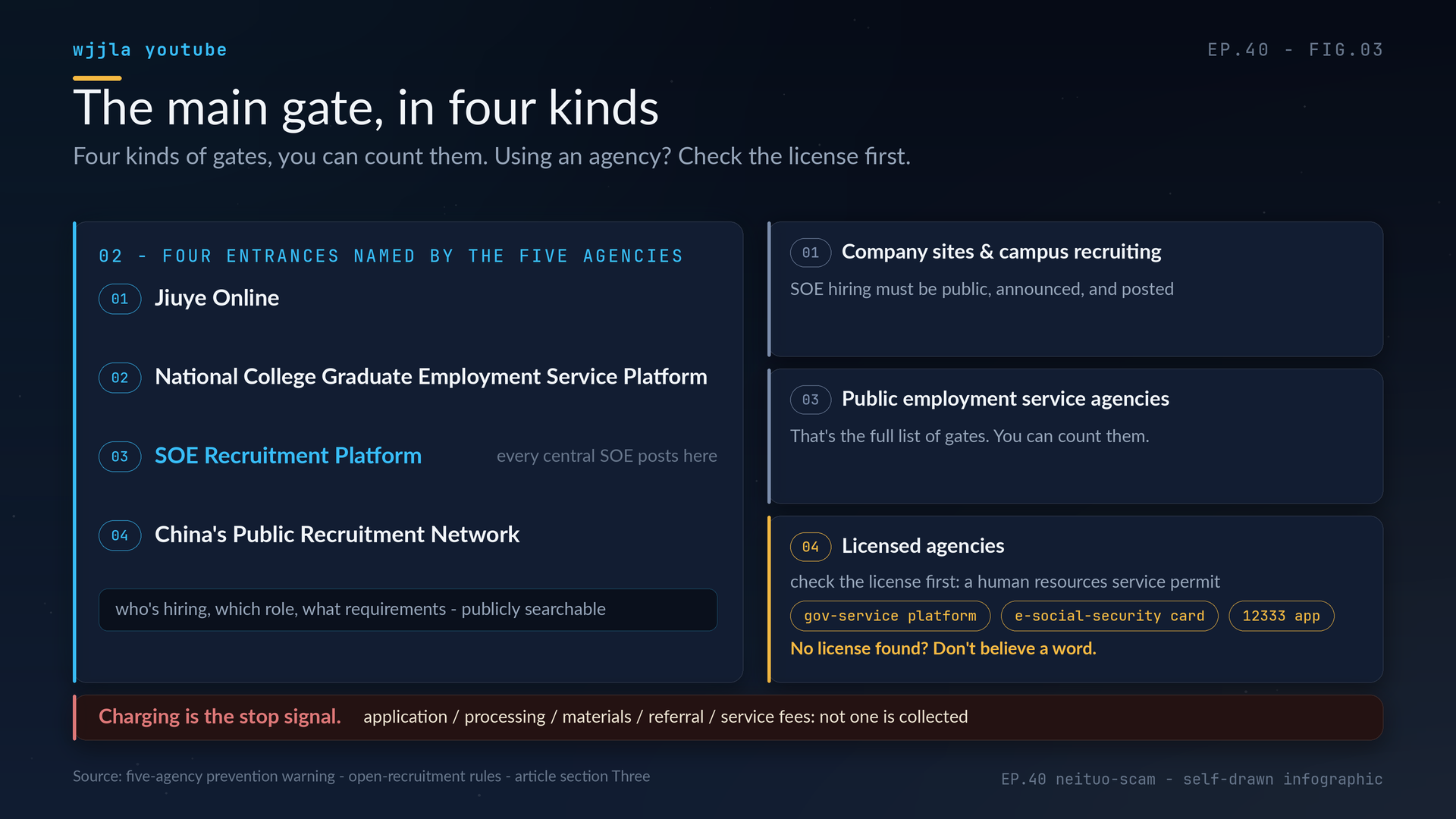
Using an agency isn’t off the table either. Check the license first: a human resources service permit.
The national government service platform, the e-social-security card, the 12333 app — all can verify it.
No license found? Don’t believe a word.
Then, the boundary line.
Internal referrals by company employees are real.
A colleague slipping your resume into the system is a real, existing channel.
But the key to that channel is not in any employee’s hand.
Getting hired passes through announcement, screening, assessment, and public posting.
Every step public. Every step leaving a trail.
The regulator’s documents say it plainly: open recruitment, open information, proposed hires must be publicly posted.
So what does a legitimate referral look like?
It doesn’t charge you a cent.
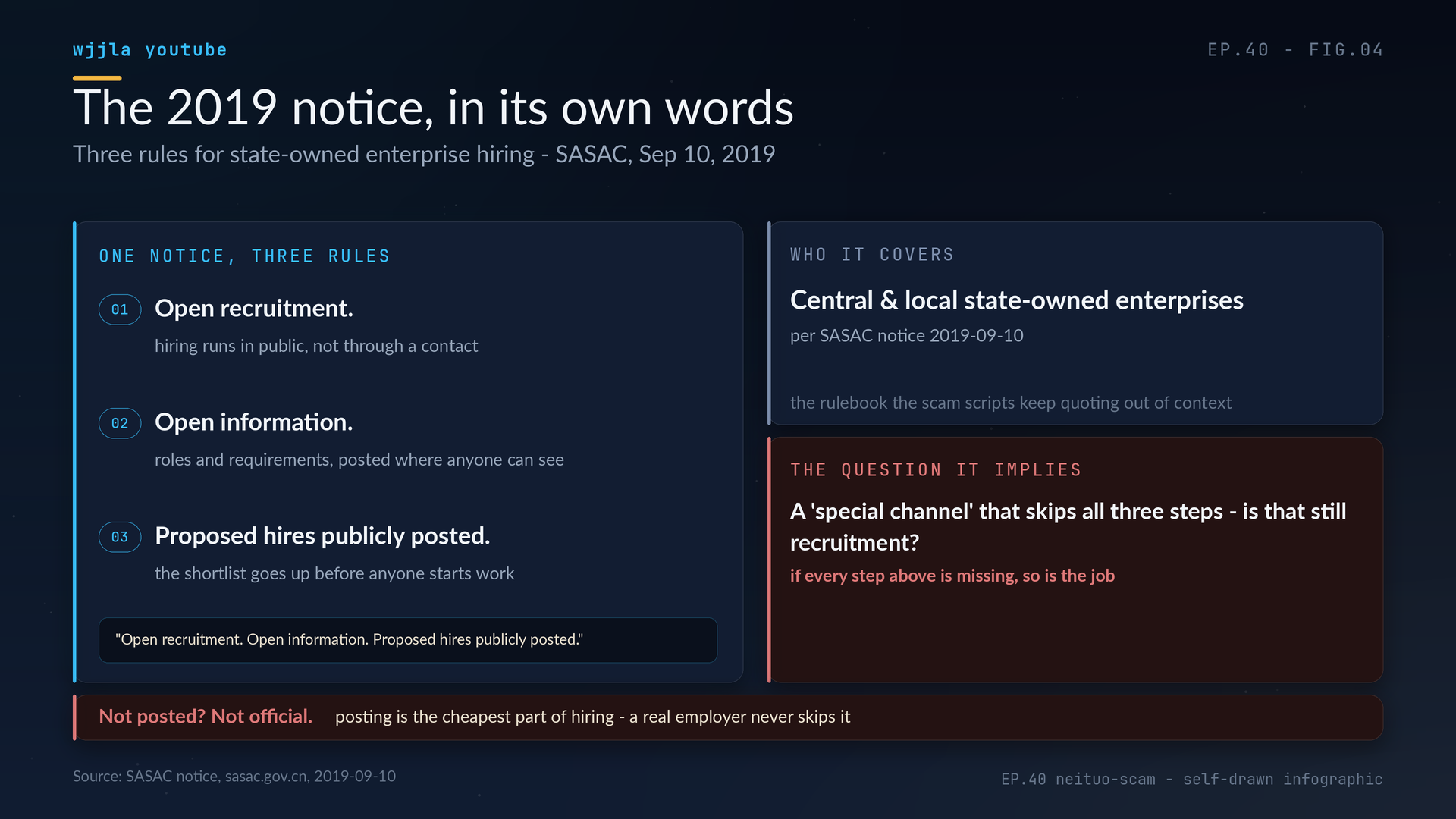
Whether it works out: depends on assessment, on public posting.
What does a scam referral look like?
It collects money first. The money goes into a personal account.
The job? Nowhere to be found.
The “ticket” it sells has no seat anywhere in the system.
The three-question test is short.
Do they charge? Whose account does the money enter?
The thing they promise to do — which public page can verify it?
Three questions, no good answers: the gate is fake.
One more layer on why tickets sell.
Employee referrals: many companies genuinely encourage them.
Someone you know is a known quantity; it saves a round of screening.
That channel is real, and so is its reputation.
And real things are the easiest endorsements for fakes.
What the scam sells isn’t the channel. It’s the channel’s shadow.
The shadow has no physical form, but it doesn’t stop the money.
The difference between a ticket and a friendly favor is one word: money.
Real agencies also charge. The resume editors — the resume really gets edited.
The ones selling “referral slots” — the slot is freshly invented.
That’s the legal line.
The key isn’t what the contract is called.
An intermediary agreement, a service agreement — both are overcoats.
Only one question matters: at the moment money changes hands, does he hold anything real?
Yes — it’s business.
No — it’s unlawful possession under criminal law.
The promise of “full refund if it fails” is precisely the price of air.
If it happens to you, play your cards right.
Keep the chat records. Keep the agreement. Keep the transfer receipts.
Beyond reporting to police, two more lines exist.
Labor inspection at the labor ministry handles illegal agencies.
12377 handles false job postings online.
The line is drawn.
But harvesting doesn’t stop at a line.
Four: No Off-Season for Harvest
Autumn recruiting season always ends.
The scenic area enters its slow season. Will the toll collectors pack up?
This is my judgment; the officials didn’t write it.
No. They’ll move to the gate of the next busy season.
Past graduates will get “supplementary intake referrals.”
Civil-service exam takers will meet “guaranteed-pass classes” and “carved-out positions.”
Returnees from overseas: the experience is an ocean away, unverifiable on the spot.
Outside the factories, “paid onboarding” is waiting.
The crowd rotates. The script changes one layer of skin.
The playbook is the same playbook.
Make you anxious, make you believe, make you transfer.
Once the money moves, does it come back?
Look at the verdicts and you can feel the weight of the answer.
The Henan case reads: “all illicit gains returned to the victims.”
That victim was lucky; the money was recovered in time.
More verdicts read: “ordered to return and compensate.”
Ordered is the language of the verdict.
Returned is a matter for the bank account.
Set the two side by side, and you know how hard recovery is.
Money, once in hand, splits, gets spent, changes hands.
So recovery is luck. Non-recovery is the norm.
This is my judgment.
If recovery is a dead end, where’s the solution?
The officials already gave the coordinates.
Within half a year: two five-agency warnings, one national special enforcement campaign.
The previous scam was called training loans. This one is called referral fees.
The lead agency rotated with the scam: financial regulator, then the state assets regulator.
The lights are being installed one by one.
But three layers of difficulty remain.
Students’ information gap: not knowing where the main gate is.
A first-time job seeker hasn’t even walked the process once.
Asking them to tell real referrals from fake ones is asking a first-time visitor to find the way.
Parents’ outdated map: not knowing the gate was moved.
The platform gap: the deal behind the door, the regulator outside it.
A short-video order deleted, a group chat dissolved.
The victim can’t even file a report without first reassembling the chat records.
Three layers stacked: that’s the soil this business grows in.
The soil isn’t cleared. Harvest after harvest will keep coming.
Finally
Back to the link from the opening scene.
The roommate asked: real or fake?
Now you know how to do the math.
Traffic of 12.7 million. Unit price from five thousand to hundreds of thousands.
Only one raw material: the anxiety of not knowing where the main gate is.
And the main gate never charges admission.
Charging is the stop signal.
That sentence isn’t mine. It’s the five agencies'.
Legitimate central SOE recruiting charges no application fee, no processing fee, no materials fee, no referral fee, no service fee.
Five fee names. Not one of them is collected.
Remember the four gates.
Jiuye Online. The National College Graduate Employment Service Platform.
The SOE Recruitment Platform. China’s public recruitment network.
Screenshot them. Save them. Forward them into the family group chat.
Next time someone posts a “central SOE urgent hiring” link, check first, ask second.
What this business fears most was never running out of victims.
It’s more and more people knowing where the main gate is.
The day the toll outside the alley becomes uncollectible
begins the moment you forward those four gates into the family group.