
Paper: Knopf & Lamming, The hallmarks of protein and amino acid restriction in aging and longevity, Cell Press Blue (OnlineFirst 2026-07-31, open access) DOI: https://doi.org/10.1016/j.cpblue.2026.100079 (Lamming Lab, University of Wisconsin; ~350 studies pooled)
A counterintuitive conclusion
Walk into any supermarket: high-protein milk, high-protein bars, high-protein cereal. Fitness culture treats protein like a religion, and the newest US dietary guidelines push intake to 1.2–1.6 g/kg/day — double the official baseline RDA of 0.8 g/kg.
Then Cell Press Blue, Cell Press’s new flagship open-access journal, published this review — and its conclusion is close to heresy:for most sedentary people, eating a bit less protein may be healthier, and may extend life.
Let me set the boundary first, so you don’t read this as clickbait either: most of the evidence comes from animal studies and short human trials. The review does not hand you a diet plan, and it doesn’t try to. Its real value, to me, is that it lays out the protein–aging causal chain more clearly than anything before it. Here it is, in the order I read it.
It all started with starving rats
In 1935, McCay kept a group of rats chronically underfed. The surprise: the hungry rats lived longer. That’s caloric restriction (CR), since replicated in nearly every model from yeast to non-human primates.
The problem is that CR is miserable — almost nobody can keep it up for life. So nutrition science has spent decades asking a natural question:do CR’s benefits come from “eating less” itself, or from eating less of one specific component?
If the former, there’s no way out — you just suffer. If the latter, there’s room to act: find that component and cut only it.
The answer this review assembles is clear:the key component is protein.Keep total calories the same, but push protein down and carbs up, and many animals live longer with better metabolism. This is protein restriction (PR). Its appeal in one line: the benefits of starvation, without starving.
So what actually happens inside the body when protein drops? That’s the core of the review.
Mechanism: the body has a “protein alarm”
The review breaks PR’s benefits into six hallmarks: metabolic health, nutrient sensing, mitochondrial function, cellular senescence, epigenetic modification, and healthy aging. The paper’s own Figure 1 is the panorama:
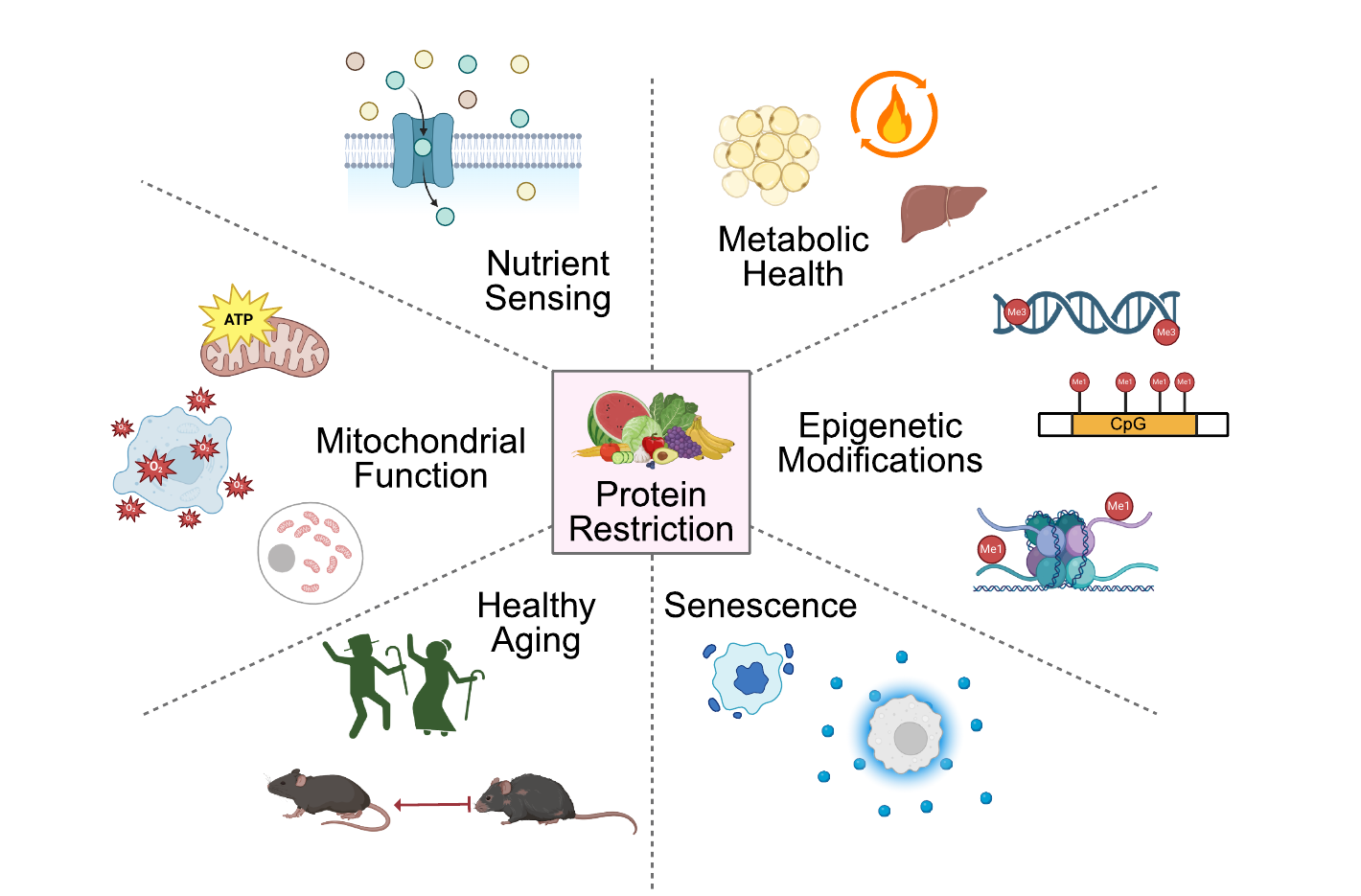
For a general reader, the first two hallmarks are the most tangible. I drew the chain they form:
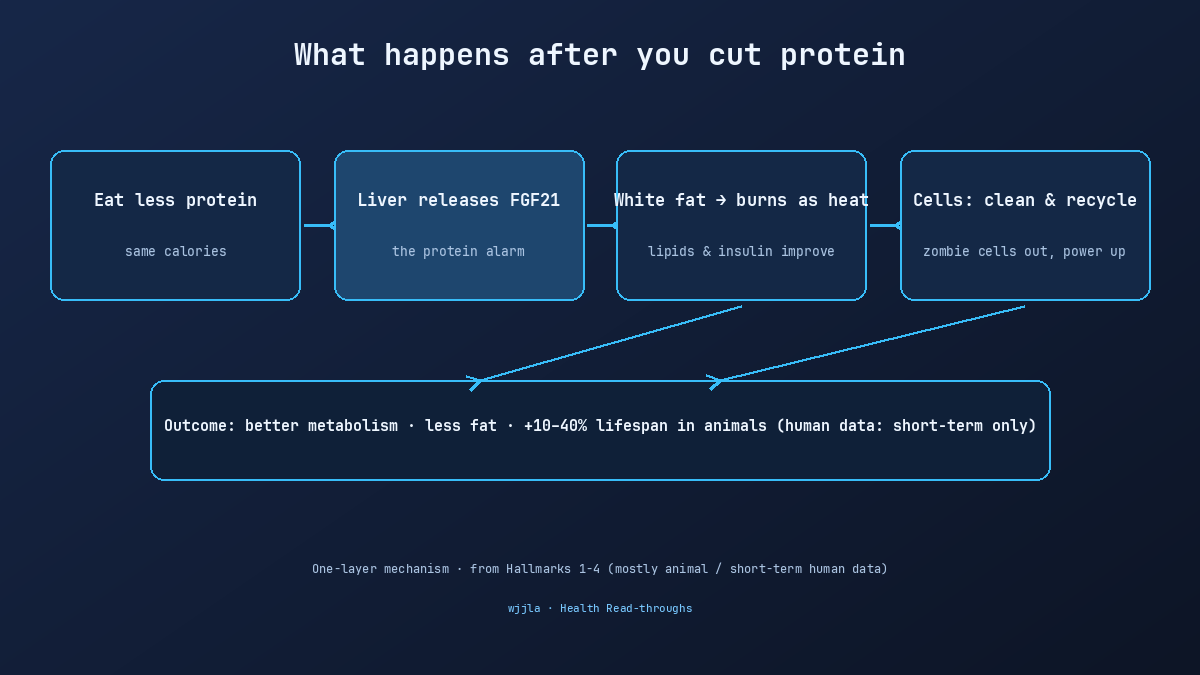
Here’s the story. Young mice on low-protein chow actually eat more — more total calories — yet end up leaner with less fat, because the body deliberately burns off the surplus. The central executor is a hormone called FGF21: when the body senses low protein, the liver releases it; it tells fat tissue to convert stored white fat into fat that burns away as heat, while improving blood lipids and insulin sensitivity. The hardest evidence:mice lacking FGF21 lose PR’s longevity benefit entirely.
At the same time, cells shift gears: from “grow at all costs” mode into “clean and recycle” mode. The growth pedal eases off, the cleanup alarm sounds, “zombie cells” (senescent cells that poison their neighbors) get cleared, and the cell’s power plants (mitochondria) get maintenance.
One detail worth noting: this isn’t just for the young. Mice starting low-protein diets at 18–20 months old — middle age in human terms — show the same effects.
Beautiful mechanism, but still mice. What does the human evidence look like? That’s a decades-long fight.
The evidence war: doctors say eat more, the data says eat less
The “eat more” camp has a solid case: aging muscles shrink, and in severe cases that’s sarcopenia — one fall, one hospital stay, and health collapses. Hence the baseline RDA of 0.8 g/kg/day, 1.0–1.2 for people over 65, and the newest US guidelines at 1.2–1.6. The goal — preserving muscle in older adults — is a good one.
But epidemiology sees the other side. In the large US NHANES survey, the more protein people ate, the higher their risk of diabetes, certain cancers, and all-cause mortality. Animal data is more direct: the review’s Table 1 collects cross-species studies where low-protein groups consistently live longer — from about 10% to over twofold in some models; in mice, the typical gain is 10–40%.
Human evidence? Only short-term trials so far, but pointing the same way: in 2016 the review’s own team reported that 43 days on a low-protein diet reduced body weight, fat mass, and fasting glucose — despite higher caloric intake. A trial in lean men found five weeks of PR improved insulin sensitivity and raised energy expenditure.
So the honest picture:“more protein” is right for older adults at risk of muscle loss, and very likely wrong for sedentary younger people.A one-size-fits-all protein cult fails both groups.
Next question, naturally: protein breaks down into 20 amino acids — which ones do the work?
Down to the parts: testing 20 amino acids one by one
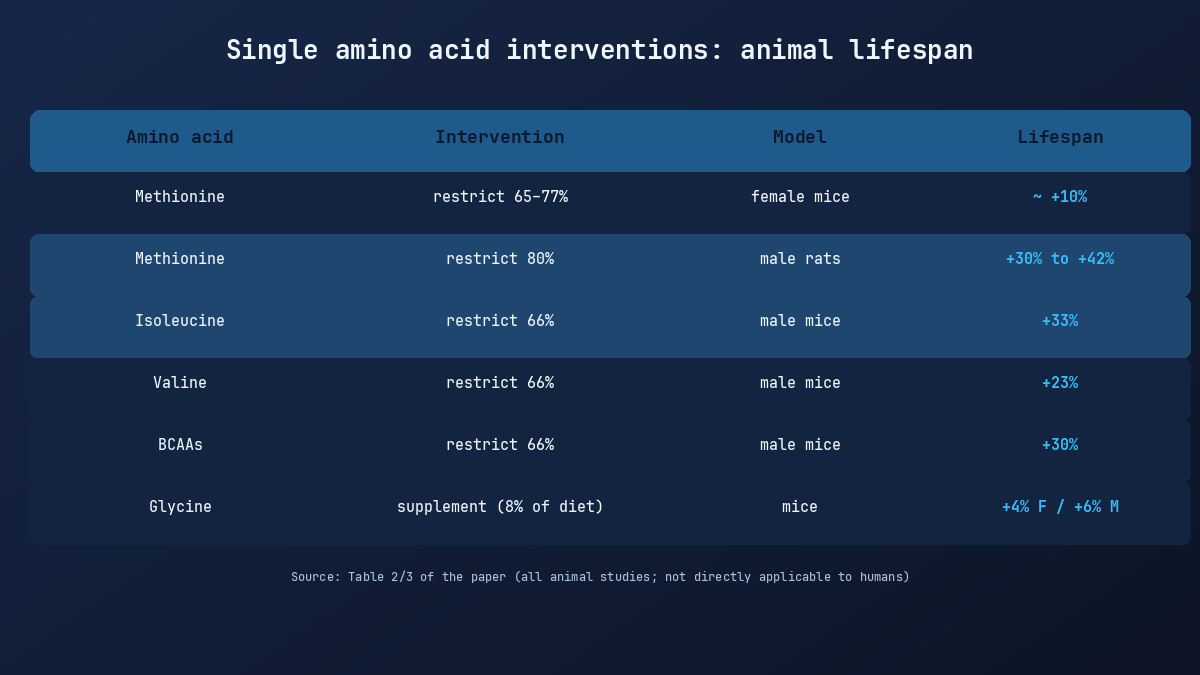
This is the most academic — and most interesting — part of the review. Researchers restricted or supplemented amino acids individually to see which reproduce PR’s benefits. Tables 2 and 3 summarize it well; I turned the key numbers into a table:
Findings worth highlighting:
Essential amino acids do the heavy lifting.Restricting EAAs (the ones your body can’t synthesize) alone reproduces most of PR’s benefits; restricting non-essential ones mostly doesn’t.
Methionine has the hardest evidence of any single amino acid.Restricting it extends lifespan by 7–42% across models. It’s also the raw material for methyl donors — the tags that get hung on DNA — so cutting it even rewrites the “gene switch labels.” A curious wrinkle: these studies often need simultaneous cysteine restriction, or the metabolic benefits vanish; the mechanism isn’t fully understood.
Among the BCAAs, isoleucine and valine do the work — not leucine, the one gym culture loves.High circulating BCAA tracks with obesity, insulin resistance, and mortality in humans; mice on 66% BCAA restriction lived ~30% longer. Broken down: isoleucine +33%, valine +23%, while leucine studies contradict each other — one made mice fatter, another leaner, with no real lifespan contribution. Stimulating muscle synthesis is not the same as extending life; at the molecular level these are separate things.
There’s also a “supplement” camp.Glycine works in reverse: mice supplemented from 9 months of age lived ~6% (males) and ~4% (females) longer, possibly because it’s a building block of the antioxidant glutathione. Others are testing collagen-inspired amino acid formulas, which extended lifespan in several species and even lowered biological age in a human trial — a plausible future direction of “formulation work.”
Cold water time, and the review itself insists on this:all of this is far from “what humans should eat,” and no single-amino-acid advice is ready.For example, human plasma analyses link low valine to aging and cognitive decline — opposite to the mouse data. Species don’t transfer cleanly. So any miracle product built on one amino acid deserves a big question mark.
Two non-data stories that stuck with me
The Dutch Hunger Winter.In the winter of 1944, the Netherlands was cut off from food; millions starved for months. Decades later, follow-ups found that children who were starved in the womb — and even their children — have different metabolic and cardiovascular markers. Extreme nutritional shifts can be written into the next generation through epigenetics: how your generation eats may shape more than yourself. Animal data matches: pregnant mice on low-protein diets have offspring with altered liver methylation and glucose metabolism.
Okinawa.Is there a real-world low-protein longevity sample? Yes. The traditional Okinawan diet gets only about 9% of calories from protein — nearly identical to the low-protein formulas in animal studies — and Okinawans are famous for longevity. Granted, 80% of their calories come from plants and total intake is lower, so low protein can’t take all the credit. But the directional hint is strong.
Three things I want to flag (my judgment, not the paper’s)
First,be wary of anyone turning this review into “eat this way now.“Long-term human data barely exists; most trials run days to weeks. Even the UK Science Media Centre published expert warnings that media coverage over-extrapolated. Whoever sells it as a diet rule has gone too far.
Second,eating less protein is not a prescription for everyone.Pregnant women, children, patients in recovery, and older adults already on the edge of deficiency should not copy it. The plausible beneficiaries are long-term high-protein eaters who barely move. And the review notes that late-life PR costs some lean mass — which exercise largely offsets. If I had to pick the most practical takeaway, it’s “don’t overdo protein, and keep moving” — not “the less protein the better.”
Third,high-protein products aren’t forbidden — they just shouldn’t be worshipped.For decades the world kept turning the protein knob up; it’s been turned too far. Where exactly it should sit, science hasn’t answered. But you can start doubting “more is better” today.
One-line summary
350 studies point the same direction: for most sedentary people, moving protein from the “worship” setting back to “normal” — letting the body’s built-in cleanup mode run now and then — may be one of the most cost-effective longevity interventions around. The animal evidence is beautiful, the human evidence is just beginning. Don’t mythologize it; don’t ignore it either.
Narration of the companion video uses an AI clone of the author’s own voice; the article itself was written by the author. Contains data cited from the paper; copyright of the paper belongs to the original authors.