An arXiv paper (2607.22529) dropped by Alibaba’s Qwen team in July 2026. The core idea: turn a “skill library” into the curriculum engine of an LLM self-play training loop. This post is not a glossary dump. It’s a working engineer’s read-through — what problem this actually solves, how it solves it, and whether it’s worth your evening.
1. The Real Pain Point: Self-Play Is Stuck Between “Diversity” and “Verifiability”
Over the last two years, LLM training has slid from “human annotation + SFT” toward “self-evolution”: the model generates its own training data and grades itself. By 2026, that road has run into a very specific contradiction:
- Environment-bound track(e.g. have the LLM write code, then run unit tests): the feedback is precise, but the task domain is narrow — basically programming and math proofs where a machine can verify outcomes.
- Open-ended self-generation track(have the LLM write a problem, then have the LLM judge it): the domain is wide, but the reward signal is unreliable. The model quickly learns how to game the judge, and once the reward gets hacked, training collapses.
In industry these two failure modes account for roughly half of all failed runs. Skill Self-Play (Skill-SP from here on) walks through the middle with one observation:a skill is naturally a middle ground.A skill is a chunk of reusable, structured executable capability. For any single task, it goes deep enough to be verifiable; swap in a new task and you can extend coverage through dynamic routing.
The biggest takeaway after I finished reading the paper: Skill-SP does not philosophically argue that “skills are the middle ground.” It just treats a skill as an executable object — a thing you can update, route, and retire inside an RL loop. That move, turning an abstraction into an operational engineering object, is far more useful than what the paper’s title suggests about “the capability frontier.”
2. Three Roles: Proposer, Solver, Skill Controller
Skill-SP’s architecture is remarkably clean. Three roles co-evolve inside one RL loop:
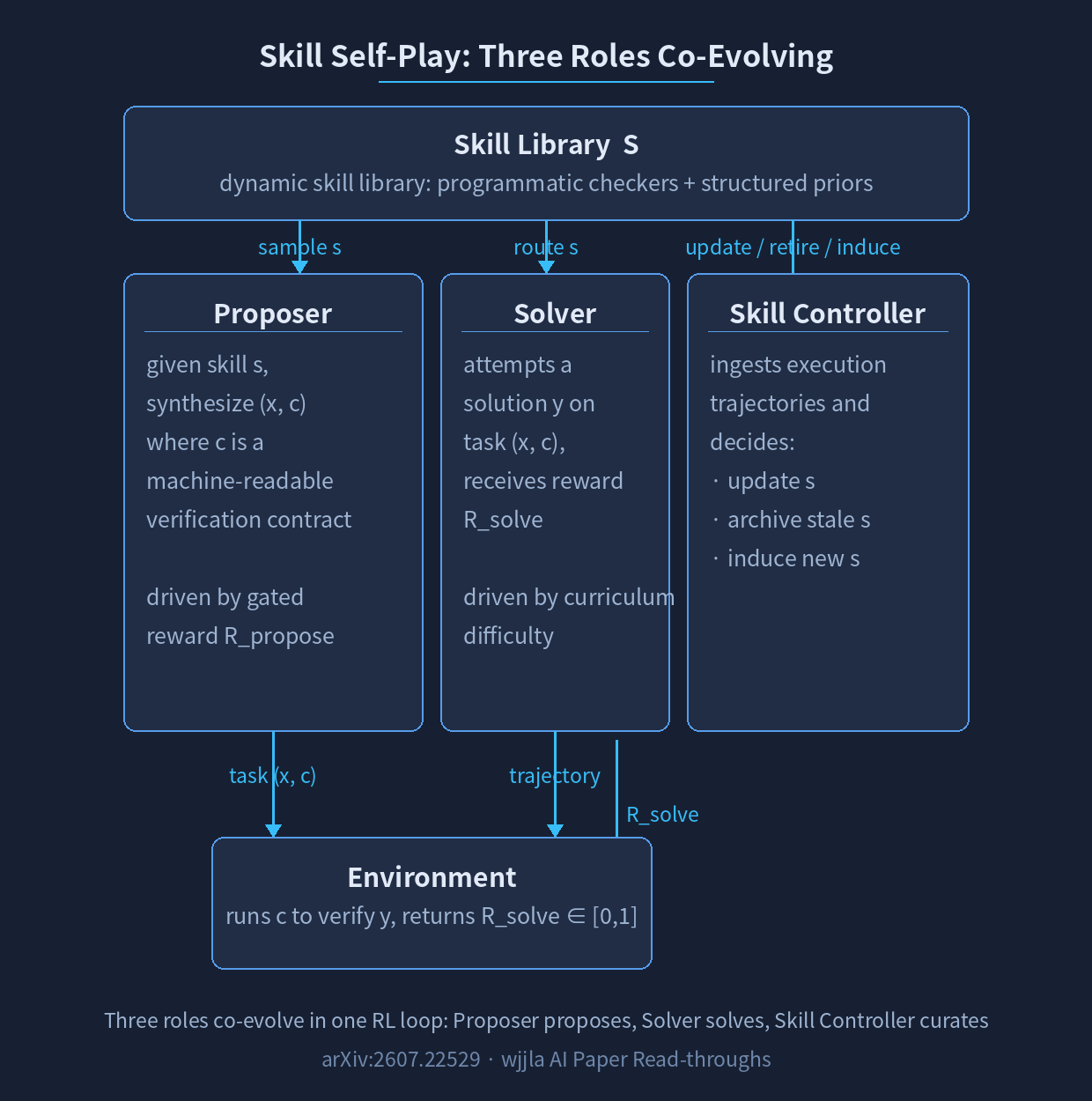
Proposeris narrowly scoped: given a skill s sampled from the library S, it synthesizes a (prompt x, verification contract c). The contract c must be machine-readable — the paper uses unit tests and reference answers as canonical examples. The Proposer’s reward is not “how hard is the task” but agating curriculum reward: the contract (x, c) only gets scored when it is structurally valid, and even then only by how close its difficulty lands to 0.5 for the current Solver. This is the key design the paper hammers: it explicitly closes the reward-hacking loophole, because the Proposer cannot fake “an impossibly hard task” by handing in an empty contract — the validity check runs before the difficulty score.
Solveris more conventional: given (x, c), it produces an answer y; the environment runs c and returns R_solve. The Solver is trained on the Proposer’s questions, but those questions are not random — they are steered by a curriculum score onto the Solver’s current “learning frontier.” The paper calls this the medium-difficulty score. Its formula is 1 - 2|v_solve - 0.5|, with the goal of pulling the Solver’s success rate toward 0.5, which is exactly the band where “one good push and you solve it” lives.
Skill Controlleris the most interesting engineering object in the paper. It is not a static list — it is a dynamically maintained library with three operations:
1.Update— based on the Solver’s execution trajectory on a given skill, refine that skill’s verification logic (e.g. add a boundary-case test). 2.Archive— if a skill has not been triggered for several consecutive rounds, mark it as stale and move it out of the main library. 3.Induce— discover new reusable structure inside the open-ended generation stream and automatically package it as a fresh skill to add to the library.
The paper’s empirical evidence: after five iterations, the number of effective skills (Shannon-entropy-weighted) grew from 1 to 46, with 86 active skills in play. That means the library really does expand during training — the Proposer is not just cycling through a fixed handful of skills.
3. The Core Engineering Trick: How the Skill Library Avoids Mode Collapse
The classic failure mode of self-play training ismode collapse: the Proposer discovers that some skill’s questions produce stable Solver feedback, so it hammers that skill repeatedly, and the training distribution narrows to a few high-frequency skills. Skill-SP defends itself on three layers.
3.1 Dual-Stream Sampling (dual-stream)
Tasks are not 100% sampled from the skill library. The paper’s ablation in Figure 4 implies a practical split:
- Skill-stream: sample a skill
sfromS, the Proposer builds a task around it. This branch is responsible for “keeping difficulty pinned to the Solver’s frontier.” - Exploration-stream: no skill binding, the Proposer generates freely — this preserves task diversity and prevents collapse.
I could not find the exact mix ratio in the paper itself. The ablation numbers, though, are clear: pure Skill-only training (100% skill stream) drops the average score by 4.1 points; pure Unguided SP (0% skill stream) drops it by 2.6; only the mixed stream produces stable gains (the paper’s title implies both streams coexist). Skill-SP does not replace open-ended self-generation — it inserts the skill library as a throttle that balances task difficulty against diversity.
3.2 Gating the Difficulty Score (the Gated Curriculum Reward)
This is the mathematically most important part of the paper, so it deserves its own section.
The Proposer’s reward R_propose is not a naive “harder = better.” It is:
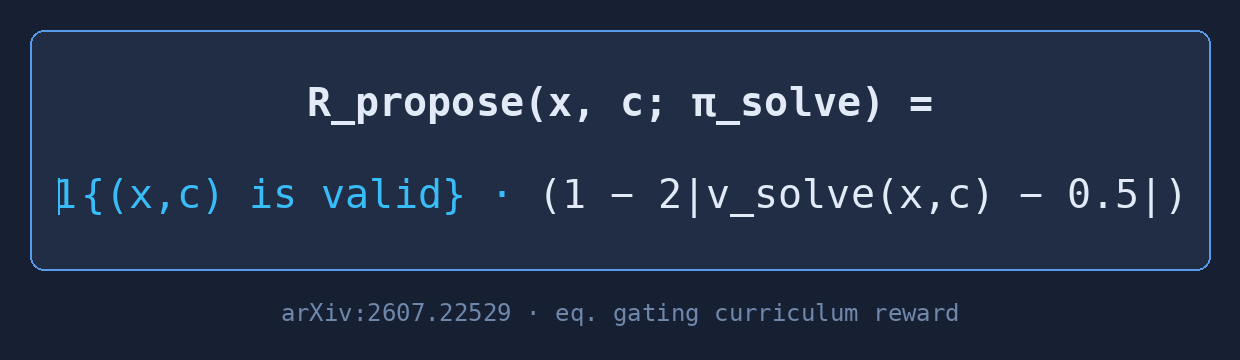
The first term, 𝟙{(x,c) is valid}, is a binary filter: the task contract (x, c) must be structurally valid — i.e. the environment must actually be able to run c to check y — otherwise the entire R_propose is forced to 0. The second term is the medium-difficulty score. The smaller |v_solve - 0.5|, the higher the score — in other words, the Proposer is rewarded for producing tasks whose current Solver success rate hovers near 0.5.
Why 0.5 and not 0.1 (extremely hard) or 0.9 (extremely easy)?
- Too hard (
v_solve ≈ 0): the Solver gets no learning signal, the reward is just noise. - Too easy (
v_solve ≈ 1): nothing is learned, it is busywork. - 0.5 is the “one good push and you get it” sweet spot — RL converges fastest there.
The gate is the crucial part. Without it, the Proposer would learn to “produce problems that look complicated but where c is an empty shell.” Rewards drop to zero, which forces the Proposer to ship real tasks. This is exactly what the paper’s title means by Co-Evolving Skills — not only the skill library evolves, the Proposer–Skill–Solver trio is constantly disciplining each other.
3.3 How the Skill Controller Is Actually Built
The paper does not publish the full code (Qwen’s IP stack), but it does specify the contracts on the three operations:
- Update— a skill bundle =
(executable template, verifier code, example set). When the Controller receives a Solver trajectory on that skill, and the failures cluster around a specific boundary, it auto-appends new test cases. - Archive— the Controller maintains a “cooling queue.” Any skill that the Proposer does not sample for
Nconsecutive rounds (the paper does not give me a specificN) is moved into archive to free capacity in the main library. - Induce— this is the most interesting one. The Controller runs a lightweight clustering pass (using
all-MiniLM-L6-v2+ PCA, per Figure 5b’s description) and groups the high-frequency “programmatic structures” coming out of the exploration stream (e.g. “always require deduplicating then sorting a list”) into brand-new skill bundles.
That Induce pipeline is, in practice, “automatic discovery of reusable priors from the data distribution.” It is the same idea as option discovery / hierarchical RL in classical RL — but applied to LLM data synthesis, which is genuinely new ground in 2026.
4. Experimental Data: Who Gets the Lift, Who Doesn’t
The paper evaluates on two domains: tool calling (API-Bank + the four BFCL splits) and logical reasoning (ZebraLogic, four difficulty tiers). Table 1 is the core dataset. Let me re-organize it by base-model size:
Strong 8B-class bases (Qwen3-8B)

Weak <8B bases (Ministral-3-8B and similar, hard to train)
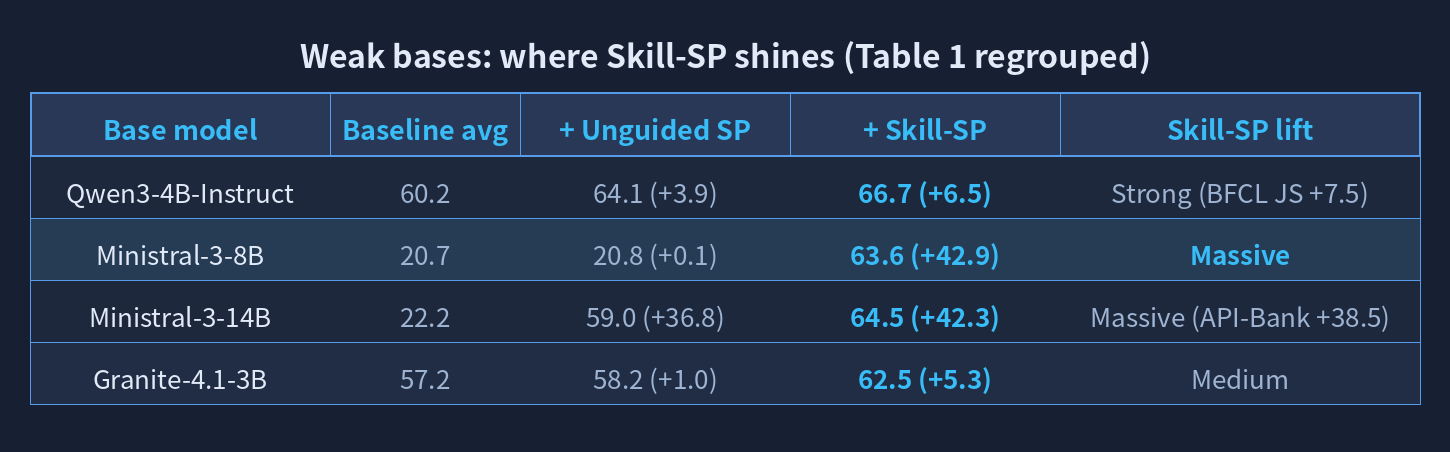
The row worth dwelling on isMinistral-3-8B: the base model scores 20.7 (basically cannot use tools yet), Unguided SP does nothing for it (+0.1), but Skill-SP yanks it up to 63.6 (+42.9). The reason is that a weak base does not even know “what kind of tool-calling question to write” — Unguided SP sets it loose and it just produces garbage questions. Skill-SP’s library gives it the prior “what a good tool-calling question looks like,” effectively bolting an external curriculum onto it.
Compare that to Qwen3-8B, which is already strong — Skill-SP still lifts it, but only by +2.8. This confirms an industry intuition:the marginal return of self-play is inversely proportional to the base model’s strength.Weaker bases need curriculum steering; stronger bases can self-sustain. Qwen’s positioning of Skill-SP as “small-model rapid usability” is not accidental.
5. Ablations: Which Knob Breaks If You Yank It?
The paper keeps the ablation study tight — four dimensions:
Cut 1: No skill routing at all (Unguided SP)
This is the baseline. We already saw it above: small models barely move (Ministral-3-8B +0.1), big models move a little (+1.6). Conclusion: skill routing is the core value. Remove it entirely and you are back to vanilla self-play.
Cut 2: Skill-only (100% skill stream, no exploration)
Skill-only training loses points on every base, averaging a 4.1-point drop. The intuition: if every task is built around an existing skill, the distribution slowly shrinks to a handful of high-frequency skills. The Solver overfits to those skills and its general capability actually regresses — textbook overfitting to the training distribution.
Cut 3: Frozen skill library
A frozen skill library (skills do not evolve during training) loses 2.3 points on average. That means the Skill Controller’s update/archive/induce trio is doing real work, not decoration.
Cut 4: Uniform routing
Uniform routing (no execution-feedback-driven routing) loses 1.9 points on average. Dynamic routing — the Controller decides which skill deserves more training based on the Solver’s actual performance on each skill — beats static allocation.
Pulling the four ablations together:every layer of Skill-SP is load-bearing. Yank any one of them and performance drops, especially on small models.
6. A Few Caveats From My Own Read-Through
(The following is my judgment based on the paper’s content. Not all of this is stated by the paper itself.)
1. Training cost is non-trivial
The paper does not state exact GPU-hours, but five iterations × training five different-size bases × two task domains adds up to thousands of GPU-hours at minimum. This is not something an individual developer replicates directly. If you want to play with it, my suggestion: start with a 7B-class model and run 1–2 rounds to see whether the skill library can actually grow in a stable way.
2. The skill library’s initial seed is everything
The paper does not detail where the library’s initial seed comes from (hand-curated by the Qwen team? bootstrapped through a few rounds of Induce?). For a team like Qwen it is almost certainly a human-seeded kickoff. If you want to build your own,the best thing you can spend time on is not the RL algorithm — it is the initial quality of the skill library.This is a classic data-flywheel pattern in industrial projects: human seeding sets the ceiling, automatic evolution handles ongoing improvement.
3. The application domain has a boundary
The two domains the paper validates (tool calling + logical reasoning) both haveclear machine-verifiable contracts.If you care about open-ended dialogue or creative writing where there is no c, Skill-SP does not directly apply. But the principle transfers: split “task quality” into a machine-checkable proxy (length, diversity score, style embedding), gate the reward on it, and the core idea still works.
4. Not RLHF, but complementary to it
The paper uses GRPO-family RL algorithms to train the Proposer and Solver (the paper does not specify exactly which one, but the code citations point to the verl framework lineage). This is different from RLHF’s “train a reward model” — Skill-SP’s rewardcomes directly from the environment, with no human-preference model in the loop. That makes it more stable than RLHF in “verifiable reward” domains, but in “human-judgment-required” domains you still need RLHF. The two are not substitutes.
7. One-Sentence Summary
Skill Self-Play’s engineering philosophy is:acknowledge that LLM free generation is unreliable, but do not strip its room to play — frame it inside a verifiable, extensible, evolving skill library, and let it loose inside that frame.For anyone working on LLM training this paper is required reading; for anyone building agent systems it is also required reading. You do not need the full Skill-SP framework, but the abstraction “dynamically maintained skill library” almost certainly fits whatever project you are running.
Paper: arXiv:2607.22529. Code and weights will be open-sourced to HuggingFace following Qwen’s usual cadence — watch the Qwen repo for the next release.
Reference links
- arXiv paper: https://arxiv.org/abs/2607.22529
- Qwen team HF page: https://huggingface.co/Qwen