
Can integrity culture stand on its own? A new NBER working paper uses 25 years of housing transactions to give an uncomfortable answer.
In 2010, the station locations for a new Singapore metro line were still in internal planning. Before the announcement, private home transactions within one kilometer of the future stations showed a peculiar pattern: civil servants were buying. They entered one to two years before the public knew, and exited quietly after. On average, one purchase earned them about a year’s salary.
That picture led me to a question I have been carrying around: we often hear “culture” and “self-discipline” invoked to explain why an organization stays clean. But can culture really stand on its own? Or is it more like a battery that leaks charge if nobody tends to it?
With that question, I read a working paper published this September by four economists from Columbia, Stanford, and the University of Hong Kong. They had every private home transaction in Singapore from 1995 to 2019 — not a sample, the universe.
One important note up front: this is an NBER Working Paper (No. 35756, DOI: 10.3386/w35756). It has not been peer-reviewed, and the conclusions may change in later versions. After publication, Singapore’s Public Service Division said on September 14, 2026 that it is reviewing the paper and will refer the matter to the Corrupt Practices Investigation Bureau if there is substantive evidence. That is the government’s reaction after publication, not part of the paper itself.
The Crack in the Data
The researchers focused on a behavior they call an informed purchase — in plain words: knowing a metro line is coming, and buying a home near it early. A station’s location is nonpublic government information before the announcement, and common knowledge after. That timing gap is a natural touchstone.
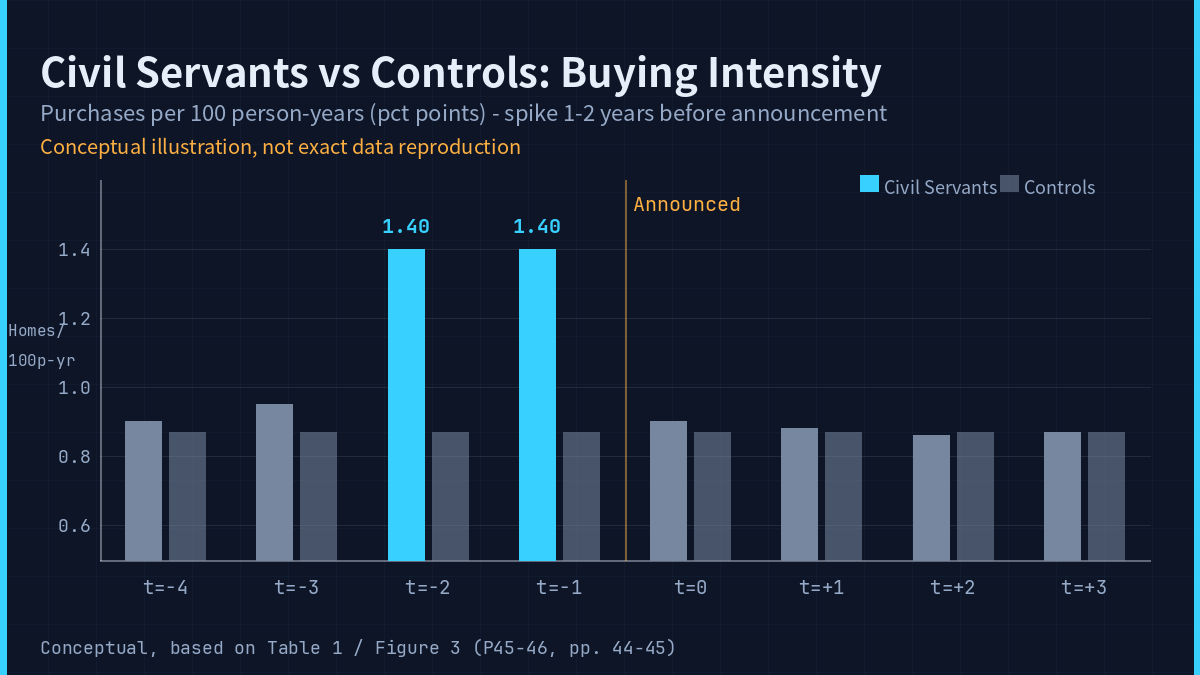
What did the data show? In the one to two years before an announcement, civil servants bought more homes within one kilometer of a future station. Their buying intensity rose by more than 60 percent relative to normal. Put differently, out of every hundred civil servants, roughly half to 0.7 of an extra home got bought. In the announcement year and after, the gap vanished. They were not chasing a rising market. They were stepping in ahead of the news.
The key caveat: the paper identifies “a pattern consistent with access to nonpublic information,” not direct evidence of insider information passing. The paper’s own language is “consistent with informed trading.” Throughout this article, I describe patterns in the data, not proven cases.
But you might ask: civil servants earn well, so maybe this is just what rich people do?
It Was Not Just the Rich
The researchers built matched control groups using propensity score matching — a statistical method for finding people who look almost identical. Same age band, same building (six-digit postal code), similar income, with one difference: not a civil servant. They found 28,529 such pairs. Then they ran the full transaction record, nearly 150,000 observations.
The early-buying crack appeared only among civil servants.
They were not done. Three more exclusions followed. First, a placebo test: shuffle the data a thousand times and see if the result survives. In almost none of those thousand shuffles did luck reproduce the pattern (bootstrap p-value < 0.005). Second, the public housing market, where prices are set by the state, showed nothing. Third, real estate agents and corporate directors, the best-informed private buyers, showed nothing either.
So it was not the rich who bought. It was the people who knew. Which raises the next question: among hundreds of thousands of civil servants, who exactly was buying?
Who Was Buying: Not Who You’d Expect
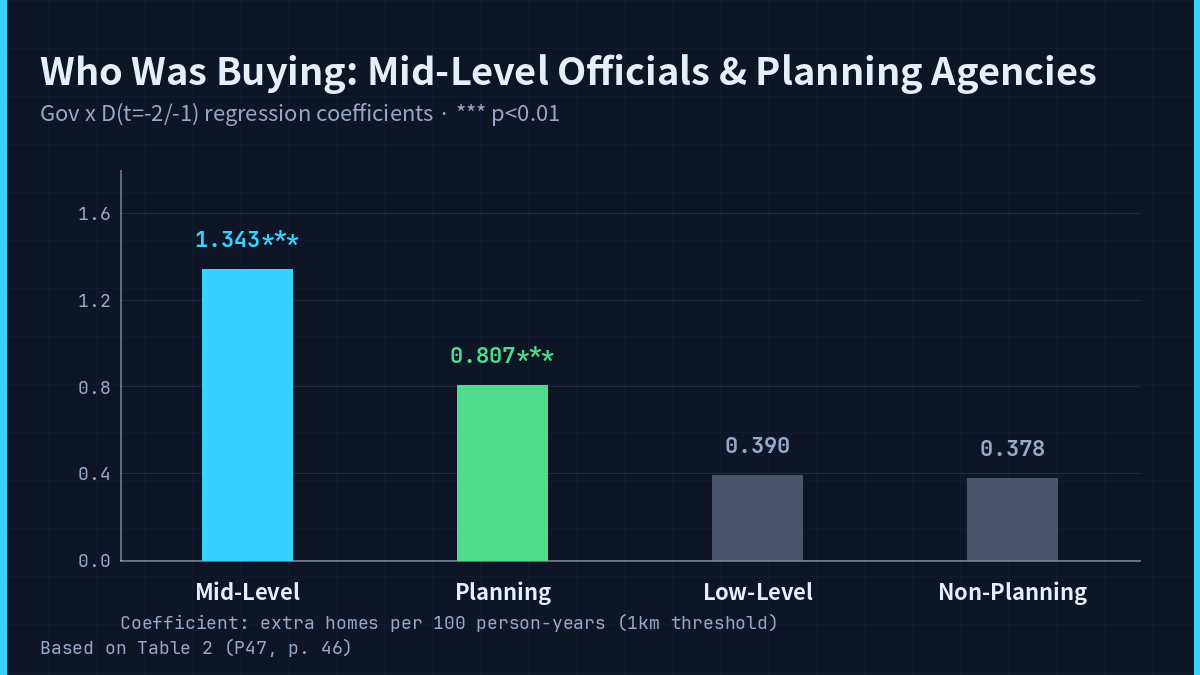
The answer cuts against intuition: not the most senior officials, but the mid-level ones.
Split by rank, the effect concentrates almost entirely in mid-level officials and in planning agencies. The regression coefficient for mid-level officials is 1.343 (statistically significant, p<0.01), meaning roughly 1.3 extra homes per hundred mid-level officials in the two years before announcement. The planning agency coefficient is 0.807, also highly significant. Low-level officials and non-planning agencies show no significant effect.
The paper’s model predicted exactly this shape, and gave it a name: the middle-concentration regime.
Here is a concept worth holding: reputational capital, meaning what a clean record is worth. Senior officials live under the spotlight. Their reputational capital is too thick to risk for one apartment. Junior officials lack the resources and the access to the core information. Only mid-level officials sit where they can see the plans, while their names are not yet that expensive.
This finding resonates beyond Singapore. In many organizations, the risk of information leakage sits not at the top or the bottom, but in the middle — the layer that has access to sensitive information but has not yet been placed under intense scrutiny. This is a structural vulnerability in organizational design, not a Singapore-specific problem.
A Full Year’s Salary
Picture this scenario, and note it is an imagined case, not a real one. In 2010, a mid-level planning official sees an internal route map in a Monday meeting. By the weekend, he is standing in a show flat along the line. He did not overpay: the paper checked, and these buyers paid no premium. What was valuable was not the home. It was the timing.
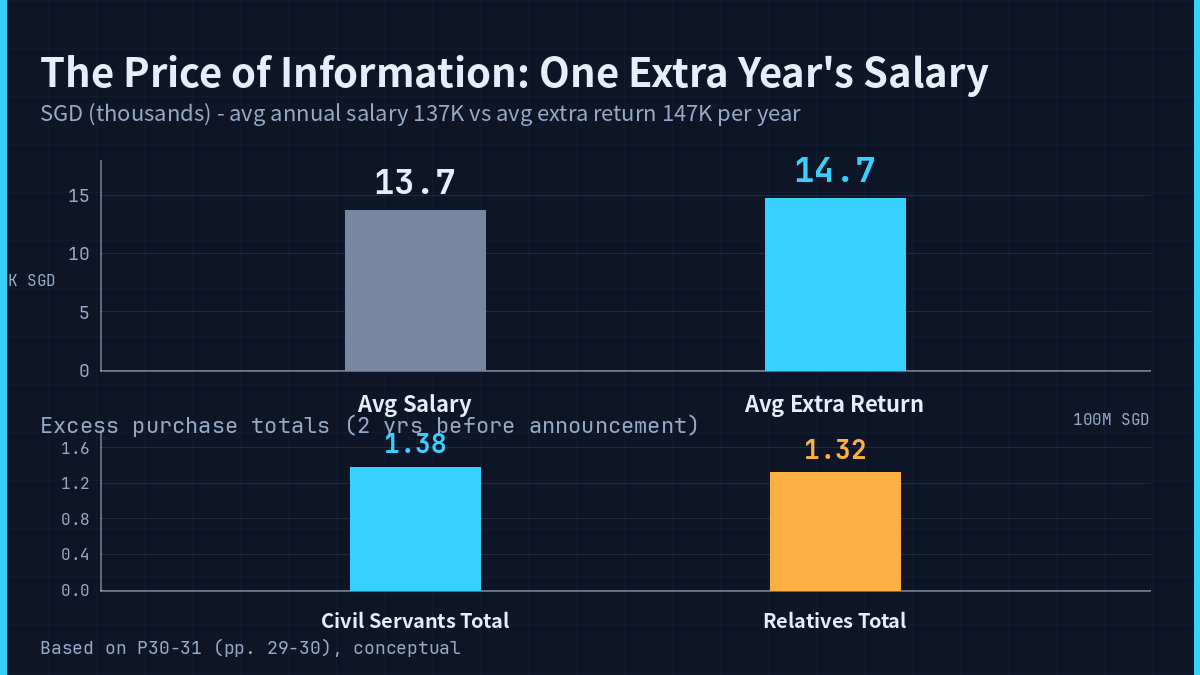
The average home in this group cost about 1.22 million Singapore dollars. The paper’s estimated non-leveraged extra annual return averages 12 percent, with a median of 5 percent. That works out to roughly 147 thousand dollars per home per year. The average civil servant’s yearly salary is 137 thousand.
One home earned an extra year of salary. That is the price of inside information. With leverage (the paper assumes 80% LTV, 30-year fixed rate), the average annualized return reaches 57.9 percent.
The News Leaked Over Dinner
What is more striking, that price was not being collected by one person alone.
The researchers also checked a special group of buyers: people registered at the same address as a civil servant — in other words, relatives. Note that they had no family relationship data; they inferred kinship from shared addresses, which can misidentify people or miss them.
The relatives of civil servants also bought at unusually high intensity, one to three years before announcements. How big was this? Excess purchases by civil servants in the two years before announcements add up to about 138 million Singapore dollars. On the relatives’ side, about 132 million. Two ledgers of almost equal size.
The information leaked through family networks, essentially intact. This makes me think of something more general: when a person holds valuable information, keeping it fully contained is nearly impossible. Information naturally flows along trust networks. This is not a moral failing; it is human nature.
The Teeth Come Out, and the Pattern Vanishes
At this point the story looks like a hopeless loop. But in 2011, something changed.
Between 2011 and 2012, Singapore did three things in a row. The Securities and Futures (Amendment) Act 2012 broadened insider trading rules and stiffened penalties. The Official Secrets Act was revised, widening the shield around government information. In the same period, several senior officials fell to corruption cases, including at the Central Narcotics Bureau, the Singapore Civil Defence Force, and the CPIB itself — the agency that investigates corruption.
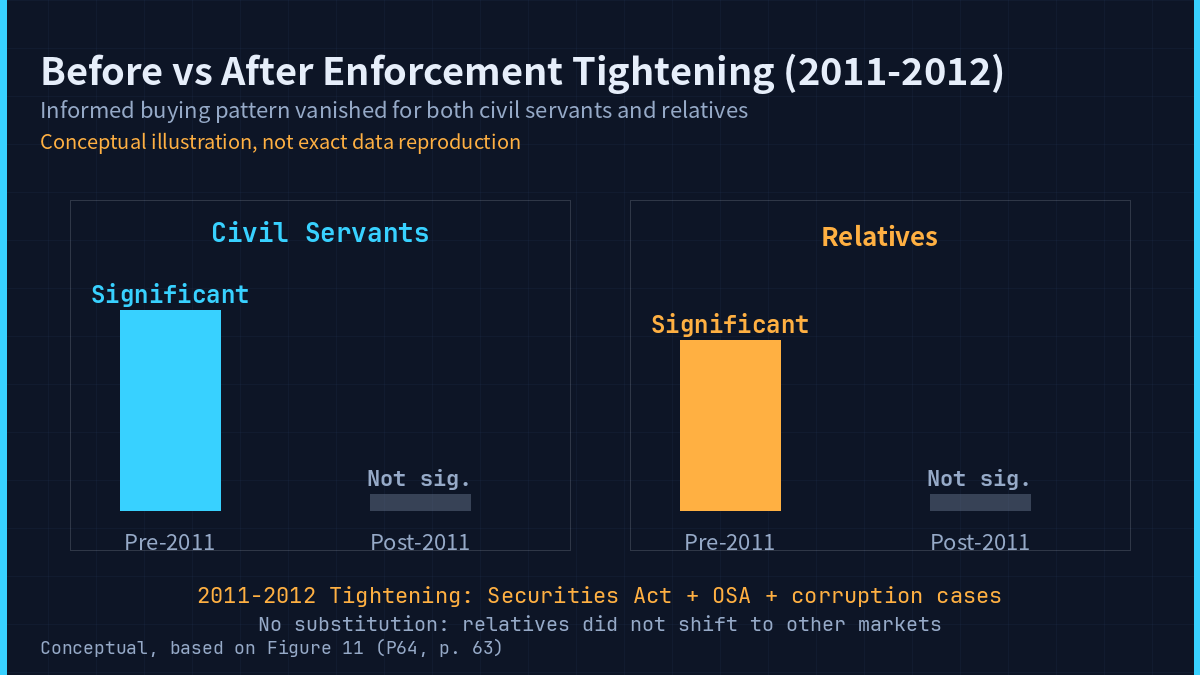
After 2011, the early-buying pattern among civil servants disappeared, and the relatives’ pattern disappeared with it. There was no substitution either; they did not move the trick to some other market.
At the behavioral level the evidence is clean: enforcement moved, and the pattern stopped. What strikes me most is not that misconduct was curbed, but that there was no substitution effect. This means enforcement did not just block one path; it recalibrated the entire group’s behavioral expectations.
The Norms Had Already Slipped Before the Crackdown
But a deeper question remains: why did the tightening happen in 2011, of all years?
The answer hides inside two large social surveys. The Asian Barometer Survey asked: have you witnessed corruption, and do you think officials are generally corrupt? The World Values Survey asked: can you accept taking favors, dodging taxes, skipping fares?
Pulled onto one timeline, from 2006 into the early 2010s, perceived corruption was rising, and tolerance for these behaviors was rising with it. The norms really were slipping. Then enforcement tightened, and by 2020 both measures had fallen back toward their earlier levels.
So the full story runs like this: norms eroded first, enforcement stepped in, and norms were pulled back. They did not heal on their own.
My reading: the survey data is actually more alarming than the housing data. The housing data tells you someone cheated. The survey data tells you that before anyone cheated, the whole society’s immune system was already weakening. If you only track violations, you might think “it’s not that bad.” But pull up the survey data, and the foundation was already crumbling. That means social surveys should not just be academic tools; they should be early-warning systems for integrity regimes.
Norms Are a Leaky Battery
The paper’s model can be told in one breath. It treats a society’s reputation for integrity as an asset — the reputational capital we just met. That asset has inertia: yesterday’s clean record is still worth something today. But it also decays: the more people cheat today, the less that record is worth tomorrow. Like a battery that leaks charge, it drains just sitting there.
Enforcement plays two roles here. First, teeth: raising the expected cost of getting caught, a direct deterrent. Second, a charger: a clean record is only worth keeping if someone takes it seriously.
The paper’s mathematical conclusion is called complementarity: norms and enforcement have a positive cross-partial derivative (higher norms increase the marginal effect of enforcement; stronger enforcement lowers the cost of maintaining norms). One sentence: the stronger the norms, the less enforcement you need; but remove enforcement, and the norms decay on their own.
The logic is elegant, but I have two reservations.
First, the model treats reputational capital as a single aggregate variable. In reality, different groups price reputation very differently. Senior officials face stronger reputational constraints, but the model does not explain why mid-level officials’ constraints are “just weak enough” for them to act — it can only say the data matches the middle-concentration prediction. A prediction and an explanation are not the same thing.
Second, the model has a key parameter called norm persistence (φ), ranging from 0 to 1, whose true value the government does not know. The paper itself acknowledges that they “do not pin down the magnitude or duration of norm persistence.” This means the model can tell you norms and enforcement are complements, but it cannot tell you how much enforcement is enough.
Four Soft Spots Before You Buy It
First, restate the authors’ case fairly: the data holds a buying pattern consistent with advance knowledge, concentrated among mid-level officials and planning agencies; after the 2011 tightening, that pattern vanished; survey data shows norms eroded before the crackdown and recovered afterward.
The case has four soft spots.
One, the knowledge is a statistical inference. Timing, department, and location all line up, but no single transaction comes with direct evidence of insider information. The paper itself says this should be interpreted as “a local, reduced-form estimate of potential access to nonpublic information, and likely as a lower bound.”
Two, relatives were inferred from shared addresses, which can misidentify people or miss them.
Three, this is a working paper, not yet peer-reviewed, and later versions may change the conclusions.
Four, Singapore is one of the most successful enforcement stories anywhere — it consistently ranks near the top of Transparency International’s Corruption Perceptions Index. Its effect sizes are likely a lower bound for elsewhere. In other words, if even Singapore needs enforcement underneath its norms, no society should expect the rules to stand on their own.
That said, the paper runs extensive robustness checks: placebo tests, exclusion tests, location manipulation tests — all pointing to the same conclusion. The authors are also careful with their language, never turning correlation into causation.
Norms Are Consumables, Not Assets
I do not want to end with “in summary.” Here is my judgment, plain.
First, a norm is not an asset. It is a consumable. In any society, it wears out when nobody maintains it. Next time you hear “we run on integrity culture,” you can ask: where are the teeth? Who is charging that battery?
Second, the price of information can be measured. This time, it came out to roughly one year’s salary of a Singapore civil servant. When information has a price and oversight has gaps, relying on moral self-discipline to fill the gap is pushing the burden of institutional design onto individuals.
Third, when you read the news, separate the two layers: what the data said, and how the government responded. The Public Service Division’s review is a reaction after publication, not a finding of the paper.
Last episode we talked about how metrics distort behavior. This one goes a layer deeper: can the rules themselves stand? The answer is no. Norms are a battery, not a perpetual motion machine. And the charger for that battery is called enforcement.
Paper: Piskorski, Seru, Zhang, Zhao (2026), “Do Social Norms Substitute for Enforcement?”, NBER Working Paper No. 35756, DOI: 10.3386/w35756. 86 pages, based on universe-level Singapore private home transactions (1995-2019), civil service directory (SGDI, 6 panels), MRT station announcement dates, Asian Barometer + World Values Survey multi-wave data. Methods: propensity score matching, event-study design, dynamic reputation model. Not peer-reviewed.