1. Three days
Shanghai, the morning of October 22. Yang sits down, opens her laptop, joins a meeting. Where do you take a call? For a lot of people, a café is the default. Ten minutes in, no order yet, and a barista walks over. How does that feel? In an hour and a half, she was reminded five times. She told a reporter the repeated nudges felt like being told to leave, and she ended up ordering at another branch nearby.
The trending topic said: reminded five times in one hour. She says it was about ninety minutes, and the shop was nearly empty when she arrived. A sentence clipped into a headline reads more like a rule than it is. Which version do you remember? And who ever told you the whole country runs on that rhythm?
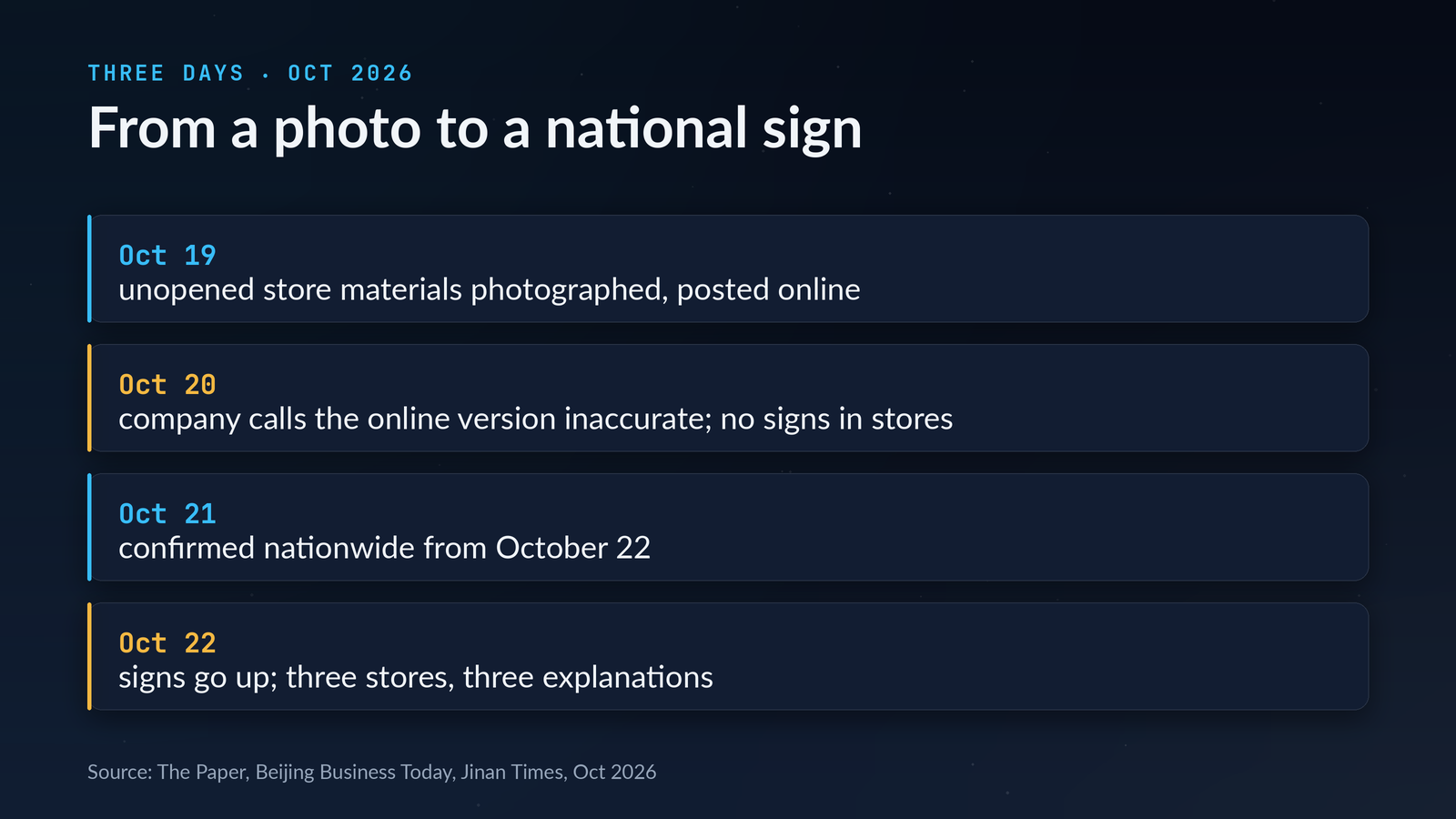
Rewind three days. On the evening of October 19, photos of unopened store materials began circulating: a poster for the “Third Place Initiative”, and under it a row of signs reading “please enjoy your seat after ordering”. On the 20th, the company said the online version was inaccurate. That same afternoon, a reporter walked several Shanghai branches and saw no signs at all; staff said the materials had not arrived. On the morning of the 21st, the company confirmed to The Paper that the policy would start nationwide on the 22nd, with staff following a friendly, courteous approach and priority given to pregnant customers and people with limited mobility. The same day, the initiative was published: four lines about leaving space, quiet, freshness and respect for one another. Nothing in them about a minimum spend, a time limit, or clearing people out. The exceptions were spelled out too: pregnant women, delivery riders, people sheltering from rain, nearby security staff — no purchase needed, and free hot water. One thing has to be flagged honestly: the company’s newsroom page still stops at July 30, and the original WeChat post could not be found, so the four lines rest on Cover News’ full transcription, marked as no verifiable primary source.
On the 22nd the signs went up, and the wording scattered. Beijing denied any “reminder every fifteen minutes”. Jinan said reminders would not exceed three, and that staff would not keep bothering people who had not ordered. Dalian said the reminder would be friendly, and that no customer would be forced to buy or to leave. The rules were written in Beijing; they land at the counter, in the mouth of whoever is on shift. Like one recipe handed to several kitchens — what comes out is not the same dish. I call that gap the wording gap.
2. The arithmetic
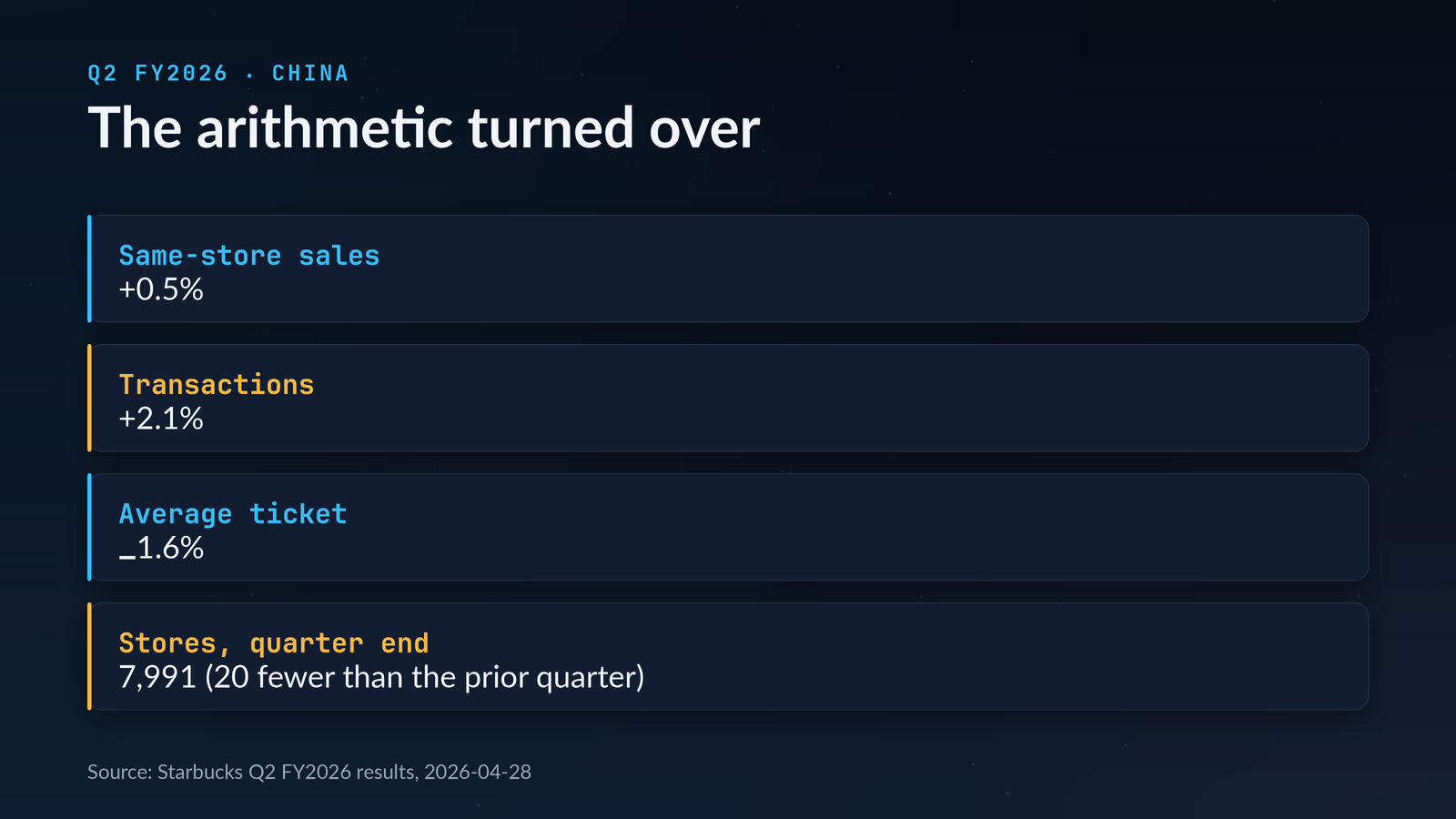
Two words first: same-store sales, whether older shops earn more than a year ago; average ticket, how much each customer spends. In the second quarter of fiscal 2026, China same-store sales grew 0.5%, transactions rose 2.1%, and the average ticket fell 1.6%. More people came in. Each of them spent less. What does that have to do with you? It shows up after you sit down. At quarter end there were 7,991 stores in China, twenty fewer than the 8,011 at the end of the previous quarter.
 In fiscal 2025, China same-store sales fell 1% and the average ticket fell 5%; the market share slid from 42% in 2017 to 14% in 2024 (media figure).
When gold prices rise, gold shops still close. Rent and wages are fixed costs; once volume drops, they cannot hold. The same shopfront: when footfall is rising, whoever sits there is profit; when it flattens, whoever sits there is cost. The counter at the gold shop sat empty too — the old traffic used to pay for it. The chair in a Starbucks has always been the part of that shopfront that produces no revenue.
On November 4, 2025, Starbucks and Boyu announced a joint venture: Boyu up to 60%, Starbucks keeping 40%, on an enterprise value of about $4 billion, with roughly 8,000 company-operated stores moving to licensed operation. The deal closed on March 30, 2026. Licensing, put plainly, means someone else now does the arithmetic, and each store’s output is reported on a regular basis. By the end of September 2026 there were 8,342 stores in China — still opening, just more slowly.
That same 21st, the company announced more than 300 million yuan of new investment for fiscal 2027: peak-hour staff in nearly half its stores, over 270,000 additional service hours a month, and about 1,000 stores refreshed. Huxiu did the math: 270,000 hours is roughly 1,550 full-time equivalents, all pointed at the busiest few hours; 1,000 stores is about 12 percent of 8,342. Money and people pushed toward the peak. What the peak lacks is somewhere to sit. So what do you feel from that 300 million? Faster drinks, not a longer seat.
This layer is staff account, not official text. On October 22, Huxiu reported that several employees said the annual bonus tied to the 14th-month salary would become a quarterly performance bonus linked to store sales and operations; Huxiu added that it had not obtained the full assessment rules. Separately, a store manager with thirteen years at the company said the 14th-month salary had also become a performance bonus. On the official side: the 14th-month salary was added in November 2021 as a benefit for nearly 40,000 full-time partners; on August 12, 2026, 21st Century Business Herald confirmed that Starbucks China had not cancelled it and had not changed contracts. One says it was not cancelled; one says it became performance pay. Which do you believe? Both are on the table. I am not smoothing it over for either side. The official announcement for the China quarterly assessment could not be found, marked as unverified. In September 2026, several employees told reporters that hand-drawn smiley faces on cups had entered the assessment, that a missed one earned a written warning, and that two within a year cost the 13th- and 14th-month pay.
The metric is broken down from headquarters, and the person who ends up at your table is the barista. He has to remind you, and he is afraid you will end up in a trending topic. The back office can be replaced. The front counter is one person. This is my reading: the nudging is a KPI travelling downstream, not a barista’s mood.
3. Lock the chairs first, write the rule later
Before the national rule, there was a clumsy pilot. On September 15, 2026, a store in Nanchong, Sichuan, chained its outdoor tables and chairs, with a note: for paying customers only. Online, people said: this is a coffee shop, not a throne. The store said the outdoor seats filled with elderly regulars every afternoon, and staff could neither persuade them to leave nor physically move them; fifteen signs had been made, all but two thrown away. That afternoon the chains came off, and staff went back to asking politely. Earlier still, on July 2, a Tianjin branch put the sign on every table; among more than 3,000 comments, most supported it, and customer service said the company fully respected customers’ choices. Overseas it moved earlier: in 2025 Starbucks North America updated its store code of conduct, giving paying customers priority and barring non-paying visitors from occupying seats and restrooms long-term; in South Korea, stores banned desktop computers and printers. For China, this is the first time in 27 years that the line has been written into a rule. The ones photographed and criticised have always been the staff on the floor. The moment you are reminded at the counter, the order behind it is this: first it gets photographed, then it gets written down.
4. That chair
The “third place” was not invented by Starbucks. In 1989 the sociologist Ray Oldenburg proposed it: a place that is neither home nor work, where people are willing to stay, usually around a drink. Starbucks turned it into brand narrative; the founder told it as his own idea, and the company’s story page still says “third places”. Oldenburg was not pleased: “They used it without even asking me. That’s a bit much.” A borrowed word became someone’s own signboard. Whoever’s name is on the signboard sets the rules.
In January 1999 Starbucks entered the mainland and brought the idea along. Since then, a free afternoon has been the default expectation. It was never free: rent, air conditioning, sockets, Wi-Fi, staff hours — all folded into that cup of coffee in the thirties. While the rule stayed unwritten, the brand paid for everyone. Why would it? Because people who sit in the shop carry away the cup, the photos, and their next choice. The seat is an advertising budget. When the budget tightens, it is not that the brand turned stingy; the maths of footfall stopped working.
In July 2025, stores in Guangdong, Guangxi and Hainan tried the opposite: a study room, no purchase needed, no time limit, no booking, free sockets, hot water, Wi-Fi. A year later, the same company put up signs nationwide asking people to order before sitting. Free was tried, squatting was tried; what is left is a price tag.
Not only Starbucks charges by the seat. Sichuan-based Vector Coffee has long required at least one order per person to sit. On October 22, a reporter visiting McDonald’s and KFC in Dalian found both allowed people to sit freely. Same business, different answers: bookshops sell books, fast food sells meals, and the seat is a supporting actor. Whoever makes money from seats has to manage seats. Luckin and Cotti, built around pickup, and Starbucks, built around space, are not selling the same product.
So I do not believe this is about sentiment. When footfall rises, a seat is a loss leader — empty anyway, and the person sitting there may buy next time; when same-store sales flatten, the ticket falls and the new owner wants output per square metre, the seat becomes a cost item. The part given away was a budget the brand spent on goodwill while it was growing; once the budget tightens, it turns back into a price.
Tang Jiansheng, deputy secretary-general of the Shanghai Consumer Council, says ordering before sitting is basic commercial practice, while short rests are a public-service matter, and both sides need to accommodate each other. That holds up on both law and cost. The merchant has priced the seat. The public side has not been priced yet — the wording gap has closed on one side of the counter, and the question on the other side has only just opened. When you are the one turned away, where do you sit? The places that can be documented are few: benches in malls, libraries, subway concourses, community centres. Where the next sign will go up, you can probably guess.