
Last time, the author held something down.
In the earlier lecture he said that the question of rational behavior still had no satisfactory treatment.
He also set something else aside: utility. That lecture assumed what you want is money, and stepped around the question of how much you want it.
This lecture lifts that hand. It answers one thing head on: how much you want something can be measured. It is a number you can calculate.
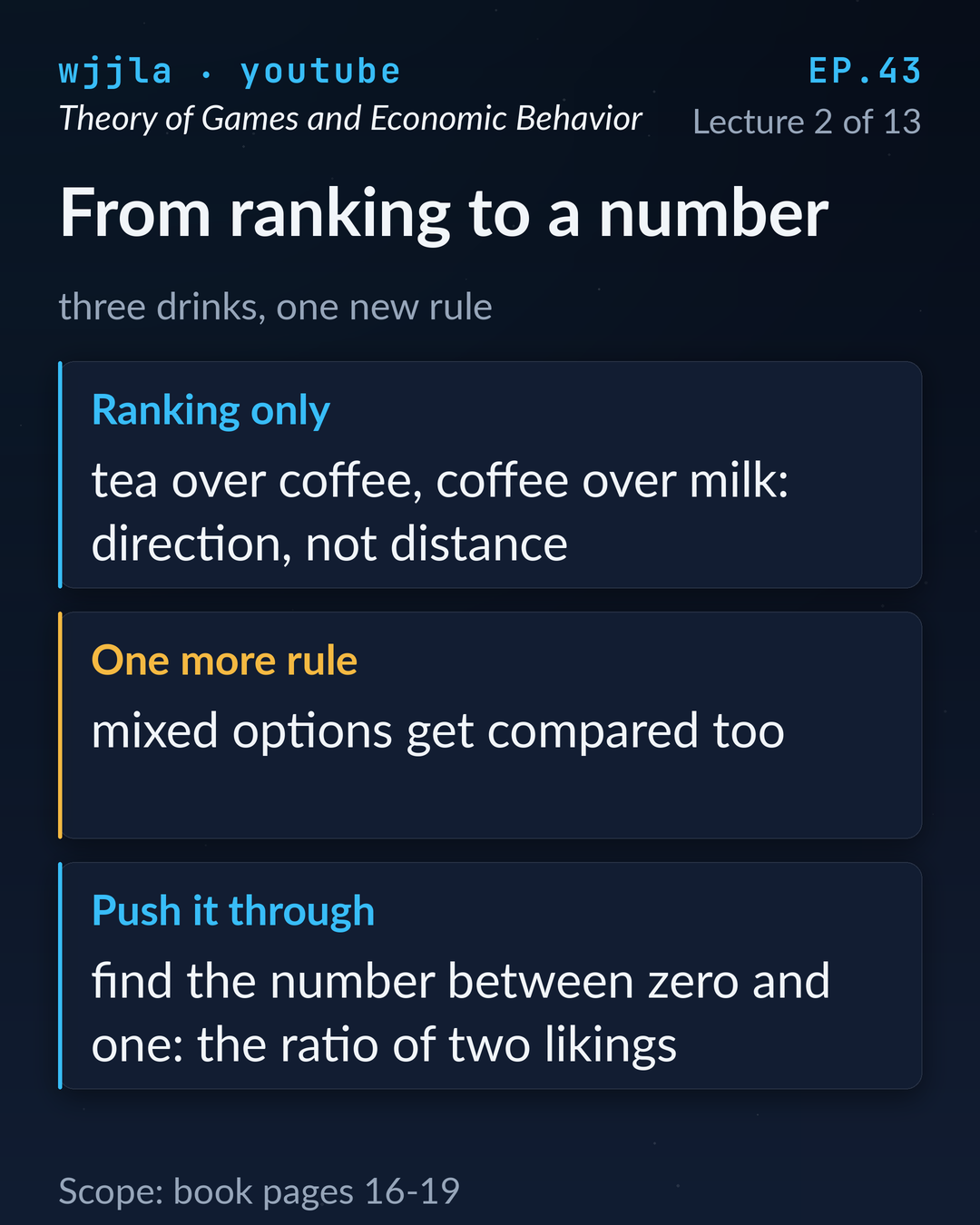
Start with three drinks. The author’s own example: a glass of tea, a cup of coffee, a glass of milk.
You prefer tea to coffee, and coffee to milk. The ranking is perfectly clear.
Then he asks: is the extra liking you get from coffee over milk bigger or smaller than the extra from tea over coffee?
You cannot answer. You can say you want it more. You cannot say how much more.
1. Between “wanting more” and a number
Let us put the gap plainly.
“Tea over coffee” is a ranking. A ranking gives direction, not distance.
It cannot answer a more basic question: inside one person, can these two likings be added together?
The author says there is no sensible way to add up two utilities of the same person. So the claim that utility is not a number at all begins to look reasonable.
Why not simply skip the problem? Because skipping it leaves nothing to write with.
The rest of the book puts your choices into mathematics. Something in the middle has to turn “I prefer A to B” into “A is seven and B is three”.
Without that step, expectation cannot be written, and neither can sums or differences.
So his order is: first show the translation works, then use it.
Why believe the translation works? He borrows a piece of scientific history.
When the theory of heat began, it stood in the same place. One body feels warmer than another, and you can feel it. By how much, how many times, measured how, nobody could say.
How did heat finally become numbers? Not one number. Two: quantity of heat, and temperature.
Quantity of heat adds directly: pour two buckets together and you get the sum. Temperature does not add that way: two cups at fifty degrees poured together stay at fifty, not one hundred.
Temperature became a number through the steady behaviour of gases, which settled a scale that would not budge.
Why is this history worth borrowing? Because precise measurement is often the result of a theory, not its precondition.
The objection says utility cannot be measured, therefore it cannot be mathematised. My reading is that the author uses the history of heat to reverse the causality: it could not be measured, often because the theory had not been built yet.
The temperature road took a long time. At first people knew only “warmer”, and temperature was a number good up to any monotone transformation. Measuring with ideal gases narrowed it to a linear scale. Thermodynamics then fixed absolute zero.
Utility today has one relation, “wants more”, and sits at the loosest level. Indifference curves express exactly that position.
The real turn comes from one move: bring probability in.
The author asks you to suppose that you can state a preference about anything imaginable. Now add one rule: combinations with probabilities also get compared.
The same three drinks. Coffee, or a drink decided by a coin toss, half tea and half milk. Which do you take?
Your answer to the new question carries information the ranking did not.
You prefer tea to coffee, and coffee to milk. Now say this: you prefer coffee to that half and half drink. That sentence has content. It says the step from tea to coffee is bigger than the step from coffee to milk.
Follow the move all the way down: find a number between zero and one that makes tea, for you, exactly as desirable as coffee at that probability and milk with the rest.
That number is the ratio of the two likings. The step from ranking to numbers is exactly this step.
Euclid made the same argument for points on a line. In economics, Pareto pointed it out first.
On probability he does not blur the line. If it is going to build numbers, it cannot be an unspoken feeling.
The simplest route: probability is frequency in long runs. A footnote keeps an exit: if you reject that reading, axiomatise probability and preference together.
2. What guarantees the number: three groups of axioms, and three places he marks himself
The number exists. What keeps it from being word play?
The author writes the requirements down as axioms. Every later step that uses numbers has to accept them.
First group, complete ordering: given any two utilities, exactly one holds, equal, preferred, or less preferred, and no cycles.
Second group, ordering and probability must fit together: what you prefer stays preferred when a little probability is mixed in.
The other half of it: when two options both fall below a middle one, a small enough chance of the preferred one cannot lift the mixture above that middle.
Third group, the algebra of mixing: the order of mixing does not matter, and two steps equal one.
Why insist on probability at all? Because if probability is going to build numbers, it has to stand on something that can be observed again and again.
He also refuses Pareto’s easier route, narrowing the scale by requiring that equal utility differences stay equal. His reason: that relation cannot be explained by observations anyone can repeat.
He replaces it with a natural operation: combine two utilities at a given probability. That step narrows the translation from utility to number down to a linear transformation.
The appendix added for the second edition cashes this claim in as a proof: such a correspondence exists, and only a linear transformation is left free.
He adds one limit: no absolute zero is fixed, and no absolute unit either. So “utility is a number” is not “utility is money”.
At this point he stops and asks himself: are we proving too much?
Mathematical expectation has always been contested. Could you have a taste for gambling itself, a liking the expectation quietly drops?
His answer is not a defence. It is a change of wording: numerical utility is whatever makes the calculus of expectations legitimate.
The appendix gives an example: Bernoulli defined utility as the logarithm, and every axiom still holds. The special feeling of a gamble gets absorbed by a suitable definition.
Then the most valuable part. In the appendix he marks the places where his own argument can be hit.
First, completeness. A person may simply want two utilities to stay incomparable. He says himself that treating full comparability as a fair idealisation is very dubious.
Second, the rule that a small enough chance cannot override. Give it up, and you admit infinite utility differences. He does not think that is worth it.
Third, and the most critical: the rule for combining itself. A special utility for gambling can exist only if that simple rule fails. To hold it, the axioms would have to change, and the mathematics gets much harder.
He leaves the sentence in the book and hopes someone finds the road.
In 1953, Allais published a long paper in Econometrica aimed at exactly this line: the utility axioms, and the appendix. (Outside the book.)
He does not deny that utility can be defined operationally. What he rejects is something else: defining a rational person as one who obeys a set of axioms, then announcing that whatever follows is rationality. Such a definition, he says, is not worth arguing about.
This is my reading: the author trades an empirical question for a definition, and that trade is what Allais refuses. Their disagreement is not about mathematics. It is about who gets to define the word rational.
By this point utility is a number. The moment it is, a new question arrives.
3. Once the numbers exist, what counts as an answer
Utility can be measured, so take one step further: inside a situation, every way of splitting the payoff can be written as a set of numbers, and compared.
So the question changes: which splits count? What kind of answer should the theory hand over?
The author starts with a plain version: give every participant a rule that says how to move in each situation.
Then he blocks the easy road. Assuming everyone else is rational is not enough. If someone who departs from the rule does better, the rule abiding player loses, and the answer does not hold.
So the rule must have a reply for any behaviour by the others.
Utility is a number, so the enormous catalogue of rules collapses into one sentence: how much you get if you behave rationally.
Push that number to several people, and the author gives it a name, an imputation: a set of numbers saying how the total payoff is divided.
What if the answer is a single set of numbers? Then you have an absolute equilibrium, with your share pinned exactly.
He says such an answer generally does not exist. The two person case, where your gain is my loss, is the exception.
So he relaxes the demand. Three people divide a total, and any two of them can join and take more.
The question becomes: how is the coalition split?
Here comes the liveliest detail in the chapter: room to bargain.
If the rule gives you too much, your partner can leave and join the third player, and take more. You would rather give something up and keep the coalition.
Three possible two person coalitions, three splits. So the shape is fixed: the answer is not one set of numbers, but a system of splits.
Stability belongs to the whole, not to any single member.
How do you compare two splits, then? Not the way you compare sizes.
He gives the relation a name: domination. Society is considering split B, and split A is put on the table. If enough people prefer A for their own sake, and believe A can actually be delivered, A overrules B.
Here is the trouble: domination does not carry over. A is dominated by B, B by C, and C by A. This happens.
Why? Because the “enough people” each time can be entirely different groups. The conclusion from the first two groups says nothing about the third.
He agrees this is annoying, then says it is an old social fact in different words: groups keep overturning each other’s positions.
My reading: what fails here is not the mathematics. What fails is the phrase “who decides”, which changes with every coalition.
So the answer can only be a whole system.
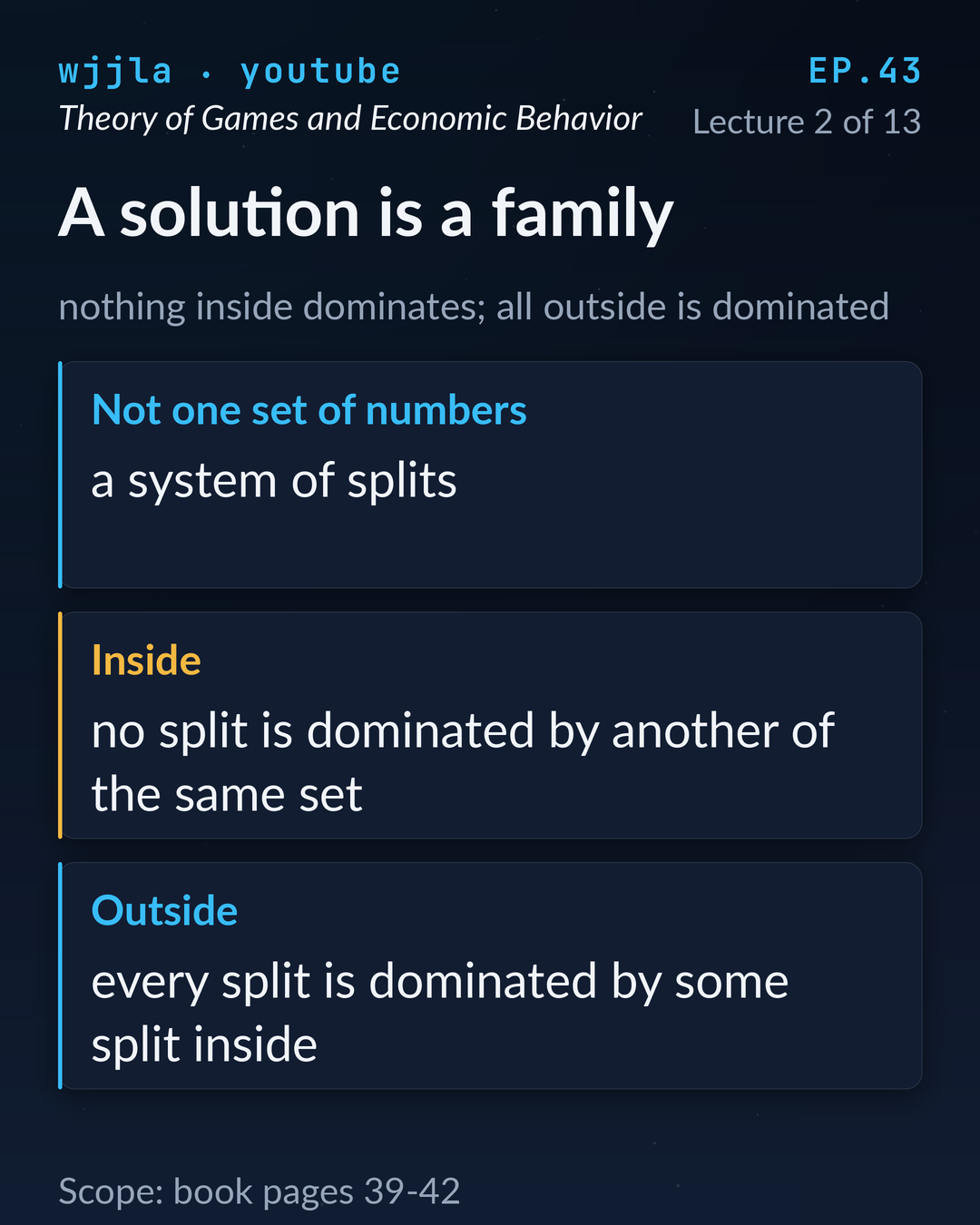
His final form: a solution is a set of splits. Two requirements. Inside the set, no split is dominated by another split of the same set. Outside the set, every split is dominated by some split inside it.
Then he takes his own definition apart: nothing guarantees such a set exists, or that only one does. In his words, we have not defined a solution; we have described its properties.
Then he ties the set back to something you know: an accepted standard of behaviour.
A society facing given material conditions never adjusts a single frozen split. It adjusts a family of splits, broadly in tune and different in detail. That family is the established order of the society.
Put together: a standard of behaviour, once generally accepted, overrules everything else. Inside it, no part can be overturned. That is what he calls inner stability.
The price is not hidden: existence is not negotiable, and if no solution can be found the theory must change. Uniqueness is not promised. On the same material base, several standards can stand, each stable and each contradicting the others.
He also draws a boundary. What he wants is not what ought to happen by some prior principle, but where the balance of forces lies.
The last pages are a list of reservations. The theory is entirely static. The complete answer is not one split, but the set of all solutions.
As for what a dynamic theory will look like, he closes with one honest line: on a subject full of uncertainty and obscurity, this is of course only a surmise.
Last time we ended on this: with more players, the order of the variables turns around.
This time the second line connects: with more players, even “which answer” stops being one.
Three splits lie on the table, and all three claim to stand. The book does not say which one is right.
— So how much is your wanting worth?