
You and the broker have your eye on the same apartment.
You name a number, he answers with a line. You name another, he answers again.
After three exchanges, what you name is no longer the price but what he will think of you.
From the moment you speak, this number is no longer yours alone to set.
Two shops at the corner fight over one customer. Two countries refuse to yield over one lane. You and a colleague compete for one promotion.
What these share: every move you make starts with a guess about how the other side will move.
Theory of Games and Economic Behavior opens with more than ten pages and not one chessboard.
It wants to answer only one line: when interests collide, how do people compute?
1. One person’s number and two people’s number are not the same kind
The book first shows you a solitary island.
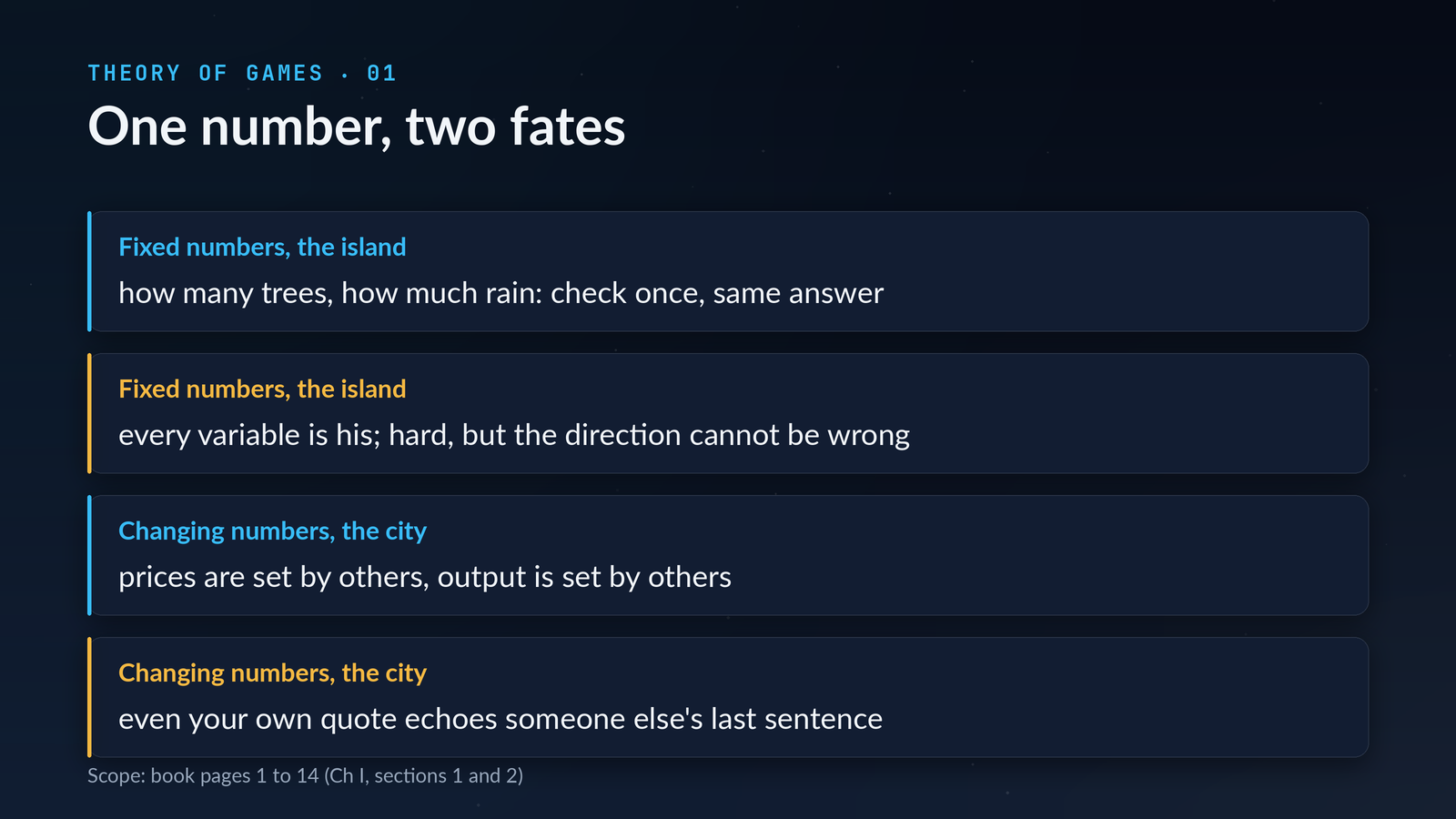
Robinson alone on the island. How big it is, how many trees, whether it rains: all laid out, all his to arrange.
The rain does not consult him, but it does not change its mind either.
These numbers are easy to compute. The variables sit in his hand. At worst the work is hard, but the direction is never wrong.
The book calls this a problem of maximizing the result.
Trouble begins when he returns to the crowd.
You too want to maximize your result, but mixed into that result are things you cannot set.
The other side’s offer, the rival’s output: none of it is yours to set.
On this the author gives his judgment: no longer a problem of maximizing one result, but several things each maximizing and clashing.
Classical mathematics has no ready-made solution.
Each person follows their own plan. No one can set every variable that affects their own interests.
He even named the sentence everyone can recite: the aim of social effort is the greatest good of the greatest number.
What is wrong with that sentence?
One principle cannot demand that two things each reach their maximum.
Take fairness and efficiency. Flattening income runs one way. Growing total output runs another.
The flatter you pull income, the fewer will work more. The higher you push output, the wider the gap.
The two goals each have their own maximum, and the maxima are not in the same place.
Who listens to whom?
You may think: if you cannot compute the other person, treat him as weather and give a probability.
Weather forecasting works this way. Where the clouds go, whether rain falls: no one can say for sure, so a probability is given.
Why does this trick fail on an opponent?
Because the person opposite computes you just as you compute him. You treat him as weather. He treats you as a variable.
The book leaves one honest line: what rationality actually means, they themselves have not made clear.
The numbers on the island and the numbers in the city differ in one thing.
The island’s numbers are fixed: how many trees, how many rains. You check once, and it stays.
The city’s numbers change. Prices are set by others, output by others, and even the offer in your hand is an echo of another’s last line.
Robinson holds fixed numbers. You hold changing numbers.
Things like price are the product of other people’s actions and will.
So the number in your hand cannot be worked out by one person alone.
Every step you take requires first imagining how others will move; others are imagining how you will move.
You compute him, he computes you. Does this number still have an owner?
You go to the market to buy scallions. You fear he will see you as unfamiliar and quote high; he fears you will bargain hard and walk away.
You guess his price, he guesses your bottom line. Both sides are computing.
The author says this is not a technical difficulty but a conceptual gap.
The theory of strategy games is aimed straight at this gap.
2. First he does not define rationality, he changes the angle
The author does not begin by defining rationality.
He admits that no satisfactory formulation of rational behavior existed at the time. Even the line “rationality means maximizing your own result” had not been stated clearly.
No definition can be given, so he does not argue definitions. He changes angle: problems of buying, selling, and exchange are studied from the standpoint of a strategy game.
How big is this step? Watch how hard he guards against misreading.
He adds a sentence on purpose: do not read our work as merely saying that economics and games are somewhat alike.
What he wants to prove is not “somewhat alike.”
What he wants to prove is this: the problems of economics and the problems of games are the same kind of problem.
To be the same kind means writing how people compute as a set of rules you can compute by.
Like a chess record. You need not know the person opposite. You only need to know which square he played, and the next step follows.
Once the rules are written, a person becomes something that can be computed.
The rules of chess do not ask who you are. They ask only where you place your piece.
In my view, writing rationality as rules first is the largest claim this book makes.
Every theorem that follows stands on this step.
Then on what grounds does he dare to write it this way?
Because physics has already waded through every one of those objections to treating these phenomena mathematically.
People once said: economics involves human factors and psychology, cannot be measured, so mathematics is useless there.
The author’s reply: centuries ago, physics, chemistry, and biology heard these same words.
The most convincing example he gives is temperature.
The exact measurement of energy and temperature came only after mathematical theory came first, not the other way around.
You have a fever, take your temperature, and do not feel that you have just done mathematics.
Economics is the same. It had quantities first: price, money, and interest rates spoke in numbers centuries ago.
As for why mathematics kept failing in economics, he gives three concrete reasons.
Where concepts and problems are unclear, exact methods are pointless.
Because exactness only magnifies confusion. The finer you compute, the less you see that you asked the wrong question.
Mathematics is also used as decoration. Count the equations, swap words for symbols, and call it research.
This still stings today. Put the formulas up and you solve nothing but the appearance.
The empirical base is too thin. Physics rests on generations of Tycho’s observations. Economics does not.
The book says that expecting Kepler and Newton without Tycho would be absurd in physics.
Without observations, theory can only rest on second-hand reports, and the further it deduces, the less reliable it grows.
This line sets a condition on himself: how far the book can go depends on how much quantifiable material economics has already accumulated.
Then on what grounds does he say it can work now?
The book gives no proof.
He says only one line: he believes.
He believes these phenomena can be treated mathematically. This belief itself answers those fundamental objections.
He adds one line: applying mathematics to a new field often forces a new mathematics out.
Newtonian mechanics and calculus grew up together. He suspects economics must wait for its share too.
The most urgent questions: stable employment, rising national income, fair distribution. No one can truly answer them now, he says, and there is no need to pretend that a scientific answer exists now.
What happens when you force an answer to a question that cannot be answered now?
The book answers with older science: such impatience only slows progress.
His route is therefore plain: first gain maximum exactness in a limited field, then move to slightly wider ground.
The book’s own characterization is modest: the field it covers is very limited.
For now this step can only be a pathfinder: it points a direction and guarantees nothing about each step.
So the first applications can only land on the simplest problems, whose results are not in dispute.
3. First take what cannot be computed off the stage
Before the rules are laid out, the author first ushers two things off the stage.
The first is utility.
Utility is how much you want something. It sounds simple. The trouble: it cannot be measured directly.
You would queue ten minutes for a cup of coffee, or walk two extra blocks. How do you convert between them?
The author sets it aside in these pages and leaves it for later.
To make the problem stand first, he assumes what you want to maximize is money, or an equivalent monetary commodity.
Money can at least be counted.
The second is the order of the number of participants.
He first writes each person’s actions as a set of variables.
You hold a set of choices you can make. The opponent holds a set too.
Only after everyone has chosen does the full position assemble.
The total number of choices is set first by the number of people.
In a free competitive market there are so many people that each person’s conduct can be ignored.
You blend into the crowd. No one can see you.
This condition sounds agreeable, but the author does not follow it down.
He first asks a more basic question: when the number of people changes, does the nature of the problem change?
It changes. When one person’s own variables grow, the work is merely harder.
Once the participants grow numerous, the problem changes its kind.
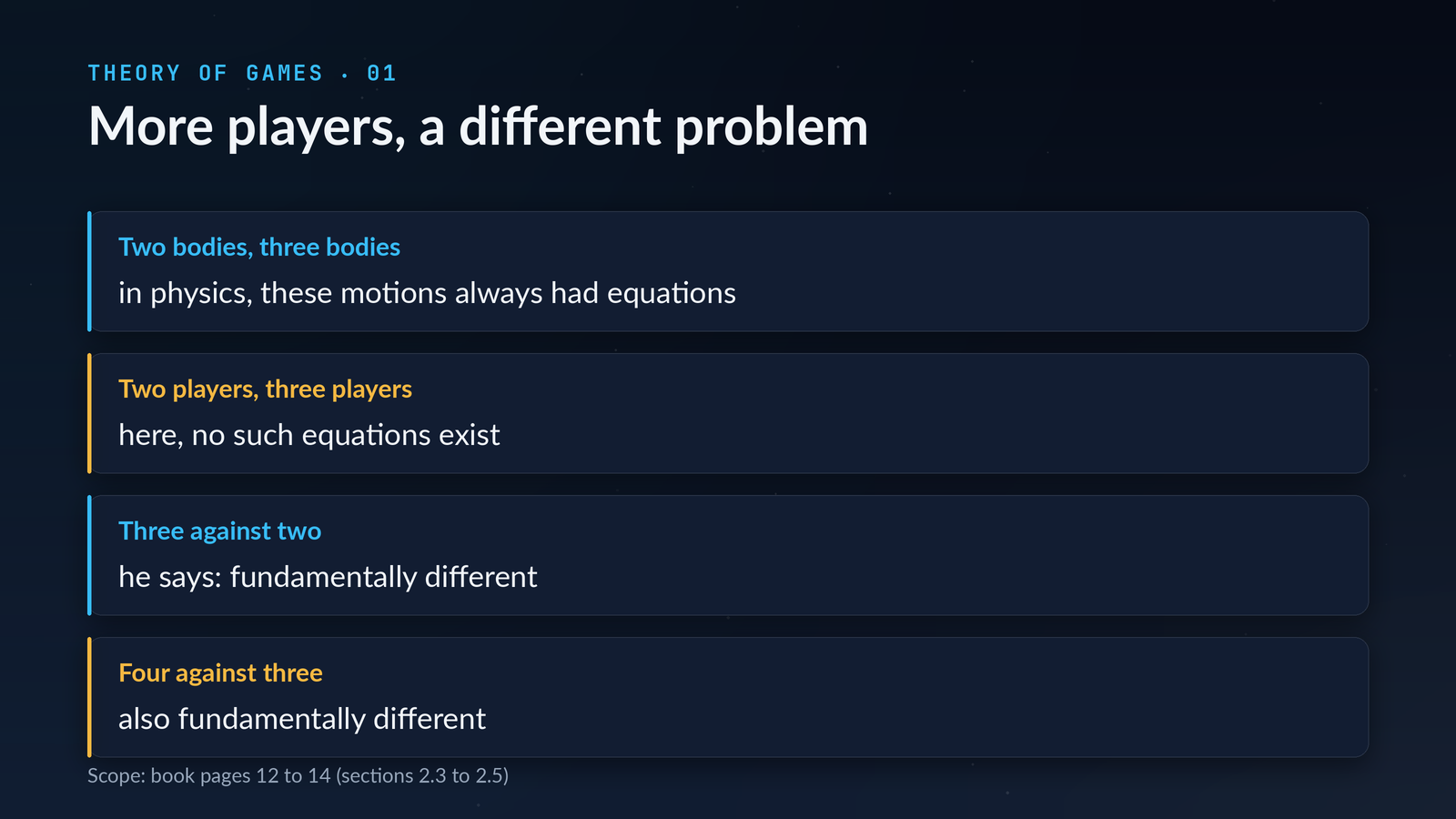
The book puts it directly: a three-person game is fundamentally different from a two-person game, and a four-person from a three-person.
Add one person, and the possible combinations grow by doubling.
Why does the nature change as soon as there are many people?
Because the complexity of combinations grows rapidly with numbers, and everyone’s choices are affected by others.
He also gives a counterexample, for those who think that many people make things easy.
Gas theory must handle about 10^26 freely moving particles, yet it is far easier to handle than the solar system with nine main bodies.
By this logic, should more people not make it easier?
But this analogy is far from perfect for economic problems. On the gas side there are statistics and probability to use.
In physics, the motion of two bodies and three bodies both have equations that can be written.
In games, by contrast, two-player and three-player positions have always lacked such equations.
So the book fixes the order. Until the theory of medium numbers of participants is developed, no one can judge whether large numbers will simplify the position.
This order is not arranged casually.
Rather than hand the large market a pretty model first, he admits that small and medium scales are not yet worked out.
You cannot even read three people’s cards, so do not talk about the large market yet.
At the book’s end, on free competition, the author’s characterization is still “conjectures of considerable value.”
They are not yet results.
So what does rationality actually mean?
By this page the answer is still the same honest line from earlier:
No satisfactory treatment.