
Let me start by laying out what I thought before I read this paper.
I had always assumed “vampire graves” were a media invention. Any 17th-century skeleton found in an awkward pose, and the headline writes itself: “Archaeologists Discover Vampire.” So I came to this paper expecting another victory for sensational titling.
Then the first detail stopped me cold: a padlock clamped on the big toe of her left foot, and a sickle laid across her neck with its blade facing her throat. And on top of that, the grave had been opened twice.
From that point on, the question I wanted answered was no longer “Was she a vampire?” It was something harder:What would a person have to do to frighten an entire village this much?
The paper offered an answer, but its shape surprised me. Half of it is concrete: a real, documented set of actions carried out against a “suspicious” dead person. The other half is empty: what she actually did was never written down, and how she died remains a mystery after five different scientific analyses.
What I took away from the paper is not “so anti-vampire practices really existed,” but rather a way of telling apart two questions: when to ask “What is the evidence?” and when to ask “What is the interpretive framework?” The most impressive thing about this paper is that it draws that line with great precision itself.
I. Laying Out the Grave: One Lock, One Sickle
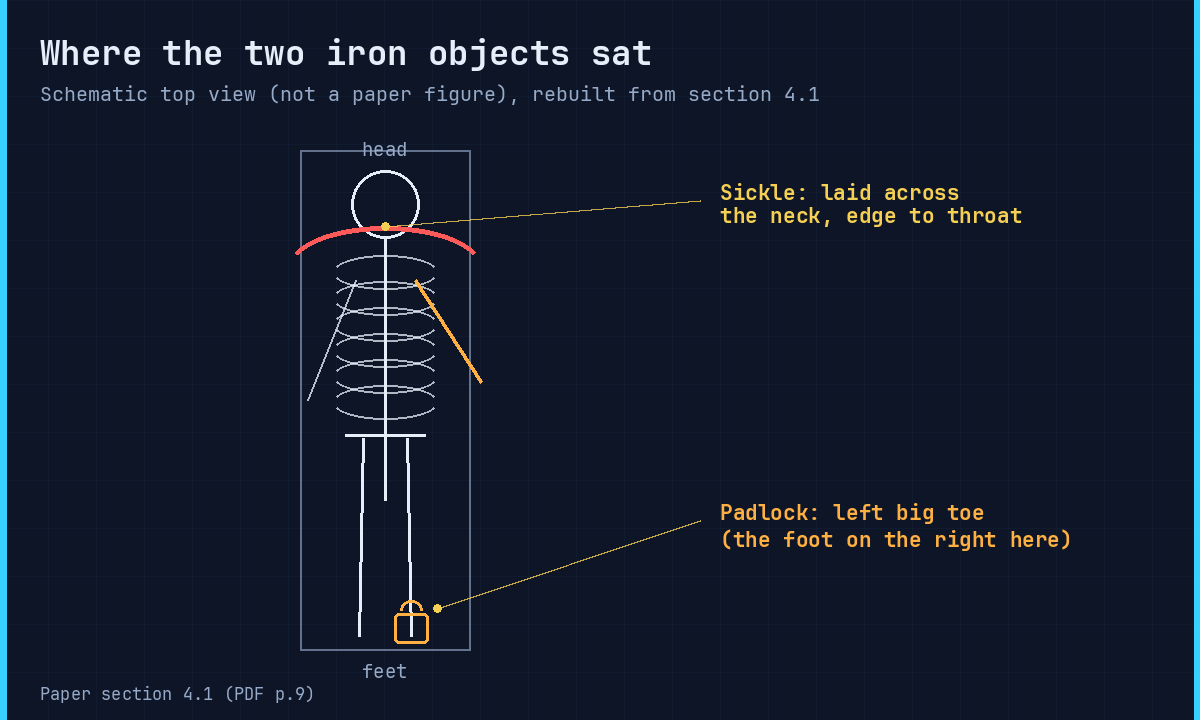
The grave sits in a village called Pień in central Poland. During the 2022 field season, the archaeology team excavated grave 75 on a hillside slope, part of a 17th-century cemetery.
Her posture reads as follows: she lay on her back, body essentially straight, face up. It looks like a proper burial. But several details are off.
First, orientation. People of that era were typically buried along an east-west axis. Hers deviates: the east end tilts south, the west end tilts north.
Second, beneath her skull and shoulders there is a rectangular dark stain, roughly pillow-sized. This suggests she may have been laid on something, and probably in a coffin, though no wood traces survived in the grave. The authors describe this as “probable,” nothing more.
Third, and most striking:a large sickle was placed across her neck, blade aimed at her throat; a triangular iron padlock hung from the big toe of her left foot.
The lock was locked, at least at the time of burial. It was found open, which the authors attribute to a broken mechanism after interment.
I need to pause here. The lock itself is telling. A lock on a toe does not secure property; it secures something else entirely: “Let her not walk back.” The authors are blunt about this: it is not a practical tool. It belongs to ritual.
The sickle is even more interesting. It was not tossed into the grave as a discarded farm implement. It was placed precisely at the neck, blade toward the throat. The paper adds that similar practices appear at other contemporary European cemeteries, including one in Poland where several burials had sickles laid across the throat, blades facing the same direction.
One lock to hold the feet. One blade to block the throat.
Two iron objects, two deliberate gestures. And they were not placed at the same time.
II. What Really Made Me Sit Up: They Came Back
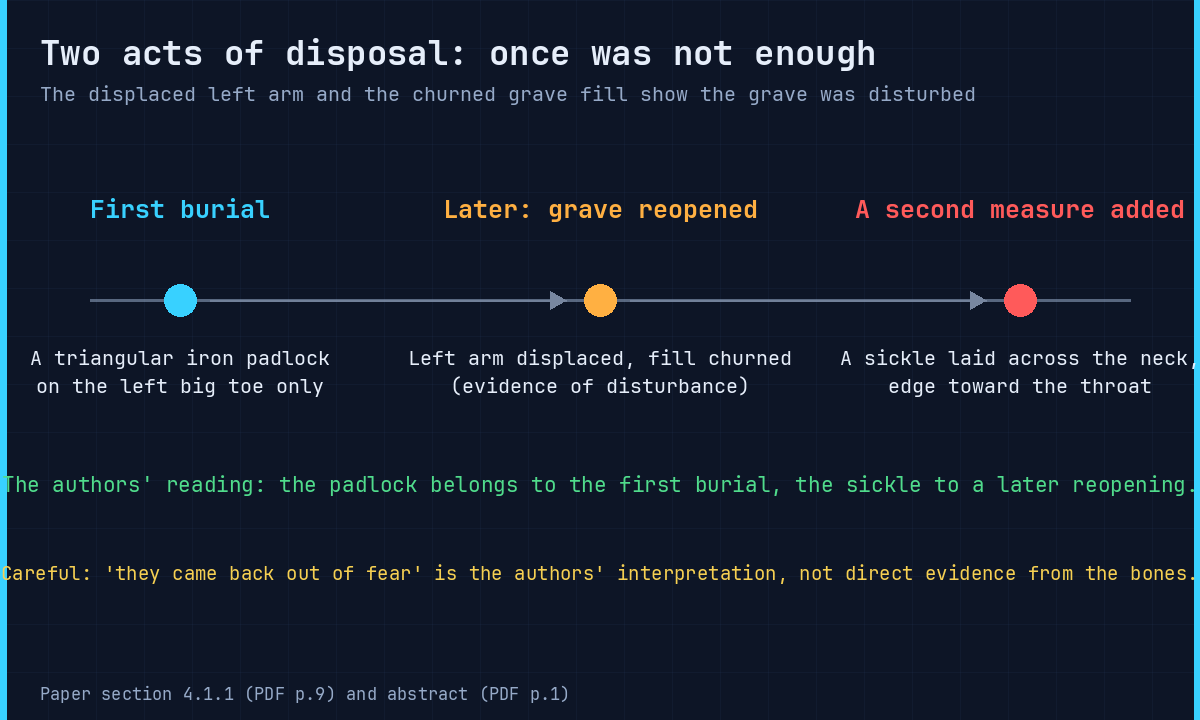
In archaeology there is a concept called “secondary deposition”: a grave is reopened and its occupant is re-treated. This is one such grave.
The authors reconstruct the sequence:at the original burial, only the padlock on the toe was present.Later, someone dug the grave back up and laid the sickle across her neck.
The left arm supports this reading. It points northeast, detached from the body, in a position impossible to achieve during the original burial. Combined with signs that the fill had been disturbed, the authors conclude the grave was reopened.
I tried to picture it. At the first burial, they decided one lock was enough. After some interval, days or months or years, someone decided it was not. They came back and added a second measure.
One measure was not enough, so they added a second. The first time was not enough, so they returned.
This is the single most striking moment in the entire paper, and it is not rhetoric. It is read from the position of the left arm and the disturbed fill.
But I have to put the brakes on here, because this is exactly where careless writing creeps in:a displaced arm proves the grave was disturbed. It does not prove “they came back out of fear.”“Out of fear” is the authors’ interpretation, not something the bones can say directly. This distinction matters, and I will return to it, because it is actually the most useful thing the paper has to teach.
For now, let us keep going. If someone is lying in this grave, who is she?
III. Who Was She: Five Methods, One Missing Answer
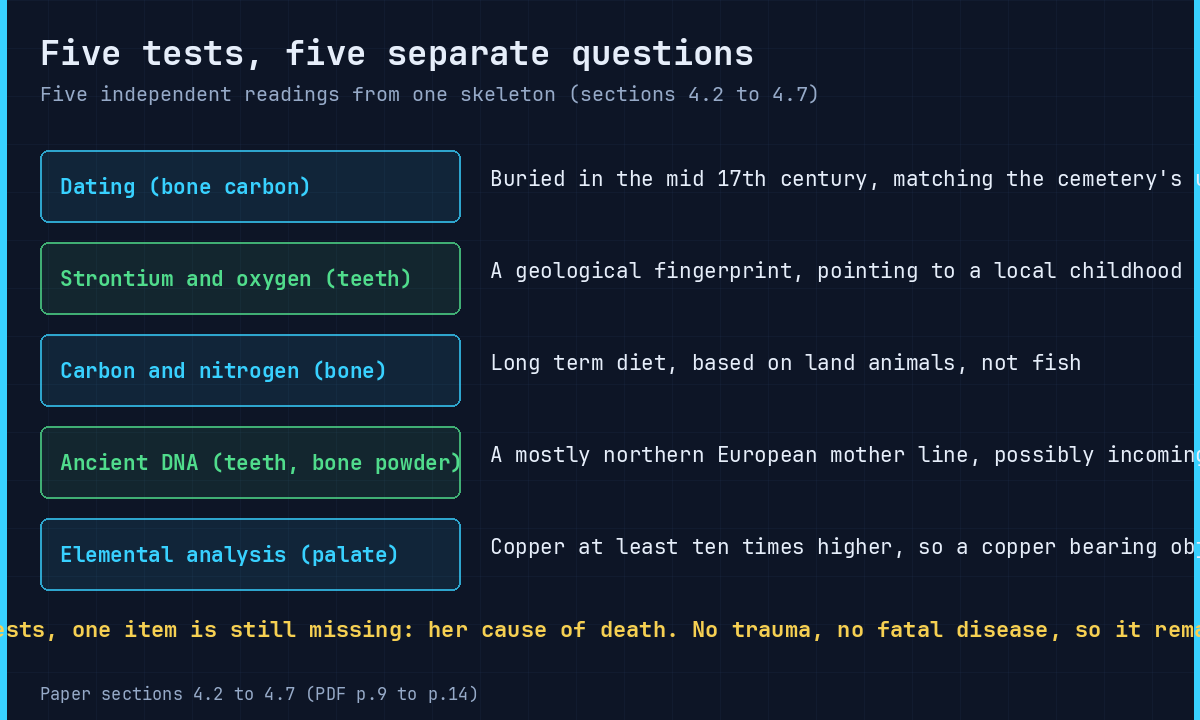
The paper subjected her to five analyses. I have reorganized them by the question each one answers, because that is how the method actually works.
First, radiocarbon dating.Carbon in the bone yields a date in the mid-17th century, consistent with the cemetery’s period of use.
Second, strontium and oxygen.While teeth are developing, they lock in the strontium and oxygen from local water; the ratios vary by region, functioning like a geological fingerprint. Both of her values fall within the local range, so the authors conclude she spent her childhood in this area.
Third, carbon and nitrogen.These two values reflect long-term diet. Her data cluster with terrestrial animals: fish was not a primary protein source. In other words, she ate much the same as others buried in the same cemetery. Nothing exceptional.
Fourth, ancient DNA.Mitochondrial DNA, passed along the maternal line only, assigns her to a sub-branch that today appears more often in northern Europe and in regions with Viking-era connections, and is virtually absent in modern Slavic-speaking populations. The authors speculate that her maternal-line ancestors may have been linked to southern Scandinavia,but immediately add a caveat: this is only one of several plausible possibilities.
Fifth, elemental analysis.The green stain in her oral cavity (detailed below) shows that something containing copper was placed in her mouth.
The osteology adds a few more facts: she was roughly 17 to 19 years old at death, about 165 cm tall, and sexed as female (the authors note that this age estimate should be treated cautiously).
Then comes the most critical line:she bore no traumatic injuries and no lesions that could have been fatal. No signs of violence, no evidence of long-term illness. Her cause of death, to this day, remains unknown.
Five tests, five methods, and a person who lived over 300 years ago reduced to comparable numbers. The conclusion: she grew up locally, ate an unremarkable diet, had no injuries or diseases, and belonged to a maternal lineage that may trace to a distant region. Cause of death: unknown.
What science did here is not provide answers. It narrowed the scope of what is unknown, then labeled that boundary with precision. That is worth remembering more than any single number.
IV. The Cloth on Her Head Was Purer Than the King’s
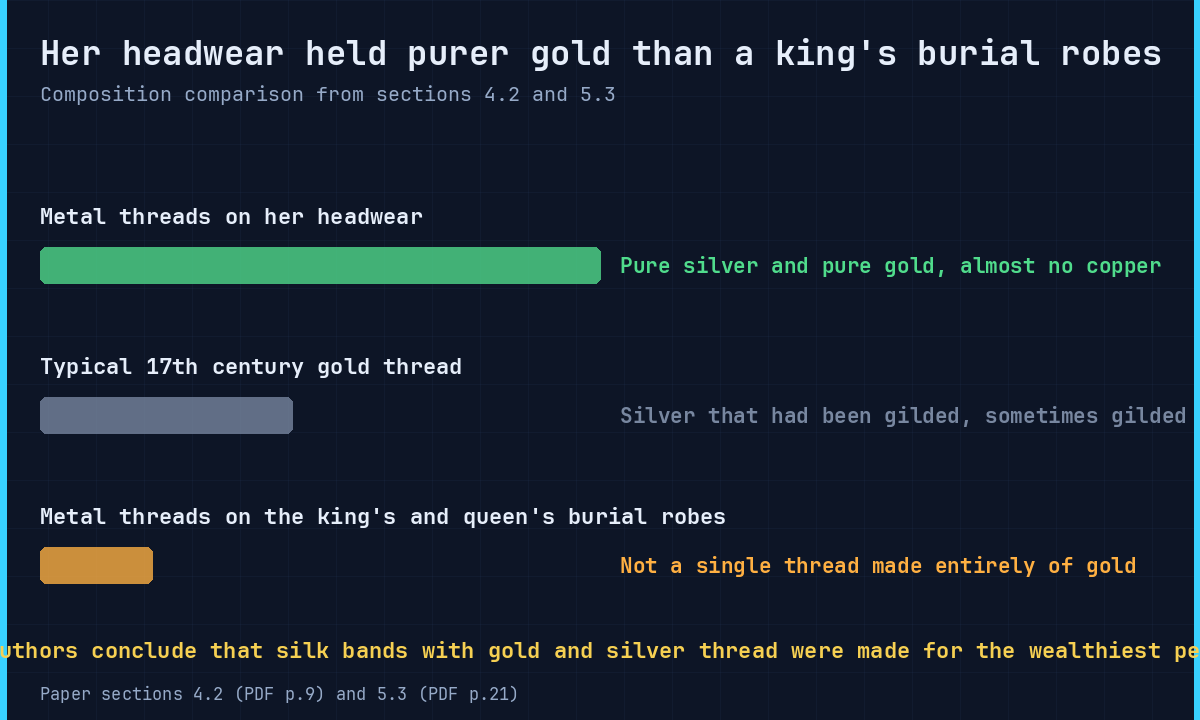
If the story stopped at “a person who was suppressed in death,” it would be a macabre curiosity. But one comparison in the paper complicates the picture entirely.
Nearly all her clothing had decayed. Only fragments of woven trim survived on her headdress. The main warp threads are silk; the edges incorporate four flat metal wires.
The result:those wires are pure silver and pure gold, with virtually no copper.
Why does this matter? Because in the 17th century, “gold thread” was almost never solid gold. It was gilded silver, sometimes gilded copper. The authors draw a pointed comparison:among the metal threads from the burial robes of King Sigismund III Vasa and Queen Constance of Habsburg, not a single thread was made entirely of gold.
She was also very likely buried in a coffin. Silk, genuine gold thread, a coffin: all of these cost money. The authors conclude that this type of trimming was reserved for the wealthiest: the aristocracy, nobility, and affluent burghers.
So the person subjected to this solemn “suppression” was not someone from the bottom of society.
This is the “shape mismatch” I mentioned at the start. I had assumed the person feared by an entire village would be a marginal figure: an outsider, a pauper, someone with no one to speak for her. This grave tells a different story. Status and fear can coexist in the same person.
And it brings up another, harder-to-explain trace.
V. The Green Stain in Her Mouth
Beyond the lock on her foot and the sickle at her neck, there is a third trace, hidden in the easiest place to overlook.
Inside her oral cavity, a vivid green discoloration is visible: the color left behind when copper oxidizes. It is not a small patch. It extends from the palate all the way to the base of the skull and the interior of the nasal cavity, and it stained the first two cervical vertebrae. The copper concentration in the posterior palate is at least ten times higher than in other regions.
The authors infer:someone placed a copper-containing object in her mouth.
If the sentence ended there, it would make excellent horror-story material: “They put something in her mouth.” But the paper then does two things I find genuinely impressive.
First, it admits it does not know what the object was.Elemental analysis can confirm copper is present, but cannot identify the object. The authors’ own words: the analytical methods did not yield a definitive determination.
Second, and more important: it actively eliminates the most tempting answer, a coin.
Ancient burials do include cases of coins placed in mouths, and the paper cites examples from elsewhere. But the authors point out that coins typically leave only faint traces on the inner surface of the mandible. Her green stain runs from the palate to the cervical vertebrae: a far more extensive pattern that does not match a coin. Sothe coin hypothesis is explicitly ruled out.
When I read that, my verdict on this paper was sealed. A researcher willing to delete the single most eye-catching, most publishable explanation from their own findings, and to write instead “we do not know what it was” that takes more courage than adding one more conclusion.
And it rhymes with the lock on her foot. The paper notes a Polish folk saying about “locking someone’s mouth” (paraphrased: “lock your mouth with a padlock, forever and ever”). A lock on the foot, a copper-containing object in the mouth: two expressions of the same impulse.
VI. So Does This Count as “Vampire” or Not?
(No new figures after fig04)
First, the authors’ own framework, because that step must be precise.
The word “vampire” only became widespread in Europe around the 18th century. The paper uses the term “anti-demonic,” meaningpractices that protect the living from harm by the dead.The authors’ definition of such a grave is plain: actions taken by a community that do not conform to the local burial norm, with the aim of neutralizing a perceived threat from the deceased.
Now comes the passage in the paper that requires the most care. I will lay it out point by point.
First, these practices were not isolated.Central and Southeastern Europe have yielded several hundred “anti-vampiric” burials, dating from the post-medieval period into modern times. The authors close with a sentence worth holding onto verbatim: these practices belong to a broader repertoire of apotropaic measures in post-medieval Central Europe,not pointing to any single cultural or religious tradition.
Second, the authors themselves reject a tempting hypothesis.A padlock in a grave most readily evokes Jewish burial customs: the paper notes that padlock fragments have been found at every archaeologically investigated Jewish cemetery within the territory of the former Polish-Lithuanian Commonwealth (a vast multi-ethnic state that once united Poland and Lithuania and neighboring regions). But the authors explicitly rule out “this is a Jewish cemetery”: the defining features of a Jewish necropolis (non-overlapping graves, sex-segregated zones, stone markers) are all absent here, and under Jewish law, Jews may not be buried outside their own cemeteries. The exclusion is clean.
Third, and most important: this is a single case.
One skeleton does not prove “everyone did this at the time.“The paper’s own wording is that this “sickle plus padlock” combinationhas not been previously reported in the published archaeological literature.Note what that sentence means: “rare,” not “common.” Those are two entirely different things.
So why was she treated this way? The authors’ interpretation: she was probably blamed as a source of misfortune, such as disease or famine. In the 17th-century Polish-Lithuanian Commonwealth, such catastrophes were a fact of life.
But the nature of this interpretation must be stated clearly:it is a cultural inference, not an experimental finding.“She was feared” is not something any instrument can measure. The authors deduced it from the objects and their positions.
VII. My Assessment: What This Paper Actually Teaches
By convention, let me first restate the authors’ claim accurately: this is a single case of a 17th-century female; the simultaneous presence of a sickle and a padlock in one grave has not been previously reported; multidisciplinary evidence shows she grew up locally, ate an ordinary diet, bore no injuries or lesions, and held a relatively high social position; the authors interpret the objects as anti-demonic practices reflecting the community’s fear of the dead.
On that basis, I raise four critiques.
First, competing hypotheses have not been exhausted.Beyond “they feared her return,” several other explanations fit the existing evidence equally well: punitive or disgraceful burial (the treatment of criminals, suicides, or outsiders), emergency measures for someone who died of infectious disease, or simply a local funerary variant. The paper acknowledges the diversity of such burials, but does not systematically rule out these alternatives. This is not a fatal flaw, case studies rarely can, but it sets an upper bound on how strong the conclusion can be.
Second, the “high social status” argument is indirect.The chain of reasoning runs: coffin present, silk trimmings present, metal threads are solid gold and silver. This is standard archaeological inference, but it works backward from “the rank of grave goods” to “the identity of the person.” In this particular case there is an added complication:her grave was disturbed.The artifact assemblage we see is the product of two interventions. The original state cannot be reconstructed.
Third, regarding the “copper in her mouth,” I want to commend the authors and caution the readers at the same time.The commendation is for ruling out the coin. The caution is that “a copper-containing object” remains an inference (the authors’ own term is “strongly suggests”). And copper has at least one mundane possible source: corrosion from nearby grave goods, or contact during body treatment. The paper does not provide exclusive evidence.
Fourth, honesty about sample size.The local baseline against which the isotopes judge “local” is not large, and the authors say so themselves. “She is local” should therefore be read as “the data are consistent with local,” not as “her local origin is confirmed.”
Taken together, my conclusion is:the value of this paper lies not in its conclusions but in its method.It demonstrates what you can achieve, and where you must stop and say “we do not know,” when all you have is one skeleton, a handful of artifacts, and a set of elemental ratios, with no written record at all.
VIII. What Use Is This Story to Us?
I do not want to end with “so we should trust science.” That is a platitude, and the substance of this paper is not there.
What I actually took away is three things.
First, the perspective of “two interventions.“We habitually treat a ritual as a one-time event. This grave shows that fear can have a sequel: the first measure did not resolve the anxiety, so people came back and reinforced it. The pattern is not unfamiliar today: after an event, rules are layered on top of rules, often not because the first round was too weak, but because people still did not feel safe after it.
Second, “evidence” and “interpretive framework” must be asked as separate questions.Evidence is the position of the sickle, the position of the lock, the extent of the copper stain, the angle of the left arm. Framework is “anti-demonic.” The “vampire” in a media headline is a third thing: packaging. Mix the three together and “a burial with an unusual posture” becomes “archaeologists confirm vampires existed.” When you encounter a headline like that, ask first what the evidence is, then ask what the framework is. That filters out most of the noise.
Third, the act of “actively eliminating the most tempting answer” is itself worth learning.The coin explanation was elegant: a coin in the mouth, universally legible. The authors deleted it. In our own work, the explanations that “tell the best story” or “are easiest to sell” are often the ones most deserving of self-deletion.
One last thing, the most honest reaction I had after reading.
In this grave lies a girl of 17 to 19. She did not eat poorly, she had no diseases, and her headdress was trimmed with real gold thread. She probably grew up on this hillside, then died, cause unknown. Then someone hung a padlock on her toe. After some time, someone reopened the grave and laid a sickle across her throat.
From first to last, no one wrote down her name, and no one wrote down what exactly they were afraid of.
All the archaeologists could do was reconstruct these actions one by one from the bones, the objects, and the elemental ratios:reconstruct the actions, not the fear.That is probably the boundary of this paper, and also its restraint.
If this kind of “inferring people from objects” research interests you, the original paper is available through DOI 10.1016/j.jasrep.2026.105967. It is open access and comes with excellent line drawings and X-ray images, especially the three-view technical drawing of the padlock, which is more immediately clear than any verbal description.